Duolingo New Languages 2027: Upcoming Languages & Updates
Duolingo New Languages 2027: What Languages Could Be Coming Next?
Duolingo has changed the way it builds and expands language courses. The biggest question for learners now is not simply how many languages Duolingo offers, but which new languages could arrive next.
Based on the development and update information available through mid-2026, several courses are already in testing or production, while others remain possibilities. Duolingo’s huge 148-course expansion in April 2025, combined with AI-assisted development, also suggests that creating courses may become faster than it was in the past.
For 2027, the most interesting possibilities include English from Urdu, English from Punjabi, Traditional Chinese courses, and Shanghainese from Mandarin. Other languages such as Farsi, Serbian, Danish, Kannada, Slovak, and Gujarati have also been identified as possible future additions, although they should not be treated as confirmed 2027 launches.
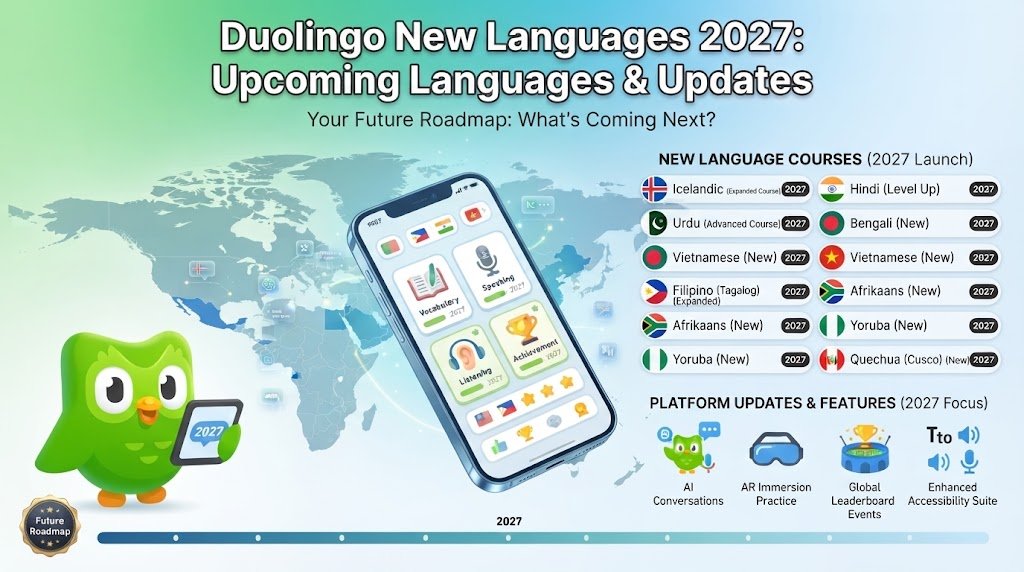
What New Languages Is Duolingo Working On?
As of mid-2026, several courses were described as being somewhere in the development or testing process.
The most notable are English from Urdu and English from Punjabi, which entered A/B testing in June 2026. A/B testing means the courses are being tested with selected users before a broader release.
Two Traditional Chinese-related courses were also described as being in production:
- Traditional Chinese from Mandarin
- English from Traditional Chinese
Another interesting project is Shanghainese from Mandarin, which was reported to be in internal beta testing.
Together, these represent 5 courses in development or testing:
- English from Urdu
- English from Punjabi
- Traditional Chinese from Mandarin
- English from Traditional Chinese
- Shanghainese from Mandarin
These are particularly important for anyone searching for potential Duolingo additions in 2027 because they are further along than languages that are merely being discussed as possibilities.
Could English From Urdu Come to Duolingo?
English from Urdu is one of the most interesting potential additions.
According to the development information, the course entered A/B testing in June 2026. That makes it different from a language that exists only on a wish list.
The exact public launch date is not guaranteed. Development and testing can continue for months, and a course in testing may change before becoming widely available.
If development continues smoothly, late 2026 or 2027 could become a realistic period for broader availability. However, the development stage should not be confused with an official launch announcement.
For Urdu speakers who want to learn English, this would be a particularly useful addition because it would provide a course designed around Urdu as the starting language rather than requiring learners to begin from another language.
What About English From Punjabi?
English from Punjabi is another course reported to have reached A/B testing in June 2026.
Its development follows a similar pattern to English from Urdu. The important point is that it has been described as being actively tested rather than simply being a theoretical possibility.
That makes Punjabi one of the more significant languages to watch when looking toward 2027.
If it reaches a full launch, it could make English learning more accessible to Punjabi-speaking learners directly through Duolingo’s platform.
Traditional Chinese and Shanghainese Are Also Worth Watching
The potential expansion is not limited to South Asian language pairs.
Traditional Chinese from Mandarin was described as being in production, while English from Traditional Chinese was also listed as being in production.
Shanghainese is even more distinctive. The course was described as being in internal beta testing, with Mandarin serving as the starting language.
This creates several different development stages to watch:
Planning → Internal Testing → Beta/A-B Testing → Full Launch
A course can spend months in beta, so the presence of a course in testing does not automatically mean that it will launch immediately.
This development pipeline is important because it provides a better way to think about possible 2027 languages: some are already moving through production, while others are still only possibilities.
Which Languages Could Be Added Later?
Beyond the courses already reported as being developed or tested, 6 additional languages stand out as possible future candidates:
- Farsi
- Serbian
- Danish
- Kannada
- Slovak
- Gujarati
These should be treated as possible future languages, not confirmed 2027 courses.
That distinction matters. A language can be discussed, considered, or prepared internally without receiving a public launch date.
For someone planning their language-learning journey, it is therefore better to separate the possibilities into two groups: languages with reported development activity and languages that remain potential additions.
Why 2027 Could Be Different From Earlier Years
The biggest reason to watch 2027 is the scale of Duolingo’s recent course-development changes.
On April 30, 2025, Duolingo announced a major expansion involving 148 new courses. The expansion was notable because it was reportedly completed in less than 1 year, whereas creating the first 100 courses had taken about 12 years.
That difference is enormous.
The 2025 expansion also more than doubled the number of courses according to the information analyzed. Rather than creating every course completely from scratch using the older development process, Duolingo increasingly relied on AI and a shared content system.
This could make future course development considerably more scalable.
How AI Could Affect New Language Development
AI is one of the most important pieces of the future-language story.
The newer development approach is designed to make it easier to build courses across multiple languages without treating every course as an entirely separate project.
The 2025 expansion demonstrated how dramatically the process could change. 148 courses were launched in a period of less than 1 year, compared with roughly 12 years to create the first 100 courses.
That does not mean every future language will be created quickly. Language quality, testing, lesson design, pronunciation, cultural context, and learner feedback still matter.
But AI-assisted development could reduce the amount of manual work required to create and expand courses.
For 2027, this may be one of the most important factors determining how many additional language combinations Duolingo can support.
What Happened With the 2025 Language Expansion?
The April 2025 expansion deserves special attention because it changed the scale of Duolingo’s course catalog.
The expansion added 148 new courses and focused heavily on making existing languages accessible to more learners.
The 7 key languages highlighted in the expansion were:
- Spanish
- French
- German
- Italian
- Japanese
- Korean
- Mandarin
These became available from 28 supported interface languages, according to the update information.
The significance is that a “new course” does not necessarily mean a completely new language.
For example, adding a Spanish course for another interface language expands access without introducing Spanish as a brand-new language to the platform.
This distinction is essential when looking at claims about future Duolingo languages.
Duolingo Has More Than Just Language Courses
The platform’s expansion has also moved beyond traditional language learning.
Recent updates discussed in the available information include:
- Chess
- Math
- Music
- Stories
- DuoRadio
- Flashcards
- Duolingo Score
- Video Call
- Redesigned intermediate courses
The math expansion added 60 new units covering grades 6–9.
Stories were available across 100+ courses, while the update information referenced 100,000+ new DuoRadio episodes across languages and levels.
The Duolingo Score also became part of the newer learning experience. Redesigned intermediate courses were associated with a 60+ score threshold, while Stories coverage included learners in the 30–59 score range.
These additions show that the platform’s future is broader than simply adding languages.
How Many Languages Does Duolingo Have?
The exact number depends on how courses and language combinations are counted.
One detailed language list referenced 42 different languages, including 40 languages for English speakers and 26 languages from which English courses were offered.
Another 2026-focused overview described Duolingo as having 40+ language courses, while also discussing 70+ languages available through another language-learning platform.
For a learner, the more useful distinction is between:
The number of languages and the number of individual courses.
A single language can have multiple courses depending on the learner’s starting language.
That is why a major course expansion can produce hundreds of new courses without introducing hundreds of completely new languages.
Which Duolingo Languages Have the Most Learners?
The available 2024 learner data provides a useful picture of which languages already attract the most attention.
Spanish was ranked first with approximately 45.6 million learners, followed by French at 26.0 million.
Japanese had 21.5 million, Korean had 17.7 million, and German had 17.4 million.
The next group included:
- Italian — 12.2 million
- Hindi — 11.2 million
- Chinese — 9.84 million
- Russian — 8.20 million
- Arabic — 7.90 million
Portuguese had 5.44 million, while English had 4.79 million.
These numbers help explain why major languages continue to receive substantial attention. At the same time, future course development can create opportunities for languages with smaller existing learner bases.
Language Rankings Have Changed Over Time
Learner numbers are not static.
For example, Ukrainian had approximately 1.71 million learners in February 2023, compared with 1.42 million in June 2024. Its ranking moved from 15th to 23rd.
High Valyrian moved from approximately 911,000 learners to 944,000, although its ranking changed from 24th to 28th.
Zulu showed an especially notable increase, moving from about 297,000 learners to 839,000 by June 2024. That means its learner base nearly tripled.
Korean also moved into 4th place, passing German, while Italian regained 6th place.
These changes demonstrate why language popularity should not be judged from a single snapshot.
Will Farsi Be a New Duolingo Language in 2027?
Farsi is one of the 6 possible future languages identified in the available development discussion.
However, there is an important difference between a possible language and a course already in testing.
Farsi was presented as a possibility, while English from Urdu, English from Punjabi, and the Traditional Chinese-related courses had more concrete development statuses.
So, if you are waiting specifically for Farsi, it is better to view 2027 as a possibility rather than a confirmed release year.
Could Duolingo Add Serbian, Kannada, Slovak or Gujarati?
The same applies to Serbian, Kannada, Slovak, and Gujarati.
All four were identified among the possible future additions, along with Farsi and Danish.
This group is especially interesting because several of these languages also appear in broader discussions about languages that learners want to see supported.
But a learner should not interpret a mention of a possible future course as confirmation that a launch is scheduled.
The safest approach is to watch for an actual development announcement, beta test, or official availability.
What About Danish?
Danish is an interesting case because it appears in both the existing language data and the possible future-language discussion.
The 2024 language list included Danish with approximately 1.0 million learners, while Danish was also mentioned among the 6 possible future additions in another development context.
This highlights an important issue with language-course terminology: a language can already exist on the platform while a different course combination, expanded course, or new learner pathway is being considered.
Therefore, “new language” does not always mean that the language itself has never appeared on Duolingo.
Are Klingon and High Valyrian Still Part of the Picture?
Yes, fictional languages are another unusual part of the Duolingo catalog.
The detailed language list identified 2 fictional languages:
- High Valyrian
- Klingon
High Valyrian was associated with Game of Thrones and House of the Dragon, while Klingon is associated with Star Trek.
Klingon was also reported to have returned in April 2026.
These languages demonstrate that Duolingo’s catalog is not restricted to conventional national or regional languages.
What Could Duolingo New Languages 2027 Look Like?
If the development information available through mid-2026 continues in the same direction, the 2027 picture could involve several different types of expansion.
The first group would be courses already moving through development:
English from Urdu, English from Punjabi, Traditional Chinese from Mandarin, English from Traditional Chinese, and Shanghainese from Mandarin.
The second group would be possible future additions:
Farsi, Serbian, Danish, Kannada, Slovak, and Gujarati.
The third type of growth would involve existing languages becoming available to more learners through additional starting languages and interface languages.
This third category is easy to overlook, but the 148-course expansion in 2025 shows how significant it can be.
A Simple Timeline to Watch
The development timeline can be understood in four stages.
Planning is the earliest stage, when a course is being considered or developed.
Internal testing comes next, allowing the team to evaluate the course before broader exposure.
Beta or A/B testing places the course in front of selected learners and provides real-world feedback.
Finally, a full launch makes the course broadly available.
Because a course may remain in beta for months, there is no guarantee that a course entering testing in June 2026 will become publicly available immediately.
That is why the transition from 2026 into 2027 is particularly important for watching these courses.
What Should Learners Expect in 2027?
The biggest expectation should be more course combinations rather than simply a huge list of completely new languages.
The 2025 expansion showed that Duolingo can dramatically increase its course catalog by connecting existing languages with more learner starting points.
At the same time, the development of Urdu, Punjabi, Traditional Chinese, and Shanghainese-related courses indicates that genuinely new learning pathways are also possible.
AI may accelerate this process further, but quality and testing will remain important.
Frequently Asked Questions
What new languages is Duolingo developing for 2027?
The courses reported as being in development or testing include English from Urdu, English from Punjabi, Traditional Chinese from Mandarin, English from Traditional Chinese, and Shanghainese from Mandarin.
Is Urdu coming to Duolingo in 2027?
English from Urdu was reported to be in A/B testing in June 2026. A wider launch could happen later, potentially around the 2026–2027 period, but a specific 2027 launch should not be treated as confirmed.
Is Punjabi coming to Duolingo?
English from Punjabi was also reported to be in A/B testing in June 2026. Its eventual public release depends on the development and testing process.
Which languages are possible future additions?
The 6 possible future languages identified are Farsi, Serbian, Danish, Kannada, Slovak, and Gujarati.
How many courses were added in the major 2025 expansion?
Duolingo launched 148 new courses in the major April 2025 expansion.
How quickly were the 148 courses created?
The available information says the courses were built and launched in less than 1 year, compared with approximately 12 years to create the first 100 courses.
Will Duolingo add completely new languages or expand existing ones?
Both are possible. The 2025 expansion primarily expanded access to existing languages, while the courses reported in development for Urdu, Punjabi, Traditional Chinese, and Shanghainese show that additional language pathways are also being developed.
How many languages does Duolingo have?
One detailed 2024 list reported 42 different languages, including 40 languages for English speakers. Other descriptions use course-based counts such as 40+ languages. The number varies depending on whether you count languages or individual course combinations.
What are the most popular Duolingo languages?
In the available 2024 learner data, Spanish ranked first with 45.6 million learners, followed by French with 26.0 million, Japanese with 21.5 million, Korean with 17.7 million, and German with 17.4 million.
Final Takeaway
The future of Duolingo language learning is becoming more interesting because “new language” can mean several different things. A completely new language, a new course from a different starting language, or wider access to an existing language can all expand the platform.
For 2027, the courses worth watching most closely are English from Urdu, English from Punjabi, Traditional Chinese from Mandarin, English from Traditional Chinese, and Shanghainese from Mandarin. Six other languages—Farsi, Serbian, Danish, Kannada, Slovak, and Gujarati—remain possible future additions.
The biggest clue may be the 148-course expansion of 2025. If AI-assisted development continues to make course creation faster, the next few years could bring significantly more learning pathways than the traditional development model allowed.