Why You Still Can’t Speak English (Even After Using Apps Like Duolingo)
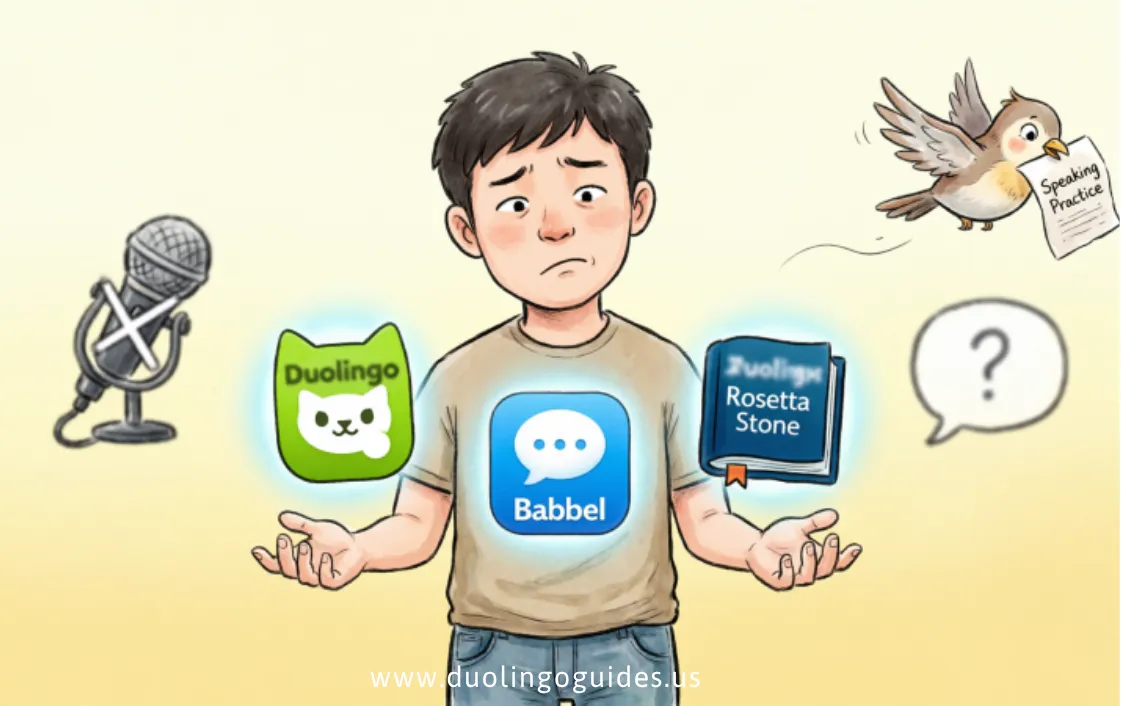
You’ve completed hundreds of lessons on Duolingo… you’ve even earned 300‑day streaks, badges, and XP. But when you stand in front of an American cashier, your brain freezes. Your mouth goes blank. You end up saying “yes”, “no”, or “I’m sorry” and nothing else.
The hard truth is: apps like Duolingo are great for vocabulary and grammar practice, but they don’t teach you how to speak real English in the USA. If you’re in New York, Texas, Los Angeles, or anywhere else in America, you need to move from streak‑hunting to real‑world speaking.
The Real Problem – Why Apps Fail
Most language‑learning apps are built like games: short tasks, instant rewards, and colorful progress bars. This is fine for memorizing isolated words, but it does almost nothing for listening comprehension, pronunciation, or spontaneous conversation.
There are three core reasons apps fail:
- They create a “speaking gap” – You click, tap, and type, but you barely open your mouth. Fluency requires repetition with real speech, not just clicking “Correct!” on a screen.
- They rely on passive learning – Matching pictures, translating sentences, and multiple‑choice quizzes are input‑only activities. You learn about English instead of using it.
- They ignore real‑life context – In the USA, English is fast, slangy, and full of reductions (“gonna”, “wanna”, “I’ma”). Apps rarely show you how native speakers actually talk in buses, offices, or friendship chats.
Also Check: The Ultimate Duolingo Guide
Common Mistakes Non‑Native Learners Make
If you’re stuck despite “hard work”, you’re probably making one or more of these mistakes common among English learners in the USA.
1. Over‑reliance on apps
Spending 30–60 minutes a day on Duolingo alone is not enough. Many learners treat the app as a full course, but it’s only a supplementary tool, not a speaking system.
2. No speaking practice
You might read, listen, and write, but you never force yourself to talk out loud. Speaking is a muscle: if you don’t train it, it stays weak—no matter how many lessons you finish.
3. No real‑life exposure
Watching Hollywood movies is fun, but it’s not enough. To speak natural American English, you need podcasts, YouTube vloggers, TV shows, and real conversations with people in the USA.
4. Avoiding mistakes
You’re afraid of sounding “wrong” or “funny” in front of Americans. This fear kills progress. Research shows that making mistakes is how your brain learns, not something to avoid.
Better Learning Method – Move from App to Real Speech
To finally start speaking English in the USA, you need a method that focuses on listening + shadowing + daily speaking.
1. Shadowing
Shadowing means listening to a native speaker and repeating exactly what they say, in the same rhythm and intonation. For example:
- Play a short YouTube clip or TED Talk.
- Turn on the transcript.
- Play one sentence at a time, pause, and repeat it out loud as if you’re the speaker.
This trains your mouth to make American sounds, stress, and linking, not just correct grammar.
2. Speaking daily
Commit to one simple rule: speak English for at least 10–15 minutes every single day.
- Talk to yourself in the mirror.
- Record a short voice note about your day.
- Join language‑exchange apps and chat with Americans.
Consistency beats perfection. Speaking daily builds confidence and fluency faster than any app level.
3. Listening to native content
Replace part of your app time with real American English:
- Podcasts (news, comedy, lifestyle).
- YouTube vloggers from the USA.
- TV shows and sitcoms with subtitles.
Focus on comprehensible input—content you mostly understand, plus a little extra challenge. This is how your brain absorbs natural phrases and slang without memorizing word lists.
Real English in the USA – Slang, Accent, and Workplace
If you’re planning to live, work, or study in the USA, you need to understand how Americans actually speak, not textbook English.
Also Check: Duolingo English Test Sample Questions & Answers
1. American slang and contractions
Americans often say:
- “I’m gonna” instead of “I am going to”
- “I wanna” instead of “I want to”
- “I’ma” instead of “I am going to” (casual)
These reductions are normal in everyday speech, but most apps avoid them, which makes native speakers sound confusing at first.
2. Accent and rhythm
American English has a strong stress pattern:
- Content words (nouns, verbs, adjectives) are stressed.
- Function words (the, of, to) are often reduced or almost silent.
If you ignore this and speak in a flat, robotic tone, you’ll sound unnatural—even if your grammar is perfect.
3. Workplace communication
In an American office, people often:
- Use phrases like “Let’s circle back” or “I’ll keep you posted” instead of long formal sentences.
- Switch between formal and casual tones depending on the person.
If you only learned formal English from apps, you’ll feel out of place in meetings or casual chats at work.
Practical Plan – 7‑Day + 30‑Day System
Here’s a step‑by‑step plan you can follow in the USA (or anywhere) to build real spoken English. Adjust the time based on your schedule.
7‑Day Kickstart (Daily)
- Listen & shadow (10–15 min)
- Pick one short YouTube or TED Talk video (about 1–2 minutes).
- Use shadowing: listen, pause, repeat, match rhythm and stress.
- Speak out loud (10–20 min)
- Record a 1‑minute voice note about simple topics:
- “My day”, “What I like about living in the USA”, “My favorite food”.
- Listen and repeat, fixing mistakes.
- Record a 1‑minute voice note about simple topics:
- App time (optional, 15–20 min)
- Use Duolingo or another app, but only after your speaking practice. Treat it as a warm‑up or review, not the main event.
30‑Day System
- Week 1–2: Build listening + speaking habits
- Same 7‑day routine daily.
- Add one real conversation per week (language exchange, friend, tutor).
- Week 3: Focus on American patterns
- Work on:
- Linking (“I want to” → “I wanna”)
- Reductions (“going to” → “gonna”)
- Stress and intonation in short sentences.
- Work on:
- Week 4: Use real‑life scenarios
- Practice mini‑dialogs:
- Ordering food or coffee.
- Asking for directions.
- Talking about work or study.
- Record yourself and compare to native speakers.
- Practice mini‑dialogs:
If you stick to this system, you’ll notice a visible improvement in confidence and fluency within 30 days—far more than just “streaks” on an app.
Also Check: How to Send Duolingo Scores to Universities
Apps vs Real Learning – Keep It Balanced
Apps like Duolingo are not evil; they just need to be used correctly. Think of them as vocabulary and grammar gym machines, not your full‑body fitness plan.
| Aspect | Apps (Duolingo, etc.) | Real‑Life English in USA |
| Input vs output | Mostly input (reading, matching) | Mostly output (speaking, listening) |
| Speaking practice | Very limited or none | Daily, real conversations |
| Context | Controlled, artificial sentences | Natural, slangy, fast American speech |
| Feedback | Only correct/incorrect | Human feedback, tone, and rhythm notes |
The healthiest approach is: Use apps for 20–30% of your time, and spend 70–80% on listening, shadowing, and real speaking in American English.
FAQs
Q: Why can’t I speak English even after using Duolingo for 6 months?
A: Apps focus on reading and grammar, not speaking and listening. You need to add daily speaking practice and real‑life exposure to American English.
Q: How can I sound more like an American?
A: Practice shadowing native speakers, pay attention to stress and reductions, and speak English daily—even if it feels awkward at first.
Q: Is it okay to still use Duolingo?
A: Yes, but use it as a supplement. Make sure your main focus is listening, speaking, and real conversations in the USA.
Q: Can I improve without a tutor?
A: Yes. You can shadow YouTube videos, record yourself, and join free language‑exchange communities to practice speaking with Americans online.
Conclusion
You’re not broken—your method is. Apps like Duolingo make you feel “productive”, but they don’t fix the speaking gap that keeps you silent in real American conversations. Switch to daily listening, shadowing, and real‑life speaking, and you’ll finally start sounding natural in the USA, not just passing virtual quizzes.

I’m a website professional with 5 years of experience in building, managing, and growing online content platforms. As the creator of DuolingoGuides.us, I focus on providing helpful, easy-to-understand guides and resources for Duolingo users and language learners. My goal is to make information simple, accurate, and accessible for everyone.