Duolingo Speaking Exercises: How to Improve Pronunciation Fast
Many learners in the USA use Duolingo daily but still struggle to speak confidently in English. They complete streaks, earn XP, and finish lessons, yet when they meet a native speaker in a café, shop, or class, they feel frozen.
This guide breaks down the real pain points of Duolingo speaking practice and gives you practical, research-backed fixes that actually work in American English. You’ll learn how to improve pronunciation faster, avoid the “streak trap,” and turn your phone into a real speaking coach.
Why Duolingo Speaking Exercises Alone Are Not Enough
Duolingo is great for vocabulary, grammar, and listening, but it has three big limitations when it comes to speaking in the USA.
AI limitation
Duolingo’s speech checker mainly looks for clear words and basic intonation, not natural American rhythm, stress, or slang. That means you can “pass” an exercise even if your rhythm sounds robotic to a native speaker.
Lack of real conversation
Most Duolingo speaking tasks are one-way responses: you repeat a sentence or say a short phrase. Real conversations in the USA involve turn-taking, interruptions, questions, and small talk, which Duolingo cannot fully simulate.
Pronunciation gap
The app can detect some mispronunciations, but it won’t coach you on how to fix a specific sound (like /ɪ/ vs /iː/ in “bit” vs “beat”). For that, you need extra feedback tools and targeted practice, which many learners in the USA never use.
Top 6 Problems Learners Face
1. Only relying on the app
Learners in the USA often think more Duolingo = better speaking, but they never step outside the app to talk to real people. Without real practice, their accent and fluency don’t improve much.
2. Fear of mistakes
“Everyone will laugh if I make a mistake” is a common fear. In classrooms, meetups, and online calls in the USA, most native speakers are patient and supportive—but learners avoid trying because of this mindset.
3. Wrong accent obsession
Many learners try to copy actors or YouTubers perfectly, instead of aiming for clear, natural American English that’s easy to understand. This slows down progress and kills confidence.
4. Poor daily routine
Most learners open the app randomly, do a few speaking exercises, then close it. Without a structured 10–minute routine, they never build a consistent speaking habit.
5. No feedback loop
Learners think, “If Duolingo says it’s correct, it must be fine.” The reality is that recording yourself and comparing to native audio is the most powerful way to spot what needs fixing.
6. No real-time practice
Learners in the USA might live in very diverse, English-heavy environments, yet they never use the app to prepare for real-life situations like ordering food, asking for directions, or talking to classmates.
How to Fix Pronunciation Step-By-Step
Beginner: Shadowing Duolingo Sentences
Shadowing means repeating immediately after you hear a sentence, almost like a voice echo.
- Turn on Duolingo speaking exercises and play a short sentence.
- Pause, then repeat the sentence 3–5 times slowly, focusing on each word.
- Try to copy the rhythm and stress of the speaker, not just the words.
This builds muscle memory for American English sounds and makes your voice sound more natural over time.
Intermediate: Record Yourself Daily
Once you’re comfortable repeating, the next step is to listen back to yourself.
- After each Duolingo speaking exercise, record yourself a second time using your phone.
- Compare your version to Duolingo’s native audio.
- Listen for:
- Missing or extra sounds (like /ð/ in “this” or “the”).
- Wrong stress (“TEA-cher” vs “tea-CHER”).
- Short pauses or filler words (“um,” “uh”).
This feedback helps you see progress and stay motivated in the USA, where you can test your skills in real conversations.
Advanced: Real Conversation Practice
At the advanced level, you must speak off-script with real people.
- Join free English speaking groups or online conversation clubs popular in the USA.
- Use apps like Tandem, HelloTalk, or similar platforms to practice with native speakers.
- Talk about Duolingo topics (food, travel, hobbies) so you can reuse vocabulary you already know.
This step turns “app English” into real-life English and helps your pronunciation adapt to different accents and speeds.
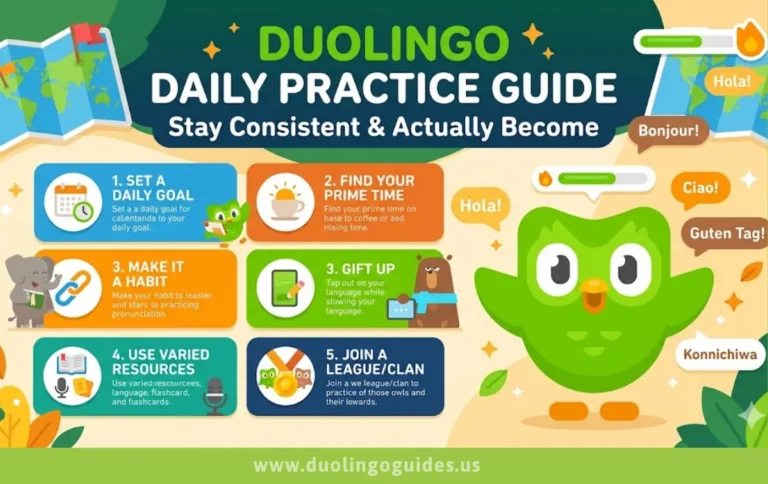
Daily 10-Minute Speaking Routine
Follow this 10-minute routine every single day to improve quickly:
2 minutes: Listening
- Open Duolingo and play a short speaking lesson in English.
- Even if you don’t speak, just listen carefully and notice how words connect in American English.
3 minutes: Repetition
- Go back to the same lesson and repeat each sentence out loud.
- Use the shadowing technique: listen, pause, repeat, then repeat again slower to focus on sounds.
5 minutes: Speaking Aloud
- Turn off the app and speak freely for 5 minutes.
- You can:
- Describe your day.
- Talk about what you learned on Duolingo.
- Pretend you’re in a café or shop in the USA and order something.
This mix of listening + repetition + free speaking builds pronunciation, fluency, and confidence much faster than just using the app alone.
Common Mistakes That Block Your Progress
Thinking too much about accent
Many learners in the USA waste time trying to sound exactly like a New York or Hollywood actor. Focus instead on clear, natural American English that people can understand easily.
Only using the app without speaking outside
If you only repeat Duolingo exercises and never talk to real people, your brain won’t learn to think in English. Use Duolingo as warm-up, then push yourself to speak in real situations.
Fear of mistakes
Mistakes are normal and useful in language learning. In the USA, most people will help you or politely correct you instead of laughing. The key is to start speaking.
No structure or routine
Random practice leads to slow progress. A short, daily 10-minute routine is far more effective than long, irregular sessions.
Duolingo vs Real-Life Speaking
| What Duolingo Does Well | What Duolingo Cannot Teach |
| Vocabulary building with spaced repetition and clear visuals. | Natural conversation flow, interruptions, and questions in real life. |
| Basic pronunciation checks for words and short phrases. | Deep correction of specific sounds (like /θ/ in “think” or /r/ in “car”). |
| Gamified motivation (streaks, hearts, XP) that keeps learners engaged daily. | Real-time feedback from human teachers or conversation partners. |
| Short, structured speaking exercises that help you practice sentence patterns. | Long-form, spontaneous speaking in real situations (jobs, interviews, debates). |
Final Action Plan: 7-Day Pronunciation Challenge
Follow this 7-day challenge to turn Duolingo into a real speaking tool.
Day 1–2: Shadowing
- Pick 3–5 short Duolingo speaking lessons in English.
- Use shadowing on each sentence: listen, pause, repeat 3–5 times.
- Focus on matching the rhythm and stress of the American speaker.
Day 3–4: Recording
- Repeat the same lessons from Day 1–2, but record yourself.
- Compare your recording with Duolingo’s native audio and note 1–2 sounds to fix.
- Practice those sounds slowly and repeatedly until they feel easier.
Day 5–7: Real Speaking Attempts
- Use what you practiced on Duolingo to have 3–5 real conversations in the USA.
- Talk to classmates, coworkers, or strangers in safe situations.
- Or join an online English conversation club and speak for 10–15 minutes.
- After each conversation, write down 3 new phrases you used or learned.
By the end of the 7 days, you’ll notice clearer pronunciation, faster speech, and more confidence when you speak English in the USA.
FAQs About Duolingo Speaking Exercises
What are Duolingo speaking exercises?
They are short tasks where you listen to a sentence or question and then speak it back into your phone’s microphone so Duolingo can check your pronunciation and fluency.
How do I learn a language on Duolingo?
You combine lessons, streaks, and speaking exercises while practicing extra speaking and listening outside the app. Duolingo builds vocabulary and grammar; real practice builds fluency.
How do I practice speaking on Duolingo?
Turn on speaking exercises, repeat sentences using shadowing, and record yourself to compare with native audio. For better results, add external tools like pronunciation apps or AI feedback.
How can I improve my Duolingo speaking skills?
Use daily shadowing, recording + comparison, and real-life practice in the USA. Focus on clear, natural American English instead of perfect accent.
Can I practice speaking with Duolingo?
Yes, but only within limits. Duolingo can check your pronunciation and give basic feedback, but for advanced speaking, you need real conversations or extra tools.
How to get speaking exercises in Duolingo?
Open a lesson that supports speaking, tap the microphone icon, and follow the prompts. If you don’t see it, update the app and check your language and device settings.
Why won’t Duolingo let me do speaking exercises?
Common reasons include:
- Your device doesn’t support the feature.
- Your mic or app permissions are turned off.
- Your language or account type is not eligible yet.
Update the app, check permissions, and try again.
How to use Duolingo for speaking?
Use Duolingo as your daily warm-up:
- Do short speaking exercises first.
- Then shadow the sentences and record yourself.
- Finally, use those phrases in real conversations in the USA.

I’m a website professional with 5 years of experience in building, managing, and growing online content platforms. As the creator of DuolingoGuides.us, I focus on providing helpful, easy-to-understand guides and resources for Duolingo users and language learners. My goal is to make information simple, accurate, and accessible for everyone.