
How Does Duolingo Make Money? – Breakdown of Its Business
Millions use Duolingo completely free every day, yet it is now a billion-dollar company.
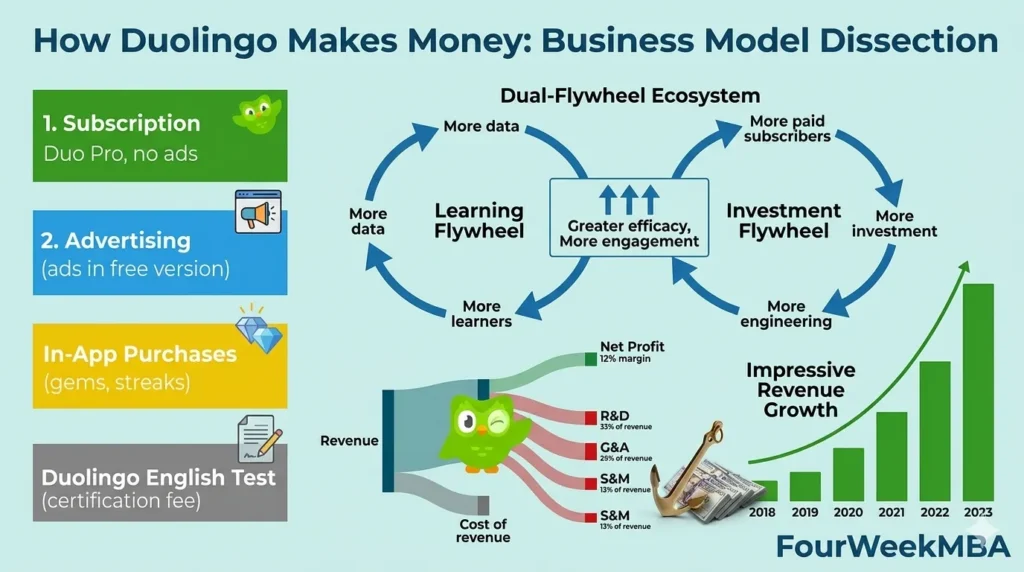
The simple answer is: Duolingo uses a freemium model and earns money from four main sources — subscriptions, advertising, in-app purchases, and certification tests.
In this article, you’ll get a clear, fact-based breakdown of:
- How much money Duolingo actually makes
- How Duolingo’s revenue model works
- Why “free” users still pay (indirectly)
- And whether upgrading is worth it
How Much Money Does Duolingo Make?
Duolingo is not just profitable — it’s a high-growth, high-value company.
Revenue and Profit Numbers
- In 2024, Duolingo reported around $748 million in revenue.
- In the last 12 months, total revenue hit about $1.04 billion, with net income of roughly $414 million.
- Subscription revenue alone grew to $607.5 million in 2024, more than doubling since 2021.
Growth Trends
- Monthly active users reached 103 million by the end of 2024.
- Paid subscribers grew from 6.6 million in 2023 to about 9.5 million in 2024, a 43% increase.
This shows Duolingo is both scaling users and converting more of them into paying customers.
The Real Secret Behind Duolingo’s Success
Beyond the money, Duolingo’s real secret is behavioral design, not just language content.
Gamification
- Points, streaks, levels, and leaderboards turn learning into a game.
- Short, bite-sized lessons make it easy to do “just one more”, increasing daily usage.
Retention Loops
- Daily streaks create a habit loop: missing a day feels like failure.
- Badges and notifications reward consistency, pulling users back in.
- Hearts and ads slightly block free progress, making upgrades feel more tempting.
These psychological tricks keep users engaged for months or even years, which is why millions stay on the platform despite the friction.
Pros and Cons of Duolingo’s Business Model
Pros
- Low barrier to entry: anyone can start learning for free.
- Multiple revenue streams: less dependence on one channel (ads or subscriptions).
- High growth and profitability: over $1 billion in revenue and strong net income.
Cons
- Ads and hearts can feel manipulative.
- Power users pay more for features that feel like “baseline” perks.
- Heavy reliance on gamification may distract from deep language mastery for some learners.
Subscription Revenue
Duolingo Super
Duolingo Super (formerly Duolingo Plus) is the primary revenue engine.
It removes ads, unlocks unlimited hearts, lets you download lessons for offline use, and grants unlimited Legendary levels and monthly streak repairs.
- By the end of 2023, subscriptions generated roughly 73% of total revenue.
- In 2024, subscription revenue jumped to about $608 million, accounting for around 76% of total revenue.
- The company reported 6.6 million paid subscribers in Q4 2023, growing to about 9.5 million in 2024.
This means each paying subscriber contributes roughly $60–$70 per year on average, thanks to pricing tweaks and annual plans.
Duolingo Max (AI Features)
Duolingo Max is a higher-tier subscription that adds AI-powered tools such as:
- Role-play exercises that simulate real conversations
- Explain My Answer (AI-based grammar feedback)
- Test-mode practice with personalized insights
These features are designed to increase perceived value, encouraging users to upgrade from Super or stay subscribed longer.
Because Super and Max together are the dominant revenue source, Duolingo can justify heavy investments in product development without relying on ads alone.
Advertising (How Free Users Pay Indirectly)
Even if you never pay, Duolingo still earns from you via ads.
Where Ads Appear
- Between lessons or after completing a session
- Interstitial ads (full-screen promo screens)
- Occasional banner or video ads in the app
Free users see these ads unless they upgrade to Super or Max, which removes them.
How Much Ads Contribute
- Advertising revenue accounts for roughly 9–15% of total income, depending on the year.
- In 2024, Duolingo’s total revenue reached about $748 million, with advertising making up close to 9%.
This means ads pay for server costs, app upkeep, and part of the content, even though subscriptions do the heavy lifting.
Why Ads Feel Annoying (Psychology)
Compared to other apps, Duolingo’s ads feel more intrusive because:
- You’re deep in “learning mode”, so an ad breaks focus and flow.
- The hearts and streak system creates urgency; an ad right before you run out of hearts feels especially frustrating.
This “friction” is by design: mild annoyance nudges some users toward upgrading to remove ads.
In-App Purchases (Small but Smart Revenue)
Beyond subscriptions and ads, Duolingo earns from small digital purchases inside the app.
Gems, Streak Freezes, and Power-Ups
- Gems act as virtual currency you can buy or earn. They unlock:
- Streak freezes (to protect your daily streak)
- Power-ups (like “two-xp” or “streak-saver”)
- Bonus exercises or shortcuts in some cases
- Streak freezes are especially popular because losing a long streak feels emotionally painful, so users pay a few dollars to preserve it.
Microtransactions Logic
These are microtransactions: small, frequent purchases by a minority of users.
Duolingo doesn’t rely on them as a core revenue source, but they:
- Boost overall monetization from power users
- Add extra lifetime value per user without changing the main pricing model
Duolingo English Test (Hidden Goldmine)
The Duolingo English Test (DET) is a low-cost English-proficiency exam that has become a major revenue stream.
How DET Works
- It’s an online test that measures listening, speaking, reading, and writing in English.
- It costs much less than traditional exams like TOEFL or IELTS, often under $100.
Why It’s Popular
- Flexible and fast: you can take the test from home, on your own schedule.
- Accepted by many universities and institutions, especially in the U.S. and Europe.
- It’s cheaper and faster than alternatives, making it attractive to students and visa applicants.
Revenue Impact
- In 2024, Duolingo English Test revenue reached over $45 million, growing steadily year over year.
- Combined with subscriptions and ads, DET makes Duolingo more than just a “language app” — it’s also a certification platform.
Why Duolingo Can Stay “Free”
Duolingo stays free for most users thanks to a clever freemium strategy.
Freemium Strategy Explained
- Core product is free: everyone can learn basic lessons, earn streaks, and use the app without paying.
- Premium features are hard to ignore: removing ads, unlocking offline lessons, and protecting streaks create real value for active learners.
- Only about 5–8% of active users upgrade to paid plans, but that small group subsidizes the rest.
This is why 100+ million users can stay on the free tier while Duolingo still earns over $1 billion in annual revenue.
Is Duolingo Manipulating Free Users?
This is a common debate — and the answer is partly yes, but within standard app-design practices.
Hearts System
- Hearts (energy) limit how many mistakes you can make in a session.
- When you run out, you must wait, watch an ad, or upgrade.
This system:
- Encourages more frequent use (short daily sessions)
- Creates false urgency that nudges you toward either watching ads or paying
Ad Frustration and Upgrade Pressure
- Duolingo’s ad placement is designed so you often see them right when you’re most engaged.
- Push notifications and in-app prompts constantly remind you of Super/Max benefits, especially when you lose hearts or streaks.
Is this “manipulative”? From a psychological design point of view, it leans toward persuasive UX, common in many free apps.
Is Duolingo Worth Paying For?
The answer depends on how intensely you use it.
Free vs Super vs Max
| Plan | Best For | What You Get |
| Free | Casual learners, occasional use | Full lessons, streaks, but ads and heart limits |
| Super | Regular learners, anti-ad users | No ads, unlimited hearts, offline lessons, streak repairs |
| Max | Serious learners using AI tools | All Super features + AI role-play, “Explain My Answer” |
Who Should Upgrade?
- Upgrade to Super if you:
- Study daily and hate ads
- Want unlimited mistakes and offline practice
- Max makes sense if you:
- Value AI-based speaking practice
- Are preparing for exams or need extra feedback
If you only use Duolingo a few times a week, the free version is usually enough.
Final Verdict
Duolingo is earning money successfully while still offering free access to millions.
Its freemium model — built on subscriptions, ads, in-app purchases, and the English test — is smart, data-driven, and highly profitable.
If you’re a light user, stay free. If you’re serious and ad-averse, Super or Max is usually worth it.
FAQs
Is Duolingo a profitable business?
Yes. Duolingo earns over $1 billion in annual revenue and has hundreds of millions in net income.
Can Duolingo make money?
Yes. It makes money through subscriptions, ads, in-app purchases, and the Duolingo English Test.
How does Duolingo generate revenue?
Mainly from premium subscriptions (Super/Max), plus advertising, in-app purchases (gems, streaks), and the Duolingo English Test.
How does Duolingo make a profit?
By keeping fixed costs low (digital product) while charging subscriptions and ads to a large user base, with only a small fraction paying directly.
Why are people leaving Duolingo?
Some users leave due to too many ads, heart limits, or frustration with the “gamification push”, or because they want deeper language education.
Is Duolingo doing well financially?
Yes. It has rapid revenue growth, strong profits, and a growing subscriber base, making it one of the most successful education-tech apps.
Is Duolingo in profit or loss?
Duolingo is solidly profitable, with net income of over $400 million in the last 12 months.
How much money did Duolingo make from advertising in 2023?
In 2023, advertising contributed roughly 9–15% of total revenue, translating to tens of millions of dollars from ads alone.

I’m a website professional with 5 years of experience in building, managing, and growing online content platforms. As the creator of DuolingoGuides.us, I focus on providing helpful, easy-to-understand guides and resources for Duolingo users and language learners. My goal is to make information simple, accurate, and accessible for everyone.


