Duolingo for Advanced Learners: Best Alternatives That Actually
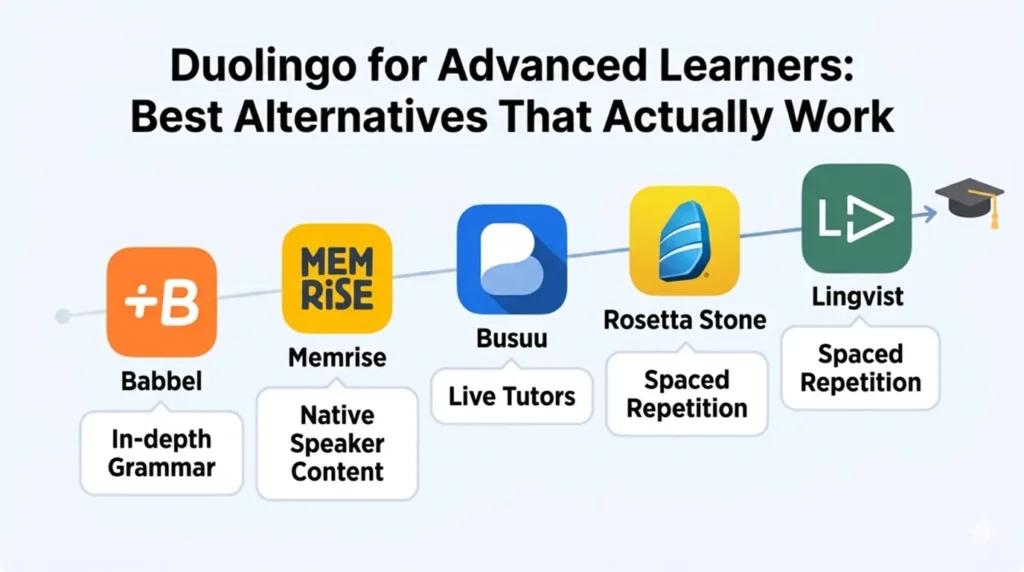
Many language learners start their journey with Duolingo, drawn in by its addictive gamification and accessible daily habits. However, a common frustration arises when the progress bar stops moving: you realize you can complete lessons, but you still struggle to hold a real conversation or understand native media. If you are looking to move beyond basic vocabulary and reach genuine, advanced fluency, this guide explores why you have outgrown the app and which tools will actually help you succeed.
Why Advanced Learners Outgrow Duolingo
While Duolingo is excellent for building a foundational habit, it reaches a structural ceiling around the B1 level. The app relies heavily on repetitive, isolated sentences that lack the complexity of real-world discourse, which is essential for C1 or C2 proficiency. Furthermore, the lack of spontaneous speaking practice and limited exposure to nuance means you may master “game” mechanics without ever internalizing the language’s natural flow. The gamification trap—where you prioritize maintaining a streak over actually engaging with difficult content—often masks a lack of real academic progress.
Common Struggles Advanced Learners Face
Once you move past the beginner phase, you likely encounter the “intermediate plateau.” You can read simple signs and order coffee, but you freeze when a native speaker talks at full speed or uses idiomatic expressions. You may find yourself stuck in a loop of reviewing vocabulary you already know, rather than challenging yourself with sophisticated grammar or professional-level topics. Without a structured pathway that demands active recall and contextual application, your retention of complex structures remains shallow and fragile.
What Advanced Learners Actually Need
To reach advanced proficiency, you must shift your focus from passive consumption to active production. You need tools that force you to engage in real-time conversation, expose you to authentic native-level content (like podcasts and literature), and provide feedback on your specific grammar errors. Effective progress tracking at this stage should involve measuring your ability to summarize complex ideas or navigate unfamiliar situations, rather than merely tracking daily XP or league standing.
Duolingo vs Real Language Learning Apps
| Feature | Duolingo | Babbel | LingQ | italki |
| Primary Goal | Habit building | Grammar structure | Immersion/Reading | Live conversation |
| Advanced Depth | Low (Up to B2) | Moderate | High | Professional |
| Speaking | Limited drills | Moderate | Self-directed | Real-time native |
| Best For | Casual learners | Intermediate | Vocabulary growth | Fluency/C1-C2 |
Best Alternatives to Duolingo for Advanced Learners
Transitioning to more rigorous platforms is the only way to break through the plateau. Consider these alternatives based on your specific linguistic needs:
- italki (Speaking Focus): This platform connects you with native tutors for one-on-one lessons. It is the single most effective way to practice conversational fluency, professional communication, and accent refinement, providing the real-world feedback that apps cannot replicate.
- LingQ (Immersion Focus): Designed for reading and listening, LingQ allows you to import authentic native content—news, books, or videos—and turn them into interactive lessons. It is essential for learners who need to build the massive vocabulary required for C1 or C2 proficiency.
- Busuu (Grammar Depth): For learners who appreciate structure, Busuu offers professional-grade lessons that include peer-correction features. It bridges the gap between basic vocabulary and complex grammar by integrating real feedback from native speakers into its curriculum.
Which App Should You Choose?
Your choice depends entirely on your target objective. If your goal is speaking confidence, nothing beats the live interaction found on italki. If you want to increase your reading and listening comprehension for professional or academic purposes, LingQ provides the best tools to consume native-level media effectively. For those seeking exam prep or formal certification, sticking to structured platforms like Busuu or traditional textbooks will provide the necessary depth for B2-C1 certification.
When You Should NOT Use Duolingo
You should stop relying on Duolingo the moment your goals shift from “casual interest” to “functional mastery”. If your objective involves business communication, navigating a foreign work environment, or achieving a native-level speaking ambition, Duolingo is no longer an efficient use of your time. The time spent on repetitive exercises is better invested in active input and meaningful, high-stakes communication with native speakers.
Final Verdict
Duolingo is a fantastic starting point for building a routine, but it is not a tool for achieving expert-level proficiency. To cross the finish line into true fluency, you must supplement your learning with tools that prioritize real-world usage and authentic content.
FAQs
Are there alternatives to Duolingo?
Yes, platforms like italki, LingQ, Busuu, and Pimsleur offer deeper, more specialized paths for advanced progress.
Does Duolingo work for advanced learners?
It is generally insufficient for reaching C1 or C2 levels because of its focus on isolated sentences and lack of native-level discourse.
Is there a C1 or C2 level in Duolingo?
Most Duolingo courses reach up to B2 proficiency, leaving a significant gap for those aiming for truly advanced or professional-level fluency.
What is the best language app for advanced learners?
There is no single “best” app; however, italki (for speaking) and LingQ (for input) are the top-rated choices for serious, long-term learners.
In conclusion, moving beyond the basics requires a deliberate pivot toward more demanding study methods. Embrace the challenge of native-level input and live conversation to finally reach your goal of true, unrestricted language fluency.

I’m a website professional with 5 years of experience in building, managing, and growing online content platforms. As the creator of DuolingoGuides.us, I focus on providing helpful, easy-to-understand guides and resources for Duolingo users and language learners. My goal is to make information simple, accurate, and accessible for everyone.