Memrise vs Duolingo 2026: Which App Actually Makes You Speak?
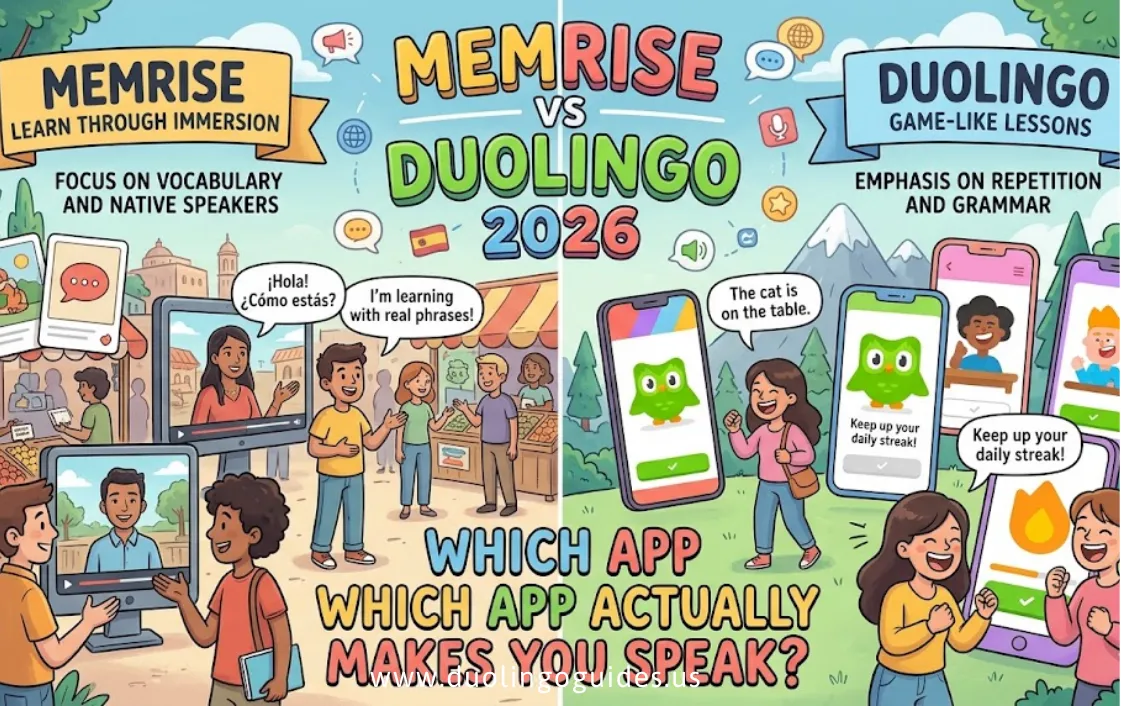
Most people in the U.S. who try Duolingo or Memrise never reach true conversation‑level fluency—no matter how many streaks they keep.
In 2026, both apps have improved, but they still solve different problems and attract very different kinds of learners.
This post cuts through the hype and shows you which app fits your real‑life goals—especially if you live, work, or travel in the United States and want to actually speak English or another language with confidence.
The Real Problem With Language Learning Apps
If you’re like millions of Americans who’ve tried duolingo or memrise, you’ve probably experienced this:
- You finish lesson after lesson.
- You unlock new levels, get hearts, streak notifications, maybe even a Premium subscription.
- Then you hear a native speaker or need to order food in Spanish/French/etc… and your brain freezes.
That gap between “app fluency” and real‑world speaking is the core problem.
Relatable storytelling
Imagine this very common scene in the U.S.:
- You’re sitting in a multilingual café in Los Angeles, Miami, or Chicago.
- Your phone is full of Duolingo streaks, but when the server asks, “What would you like to order?” your first language spills out automatically.
- You think, “I’ve done 150 lessons of Spanish… so why can’t I just say this one sentence?”
That disconnect happens because most language apps train recognition and repetition, not real conversation under pressure.
You get gamified drills, not back‑and‑forth interaction. You learn phrases like “The elephant eats an apple,” not “Where can I find the subway?” or “I’m sorry, can you repeat that?”
In the U.S., where English is dominant but Spanish, Chinese, and other languages are everywhere, people want tools that help them understand signs, ask directions, and sound human—not just translate robotic sentences.
Quick Comparison about duolingo vs memrise
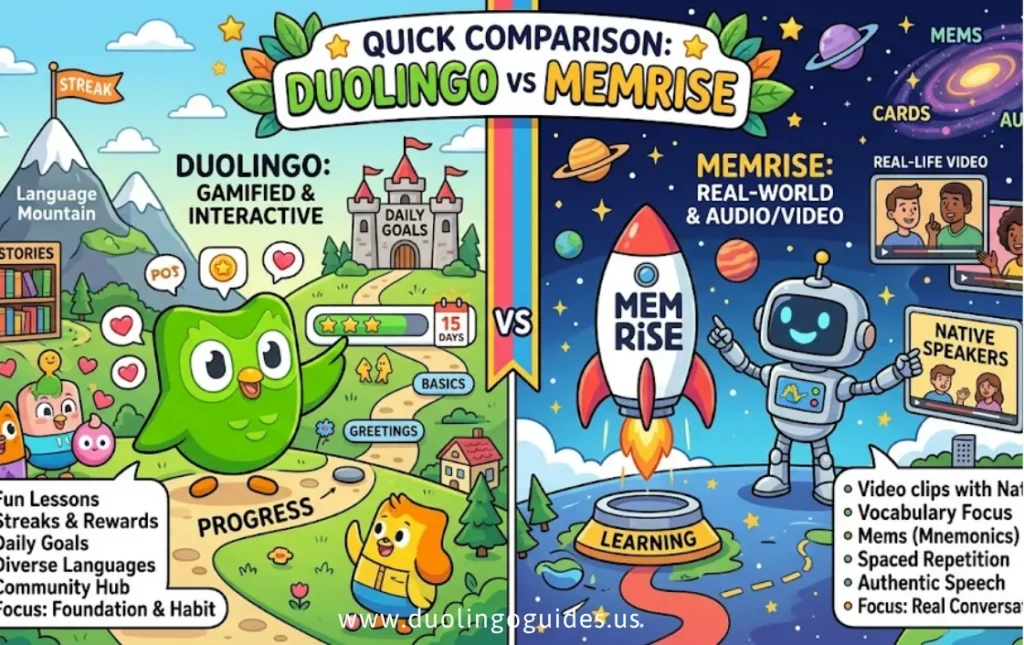
This table is not a final verdict—it’s a quick snapshot. The real answer depends on your goal.
Why Duolingo Fails Some Learners
Duolingo is incredibly popular in the U.S., thanks to its playful interface and low‑barrier entry.
But for people who want to actually speak, it often falls short.
1. The gamification trap
- Duolingo turns language learning into a game: streaks, leaderboards, XP, gem rewards.
- For many Americans, this feels like “I’m learning!” because the app is always giving you points.
- The problem? Points ≠ real‑world speaking skill.
You can complete hundreds of lessons and still feel panicked when a real person waits for your answer.
2. Lack of real conversation practice
- Most duolingo exercises are sentence‑matching, listening, and typing.
- Voice‑recognition exercises exist, but they’re rigid and robotic—you must repeat exactly what the app expects.
- Real conversations in the U.S. (ordering food, asking for directions, small talk) require flexibility, improvisation, and speed—skills Duolingo hardly trains.
In short:
Duolingo teaches you to pass its own quizzes, not to handle unpredictable, real‑time human talk.
Where Memrise Falls Short (Despite Its Strengths)
Memrise is often praised for its native‑speaker video clips and vocabulary‑focused courses, especially in 2026.
However, it’s not a magic bullet for speaking fluency.
1. No clear, structured path
- Unlike traditional classroom‑style apps, Memrise often feels course‑heavy but goal‑light.
- You can jump into random decks or user‑made courses, but there’s no unified “fluency roadmap” that guides you from complete beginner to confident speaker.
In the U.S., where learners often want clear milestones (e.g., “I can order in a restaurant” or “I can survive a job interview”), this lack of structure can feel overwhelming or aimless.
2. Retention issues and “passive” practice
- Memrise uses spaced repetition and mnemonics, which help with vocabulary memorization.
- But if you only watch videos and tap answers, you haven’t trained spontaneous speaking under mild pressure.
Studies of Memrise as a learning aid in classrooms show that it works best when combined with live instruction or active practice, not as a standalone “I’ll just do the app” solution.
So as a solo learner in the U.S., you might know a lot of words but still freeze when asked to speak them.
Which App is Better Based on YOUR Goal
There is no one‑size‑fits‑all winner. The right choice depends on what you want:
For fast fluency
- Neither Duolingo nor Memrise alone will get you there.
- If your goal is real speech—ordering, chatting, job‑related talk—you need live conversation practice (tutors, language exchange, or speaking‑focused apps like Pimsleur/Tandem).olesentuition.
Best strategy:
- Use Memrise to build strong vocabulary + listening.
- Use Duolingo lightly, if at all, to fill in grammar basics.
- Add 30 minutes of real speaking per day (tutor, partner, or shadowing) to force your brain to produce language, not just recognize it.
For casual learning (“just for fun”)
- If you’re in the U.S. and just want something light, fun, and low‑pressure, Duolingo wins.
- The streaks, cute characters, and short lessons make it easy to keep up with language practice alongside work, school, or daily life.
In this case, Memrise is overkill unless you genuinely care about mastering vocabulary and pronunciation.
For travel.
- If you’re visiting or just moved to the U.S. and want survival English (or Spanish/Cantonese/Mandarin), Memrise is usually better.
- Its native‑speaker videos help you get used to real accents, speed, and everyday expressions.
Pair it with phrase‑books or flashcards you can practice aloud in subways, airports, or grocery stores.
For professionals and career‑focused learners
- Professionals in the U.S. who need business‑level English or another language often find both apps too shallow.
- Duolingo lacks nuanced vocabulary and workplace phrases.
- Memrise can help with industry‑specific terms, but you still need structured grammar and real‑life practice.
For this group, the best move is:
- Use Memrise for specialized vocabulary.
- Use a grammar‑focused course (Babbel, a paid course, or a tutor).
- Add weekly speaking sessions (Zoom calls, language exchange, or corporate language training).
Also Check: Duolingo “Unknown Error Occurred”
Free vs Premium Features
| Feature | Memrise (Free) | Memrise (Pro) | Duolingo (Free) | Duolingo (Super) |
|---|---|---|---|---|
| Access to full language library | Available | Available | Available | Available |
| Custom vocabulary practice | Included | Included | Included | Included |
| Real native speaker video clips | Included | Included | Not available | Included |
| Smart spaced repetition system | Included | Included | Included | Included |
| Fun, game-style learning | Included | Included | Included | Included |
| Learning progress tracking | Included | Included | Included | Included |
| No advertisements | Not included | Included | Not included | Included |
Hidden Truth: Why Most People Quit Both Apps
Behind the cheerful notifications and streaks, there’s a quiet dropout epidemic for both Duolingo and Memrise—especially in the U.S.
1. The “illusion of progress”
- Apps tell you, “You completed 300 lessons!” and your brain thinks you’re almost fluent.
- Reality: you’re just good at doing the app, not at speaking under real‑world pressure.
This mismatch leads to frustration and shame—people feel like failures, not like they’re using the wrong tool.
2. No real‑world feedback loop
- In the U.S., you might use Duolingo every day but never say a full sentence out loud.
- Or you watch Memrise videos but never get corrected by a human.
Without feedback and interaction, motivation fades fast.
3. Life in the U.S. gets busy
- Work, school, family, and side‑hustles make 30‑minute daily practice feel impossible.
- When people can’t keep up with the app’s expectations, they quit entirely—often blaming themselves, not the app’s design.
Better Alternative Strategy
Instead of choosing Memrise vs Duolingo as a war, use them as tools in a bigger plan—especially if you live in the U.S. and want real speaking ability.
Step 1: Combine apps strategically
- Use Memrise for:
- Vocabulary (especially around topics you care about: work, travel, food, social media).
- Listening + native‑speaker exposure (Manhattan‑style accents, Southern speech, Mexican‑Spanish, etc.).
- Use Duolingo (if at all) for:
- Grammar basics and light review.
- Casual practice when you’re too tired for a full lesson.
Step 2: Add real speaking practice
To actually speak in 2026, you need:
- Daily speaking aloud (even if it’s to yourself).
- Weekly conversation sessions with a tutor, language partner, or at least voice‑recording yourself and playing it back.
In the U.S., this could mean:
- Joining a local conversation club.
- Using Zoom tutors or apps like Tandem/HelloTalk.
- Practicing real‑world micro‑scenarios (ordering coffee, asking for Wi‑Fi, explaining your job).
Step 3: Real‑life usage hacks
- Label your environment (sticky notes on household items) in your target language.
- Switch your phone settings or a few apps to the language you’re learning.
- Watch Netflix or YouTube with subtitles, then replay short clips and say them out loud.
Final Verdict
So: Duolingo or Memrise—what should you choose in 2026?
Choose Duolingo if…
- You want a fun, low‑pressure way to build a daily habit in the U.S. busy‑life grind.
- Your goal is casual learning (“I like Spanish/Italian/French”) rather than serious fluency.
- You enjoy gamification, streaks, and cute characters and don’t mind shallow sentence drills.
Choose Memrise if…
- You want stronger vocabulary and listening skills with real‑speaker audio.
- You plan to combine it with live practice (tutor, conversation exchanges, or classroom learning).repository.
- You’re more serious about pronunciation and authentic phrases than fun animations.
FAQ
Q: Can Duolingo make me fluent in English/Spanish/etc.?
A: No. It can help with basics and habits, but true fluency requires real‑world speaking and feedback, not just app lessons.
Q: Is Memrise better than Duolingo overall?
A: For vocabulary and listening, Memrise often has the edge. For habit‑building and fun, Duolingo wins. Neither is enough on its own for fluency.
Q: What’s the best strategy for a busy American?
A:
- Use Memrise for focused vocabulary.
- Use Duolingo only if it motivates you.
- Add at least 20–30 minutes of real speaking practice per day (partner, tutor, or solo practice).
Conclusion
In 2026, Duolingo and Memrise are tools, not teachers—especially for Americans who want real speaking confidence rather than just long streaks. If your goal is actual conversation, you should use Memrise for vocabulary and listening, limit Duolingo to light practice, and add live speaking practice to your routine.

I’m a website professional with 5 years of experience in building, managing, and growing online content platforms. As the creator of DuolingoGuides.us, I focus on providing helpful, easy-to-understand guides and resources for Duolingo users and language learners. My goal is to make information simple, accurate, and accessible for everyone.