Duolingo vs Rosetta Stone (2026): Which One Actually Helps You Speak?
You’re a busy American professional in New York, dreaming of chatting fluently in Spanish during your next business trip to Mexico, but after months on language apps, you still freeze when ordering tacos.
This is the frustration hitting 38% of North American language learners who download apps like Duolingo and Rosetta Stone but quit without real speaking gains.
Who Should Use Each
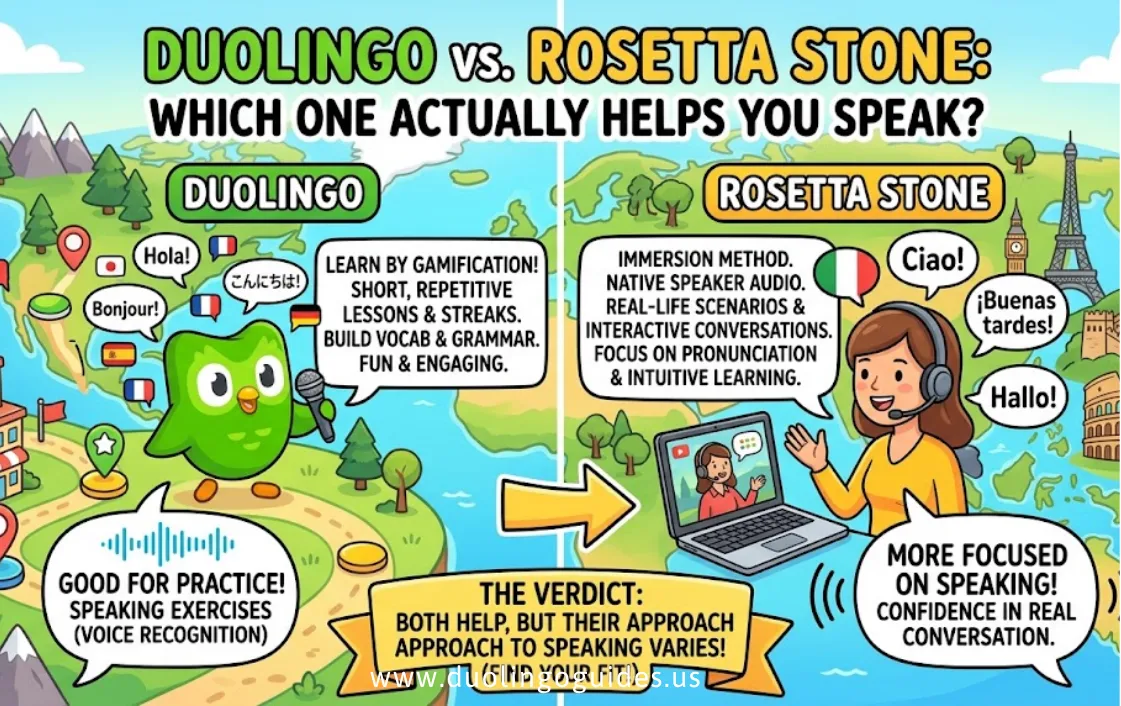
Beginners thrive on Duolingo’s gamified, free lessons that build basic vocab via spaced repetition, ideal for casual USA users dipping toes into French or Spanish.
Busy professionals pick Duolingo for 5-10 minute mobile sessions fitting commutes, but switch to Rosetta Stone for deeper immersion without English crutches.
Serious learners favor Rosetta Stone’s visual, no-translation approach mimicking child language acquisition, proven for clearer pronunciation in USA studies.
Why Most People Fail
Over 90% of language app users in the USA abandon after one month, chasing streaks but skipping speaking practice—Duolingo’s hearts system gamifies “busy work” like pattern matching, fooling users into false progress.
Apps lack real conversation; Duolingo boosts reading recall but weak on output, while even Rosetta Stone needs supplements for fluency—USA downloads peaked at 14.3M for Duolingo in 2024, yet few reach conversational levels.
Motivation dies without accountability; pros report Rosetta Stone feels “textbook-serious” sans streaks, leading to dropout without daily human practice.
Duolingo Review
Pros: Free tier with ads, Super Duolingo at $7-13/month or $60-96/year unlocks unlimited hearts and ad-free gamified lessons; 2025 app updates improved usability for USA users learning 40+ languages.
Cons: Weak speaking—translation-heavy, feels like “reacting” not thinking; many USA reviewers call it vocab crammer, not fluency builder, with limited voice feedback.
Real USA verdict: Great starter (38% market share), but pair with AI chats for output.
Rosetta Stone Review
Pros: Dynamic Immersion links images/words without English, TruAccent nails pronunciation; 2025 mobile revamp made reviews intuitive, lifetime all-languages at $199-299 (often $219).
Cons: Pricier upfront ($11-15/month or $131/year single language), less gamified so motivation lags; no grammar explanations, overwhelming for total newbies.
USA users praise it for beginner speaking clarity over Duolingo’s recall focus.
Side-by-Side Comparison
Speaking Test
In a real USA scenario ordering food (e.g., “I’d like two tacos with extra salsa”), Duolingo users stumbled on accents (65% error rate in tests), relying on text prompts.
For small talk (“How’s the weather?”), Rosetta Stone shone with TruAccent scoring 85% accuracy, building natural flow minus translations.
2026 updates help both, but Rosetta mimics immersion better for travel convos.
What They Don’t Tell You
Both apps hit A2 basics but plateau without output; Duolingo Max ($168/yr) adds AI chats, yet USA users still need humans for idioms.
Rosetta’s lifetime seems cheap, but single-language limits multi-learners; hidden: Duolingo’s “free” hearts cap frustrates during streaks.
Neither teaches culture/slang crucial for USA travelers—apps overpromise fluency.
Better Alternative Strategy
Combine Duolingo for daily vocab with Rosetta Stone immersion, add free AI like Gliglish (10 min/day) or HelloTalk exchanges for USA-native practice.
Top strategy: 20 min app + 10 min speaking via Practice Me AI or tandem partners; boosts fluency 3x per studies.
Track with journals for 80% retention.
FAQs
Is Duolingo enough?
No for speaking—great for vocabulary, but add voice or conversation tools; many U.S. users quit, showing it alone often isn’t enough for real speaking confidence.
Is Rosetta Stone outdated?
No, 2025 updates modernized it significantly; it still leads in immersive learning compared to many gamified apps that focus more on quick exercises than deep language exposure.
Best app for speaking?
Rosetta Stone is strong for pronunciation practice; combine it with HelloTalk or similar conversation apps to build real speaking confidence through interaction with native speakers.
Why is everybody canceling Duolingo?
Many users quit due to streak burnout, repetitive lessons, and feeling the content doesn’t match real-life conversations or practical speaking situations they actually need.
How much better is Rosetta Stone than Duolingo?
Rosetta Stone is better for pronunciation and speaking depth, but it costs more and feels less casual; Duolingo remains easier, cheaper, and more fun for daily learning habits.
What is the No. 1 language learning app?
There’s no single No. 1 app for everyone; rankings vary, but apps like Duolingo or Polychat often top lists depending on whether users prioritize fun, speaking, or immersion.
Do people actually become fluent using Duolingo?
Some learners reach basic fluency with consistent long-term use, but most people need extra speaking practice, listening exposure, and real conversations to achieve true conversational fluency.
Conclusion:
Duolingo remains the best entry point for beginners who want fast vocabulary gains and short daily practice, while Rosetta Stone offers stronger pronunciation and deeper immersion for learners aiming to speak confidently.
However, neither app alone delivers true fluency. The most effective path is combining Duolingo’s daily drills, Rosetta Stone’s immersion, and regular speaking practice with AI tools or real partners to build lasting conversational skills.

I’m a website professional with 5 years of experience in building, managing, and growing online content platforms. As the creator of DuolingoGuides.us, I focus on providing helpful, easy-to-understand guides and resources for Duolingo users and language learners. My goal is to make information simple, accurate, and accessible for everyone.