Is Duolingo Good for Learning French? An Honest 2026 Review

If you’re thinking about learning French with Duolingo, the short answer is yes—but with limits. Duolingo is an effective way to start French, build a daily study habit, learn useful vocabulary, and practice basic reading, listening, writing, and speaking. Its short lessons and game-like system make it much easier to stay consistent than with many traditional study methods.
However, completing a large number of lessons does not automatically mean you can comfortably speak French with native speakers. Duolingo is strongest as a beginner-friendly learning tool and daily practice companion, rather than a complete replacement for conversation, grammar study, or immersion.
Is Duolingo Good for Learning French?
Duolingo is good for learning French, particularly if you’re a beginner or someone who struggles to maintain a consistent study routine.
The French course provides practice across several important skills, including:
- Vocabulary
- Reading
- Listening
- Writing
- Speaking
- Translation
- Pronunciation
- Sentence recognition
The biggest advantage is consistency. Lessons can take only 3–5 minutes, while some users may spend around 5–10 minutes on a lesson depending on the exercise and their pace.
That makes Duolingo easy to fit into a commute, coffee break, waiting time, or short study session.
The important distinction is that Duolingo can help you learn and recognize French, but real-world fluency also requires you to produce French independently.
What Level of French Can You Reach With Duolingo?
This is one of the most important questions to understand before relying heavily on the app.
Duolingo’s French course has expanded considerably and now includes content extending through B2-level material. However, completing B2 content and actually functioning at a conversational B2 level are not necessarily the same thing.
Based on the limitations identified in the reviewed sources, a more realistic expectation for many learners is:
- A1: Very achievable for beginners.
- A2: A realistic practical target for consistent learners.
- B1: Possible for stronger or highly consistent learners, particularly when Duolingo is combined with other resources.
- B2: Duolingo contains B2-level material, but completing that material alone does not guarantee B2 conversational ability.
This difference matters because CEFR levels measure broader language ability, including independent communication—not simply how many app exercises you’ve completed.
How Long Does It Take to Learn French on Duolingo?
There isn’t a single number of hours that guarantees a particular French level.
However, one reviewed source estimates that the first 50–100 hours of study can provide beginners with a meaningful foundation of vocabulary and basic sentence structures.
Duolingo’s short lessons make those hours easier to accumulate because you don’t need to schedule a traditional one-hour class every day.
For example, someone who completes several short sessions consistently may make more practical progress than someone who studies intensively for a few days and then stops.
The key is consistency rather than streak length alone.
A 200-day streak is impressive, but the quality of practice matters more than the number displayed on your profile.
What Does the Duolingo French Course Teach?
The French course has developed significantly over time. It includes exercises designed to expose learners to different areas of French rather than teaching vocabulary through isolated word lists.
You can encounter practice involving:
- Everyday vocabulary
- Sentence construction
- Listening comprehension
- Translation
- Reading
- Speaking
- Grammar patterns
- Pronunciation
- Subjunctive structures
- Relative pronouns
- More advanced vocabulary and sentence patterns
The course has also expanded toward B2 content, making it substantially broader than an introductory French course.
Its exercise-based approach means you’re repeatedly seeing and using words and structures instead of simply reading explanations.
Why Duolingo Works Well for Beginners
Duolingo’s biggest strength is its ability to make learning feel manageable.
Instead of opening a textbook and wondering where to start, you receive a clear learning path and individual exercises.
The app uses features such as:
- Streaks
- XP
- Leagues
- Gems
- Hearts
- Leaderboards
- Stories
- Review exercises
- Guidebooks
These features encourage learners to return regularly.
For someone who has tried learning French before but repeatedly stopped, this can be more valuable than having access to an extremely detailed course that they never finish.
Is Duolingo Good for French Vocabulary?
Yes. Vocabulary is one of Duolingo’s stronger areas.
Repeated exposure and spaced repetition help reinforce words and phrases. Instant feedback also lets you recognize mistakes immediately instead of continuing with an incorrect answer.
The problem appears when vocabulary needs to become spontaneous language.
You might recognize a French word when Duolingo shows it to you but struggle to produce that same word naturally during a conversation.
This is the difference between recognition and production.
Duolingo is particularly useful for building the recognition side. You need additional speaking and writing practice to strengthen production.
Is Duolingo Good for French Grammar?
Duolingo can introduce and reinforce French grammar, but it isn’t the strongest option for learners who want detailed grammatical explanations.
This becomes more noticeable with difficult areas such as:
- Grammatical gender
- Passé composé
- Imparfait
- French prepositions
- Pronoun placement
- Subjonctif
- Differences between spoken and written French
For example, understanding why French uses a structure such as “Je veux que tu viennes” requires more than simply recognizing that the sentence is correct.
Duolingo can help you encounter grammatical patterns repeatedly, but some learners will need a dedicated grammar resource to understand why the structure works and how to create new sentences independently.
Is Duolingo Good for French Speaking?
This is where expectations need to be realistic.
Duolingo does include speaking exercises and pronunciation activities, but completing these exercises doesn’t necessarily prepare you for spontaneous conversation.
The major problem is production under pressure.
In the app, you’re generally responding to a controlled exercise. In a real conversation, you have to:
- Understand what another person says.
- Think of an answer.
- Choose the correct vocabulary.
- Construct a sentence.
- Pronounce it naturally.
- Respond quickly.
Those skills are much harder than selecting or translating an answer.
Duolingo can therefore be useful speaking practice, but it shouldn’t be your only speaking environment.
How Good Is Duolingo’s French Pronunciation Practice?
Duolingo provides pronunciation and speech-recognition exercises, which are useful for getting learners to actually speak French.
However, speech recognition has an important limitation.
The app can determine whether your pronunciation is sufficiently recognized by its system, but that isn’t exactly the same as determining whether a native French speaker would find your pronunciation natural and easy to understand.
French also contains features such as:
- Liaisons
- Elisions
- Contractions
- Natural rhythm
- Connected speech
These can make real French sound very different from carefully pronounced learning exercises.
So Duolingo is a useful starting point for pronunciation, but listening to and speaking with real French speakers remains important.
Can Duolingo Teach You to Understand Fast French?
Not completely on its own.
This is one of the biggest challenges reported in the reviewed material.
Learners can become comfortable understanding carefully presented French inside an app but then struggle when they hear native speakers talking at normal speed.
Real conversations include shortened sounds, connected words, different accents, informal expressions, and natural speaking rhythms.
This can create a frustrating situation:
You understand your Duolingo exercises but suddenly understand very little when someone speaks French to you.
That doesn’t mean your Duolingo study was useless. It means you’ve developed one part of the skill and now need more authentic listening exposure.
Does Duolingo Teach Real Conversational French?
Only to a limited extent.
The course can introduce useful vocabulary and sentence structures, but some learners may find the language more formal, unusual, or contextually unrealistic than what they hear in everyday conversations.
Another limitation is cultural context.
Knowing the grammatical construction of a sentence doesn’t necessarily tell you when a native speaker would actually use it.
For practical conversational French, you should eventually expose yourself to:
- Native French conversations
- Authentic videos
- Podcasts
- French-speaking partners
- Tutors
- Real-world situations
This helps bridge the gap between learning French as an exercise and using French as a communication tool.
What Is the Duolingo Plateau?
Many learners eventually experience what can be described as a Duolingo plateau.
You may notice signs such as:
- You recognize lots of French vocabulary but struggle to speak.
- You can translate sentences but cannot create your own.
- You understand written French better than spoken French.
- Native speakers seem much faster than Duolingo audio.
- You’re reviewing familiar material more often than learning something new.
- Your streak continues to grow while your conversational confidence stays low.
This doesn’t mean Duolingo has stopped being useful.
Instead, it usually means your learning needs have changed.
Duolingo may be excellent during the first stage, while additional resources become increasingly important as you move toward independent communication.
When Should You Move Beyond Duolingo?
You don’t necessarily have to stop using Duolingo.
Instead, consider changing its role when you notice that you’re spending more time reviewing than developing new skills.
A useful point to reassess your approach is after approximately 4–6 weeks if you’re still building your basic study routine, and especially after 6 months of consistent use if your listening and speaking abilities aren’t progressing.
You may need additional resources if:
- You cannot understand normal-speed French.
- You struggle to create original sentences.
- You want to have real conversations.
- You are preparing for the DELF exam.
- You need advanced grammar knowledge.
- You need accurate French writing skills.
- You want to live or work in a French-speaking environment.
The goal isn’t necessarily to abandon Duolingo. It’s to add the skills that Duolingo cannot fully provide.
Is Duolingo Enough for DELF?
No, not by itself.
The DELF exams cover levels such as A1, A2, B1, and B2, and successful preparation requires more than recognizing correct answers inside an app.
You need practice with:
- Original writing
- Extended responses
- Time-limited tasks
- Authentic listening
- Reading comprehension
- Speaking
- Spontaneous language production
Duolingo can support vocabulary and general practice, but it shouldn’t be treated as a complete DELF preparation program.
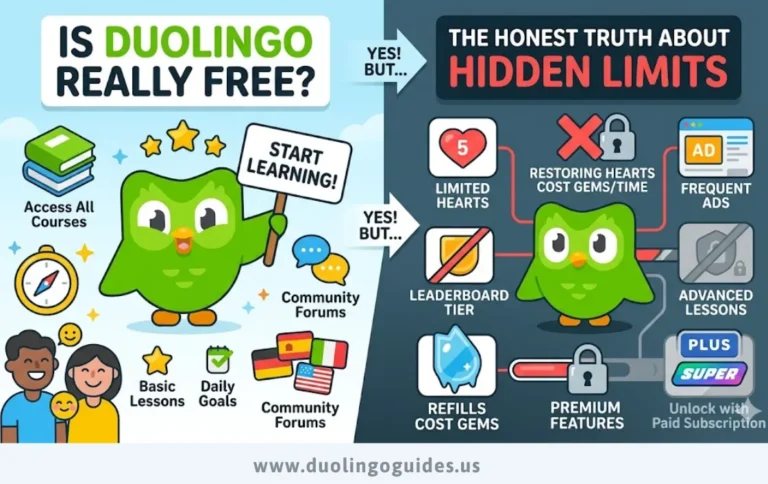
Free Duolingo vs Super Duolingo
The free version provides access to the core French learning experience, making it a good option if you’re not ready to spend money.
The main drawbacks are advertising and restrictions around some features.
Super Duolingo removes many of those frustrations and adds benefits such as unlimited hearts and offline access.
Pricing can vary by region and promotions, but the reviewed 2026 information includes approximately:
- $13.99/month for Super Duolingo.
- $95.99/year for an individual annual plan.
- $119.99/year for the Family plan.
- The Family plan supports up to 6 users.
Promotional discounts and trial periods can change, so learners should check the price shown for their account before subscribing.
What About Duolingo Max?
Duolingo Max is the higher-priced option and adds AI-focused features.
The reviewed 2026 pricing includes approximately:
- $29.99/month
- $167.99/year
- $239.99/year for a Family plan
- Up to 6 Family users
Depending on availability, Max can include features such as Roleplay and Video Call with Lily.
These features are designed to provide more interactive AI-based practice, which addresses part of Duolingo’s traditional limitation around conversation.
However, AI conversation still isn’t exactly the same as regularly communicating with real French speakers.
Explain My Answer Is Now Free
One meaningful change in 2026 is Explain My Answer becoming free for all users in January 2026.
This is important because one of the long-standing criticisms of Duolingo has been its limited grammar explanation.
Having explanations available without requiring the higher-priced subscription makes the learning experience more useful for people who want to understand their mistakes instead of simply correcting them.
It still doesn’t turn Duolingo into a full grammar textbook, but it improves one of its weaker areas.
Is Duolingo Better for French Than Other Language Apps?
Duolingo isn’t automatically the best choice for every learner.
Other language-learning platforms can take different approaches, including more explicit grammar teaching, structured courses, pronunciation work, conversation practice, or spaced-repetition vocabulary.
The important question isn’t simply “Which app is best?”
It’s:
“What skill am I missing?”
If you need motivation and daily practice, Duolingo can be excellent.
If you need detailed grammar, add a grammar resource.
If you need conversation, speak with other people.
If you need authentic listening, consume French media.
If you need exam preparation, follow a DELF-specific study plan.
This approach is usually more effective than expecting one application to teach every part of a language.
How to Use Duolingo Effectively for French
The best way to use Duolingo is as one part of a broader learning routine.
Start with Duolingo to establish your foundation and daily habit.
Then gradually add:
- Daily Duolingo practice for vocabulary and consistency.
- French listening for exposure to natural speech.
- Speaking practice with a tutor or language partner.
- Grammar study when a concept repeatedly causes problems.
- French reading to see language in realistic contexts.
- Writing practice to develop independent sentence production.
You don’t need to replace Duolingo.
Instead, use it as the tool that keeps you practicing while other activities build the skills the app cannot fully develop.
Who Should Use Duolingo for French?
Duolingo is a particularly good choice if you’re:
- A complete beginner.
- Starting French for the first time.
- Looking for a free learning option.
- Trying to build a daily study habit.
- Interested in vocabulary and basic grammar.
- Looking for short lessons.
- Easily motivated by gamification.
- Returning to French after a long break.
It can also remain useful for intermediate learners who want a convenient way to review vocabulary and maintain regular contact with French.
Who Should Not Rely on Duolingo Alone?
Duolingo shouldn’t be your only learning resource if your primary goal is:
- Fluent conversation.
- Advanced French.
- DELF preparation.
- Professional French.
- Accurate independent writing.
- Understanding fast native speech.
- Living in a French-speaking country.
- Developing natural conversational pronunciation.
For these goals, Duolingo works better as a supporting tool rather than your complete curriculum.
Final Verdict: Is Duolingo Good for Learning French?
Yes, Duolingo is good for learning French—but it is not enough for complete fluency by itself.
Its strongest benefits are its accessibility, short lessons, gamification, vocabulary practice, repetition, and ability to create a consistent study habit. The French course has also grown substantially, with content extending to B2 and improved features such as free Explain My Answer.
The biggest weaknesses are speaking, authentic listening, detailed grammar instruction, cultural context, and spontaneous language production.
For many learners, Duolingo can take you a meaningful distance toward A1–A2, while stronger learners may progress further when they combine it with other resources.
The smartest approach is simple: use Duolingo to build the foundation, then add real French conversation, authentic listening, grammar, reading, and writing as your ability grows.

I’m a website professional with 5 years of experience in building, managing, and growing online content platforms. As the creator of DuolingoGuides.us, I focus on providing helpful, easy-to-understand guides and resources for Duolingo users and language learners. My goal is to make information simple, accurate, and accessible for everyone.