Duolingo Audio Lessons: The Smartest Way to Learn a Language on the Go
Duolingo Audio Lessons are short, hands-free language practice sessions built for busy people who want listening and speaking practice without staring at a screen. They work best as a practical supplement to regular study, not as a complete language-learning system.
Introduction
Busy schedules make language learning easy to postpone, and that is exactly where audio-based practice helps most. Duolingo’s audio features are designed to fit into commutes, walks, chores, and other small pockets of time.
What They Are
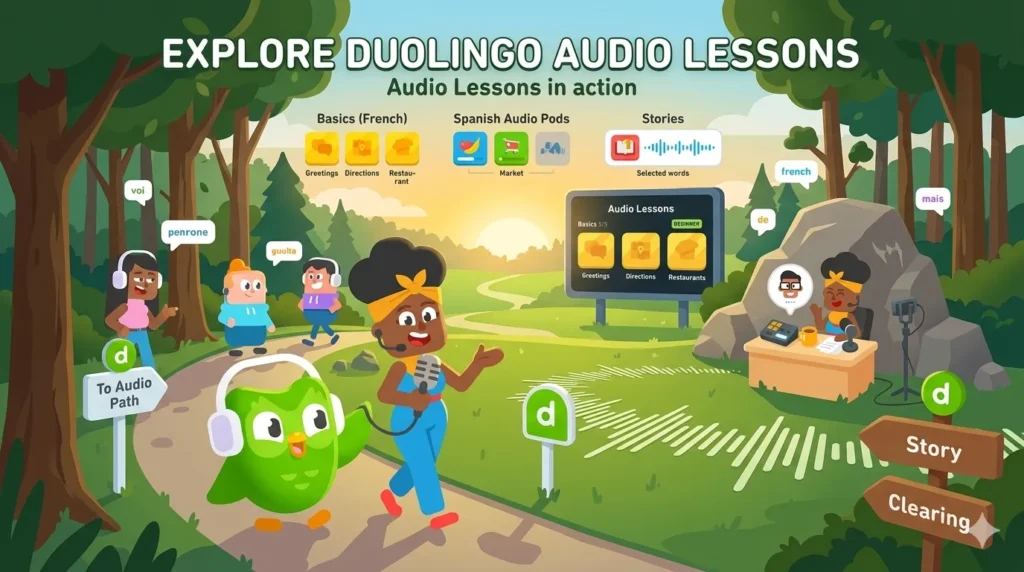
Duolingo Audio Lessons are podcast-style lessons with guided dialogue and conversation practice. They are intended to build listening comprehension, pronunciation, and everyday conversational familiarity, especially for beginner to intermediate learners.
Duolingo also offers related listening content such as DuoRadio and podcasts in some language combinations. The exact availability depends on the course and language pair, with Spanish and French being the best-known podcast offerings for English speakers.
Why People Struggle
Most people fail with audio learning for three reasons: they do not have enough time, they listen too passively, and they never check whether they are improving. Audio-only practice can feel productive even when the learner is not actively recalling words or understanding context.
Another common problem is expecting audio to replace grammar, reading, and real conversation practice. Research and Duolingo’s own studies show listening improves, but language growth is broader than listening alone.
Key Features
Duolingo Audio Lessons are short, usually around 2 to 5 minutes, which makes them easier to finish consistently. They are hands-free, so you can listen while doing something else.
They also use real conversational context and periodic repeat-after-me prompts, which helps learners hear language in use rather than as isolated vocabulary. Duolingo’s learning system also includes progress tracking and XP, which can help with consistency and motivation.
Offline Answer
Duolingo’s offline experience is limited, and audio lessons are not the kind of content you should rely on offline. In practice, Duolingo’s offline mode lets you do some mobile lessons without internet, but not the full feature set.
The safest truth is this: do not assume Audio Lessons will be available offline, and plan to download or complete them while connected. If you need offline listening, a better backup is to save podcasts or other audio resources in advance through the platform that offers them.
How To Use Them
Use Audio Lessons during low-focus moments like commuting, walking, or doing chores. That is where the hands-free format has the most value, because it turns otherwise unused time into exposure.
A simple routine is:
- Do one short audio lesson in the morning.
- Repeat the same topic later in the day.
- Pair it with one reading or speaking exercise in the app.
This works better than listening for long stretches without interaction, because active recall and repetition strengthen retention.
Audio vs Podcasts
| Format | Best for | Strengths | Limits |
| Duolingo Audio Lessons | Beginners and routine practice | Short, guided, integrated with app progress | Limited availability and not a full course |
| Podcasts | Listening exposure and story-based practice | Natural pacing, longer immersion | Usually less interactive and less structured |
| Language apps | Overall language study | Grammar, reading, writing, speaking, tracking | Can feel repetitive without extra listening practice |
For most learners, Duolingo Audio Lessons are best as a bridge between structured lessons and real-world listening. Podcasts are better for extended immersion, while full apps are better for complete skill-building.
Mistakes To Avoid
The biggest mistake is passive listening, where you hear the audio but do not recall or repeat anything. Another mistake is skipping repetition, because short lessons only become useful when reviewed often.
A third mistake is expecting audio alone to take you to advanced fluency. Duolingo can help with reading and listening, but higher-level outcomes still need broader practice, especially speaking and writing.
Best Alternatives
If you want more variety, try Duolingo podcasts, DuoRadio, or outside podcast platforms for language immersion. For structured speaking practice, the main Duolingo course and speaking lessons are more useful than audio alone.
If your goal is conversation-heavy learning, pair audio with a speaking app, tutor session, or live conversation practice. That combination is more balanced than relying on one feature by itself.
FAQs
Are they free?
Duolingo’s core learning experience includes free access, while premium plans can add extra convenience and features depending on the current app setup.
Do they work offline?
Not reliably for audio lessons; offline access is limited and should not be assumed for this feature.
Why does no one like Duolingo anymore?
Some learners dislike the app when they want faster progress, deeper grammar, or more natural speaking practice, but Duolingo still has strong listening and reading evidence in studies.
Can you reach C1 with Duolingo?
Not realistically by itself; Duolingo is useful for foundations and intermediate progress, but advanced proficiency needs broader real-world practice.
Does Duolingo do audio lessons?
Yes, Duolingo offers audio-focused listening content such as Audio Lessons, DuoRadio, and podcasts in selected courses.
Is Duolingo 100% correct? N
o app is perfectly correct, and learners should still verify unusual phrasing and pronunciation with additional sources.
Are they good for beginners?
Yes, that is one of their best uses because the lessons are short, guided, and conversation-focused.
How long should I listen daily?
Even 5 to 15 minutes daily is useful if you stay consistent and combine it with active review.
Conclusion
Duolingo Audio Lessons are most valuable when you want low-friction listening practice that fits into a busy day. They are especially useful for beginners and early intermediates, but they work best as part of a bigger study routine that includes reading, speaking, and repetition.

I’m a website professional with 5 years of experience in building, managing, and growing online content platforms. As the creator of DuolingoGuides.us, I focus on providing helpful, easy-to-understand guides and resources for Duolingo users and language learners. My goal is to make information simple, accurate, and accessible for everyone.