
How Many Sections in Duolingo Spanish? Complete 2026 Guide
Duolingo’s Spanish course is one of the most popular ways learners start a new language, especially for beginners and self-study students in the United States. With constant updates, the number of sections and units can feel unclear, so this guide cuts through the confusion and gives you a clear 2026 snapshot of the Spanish course structure.
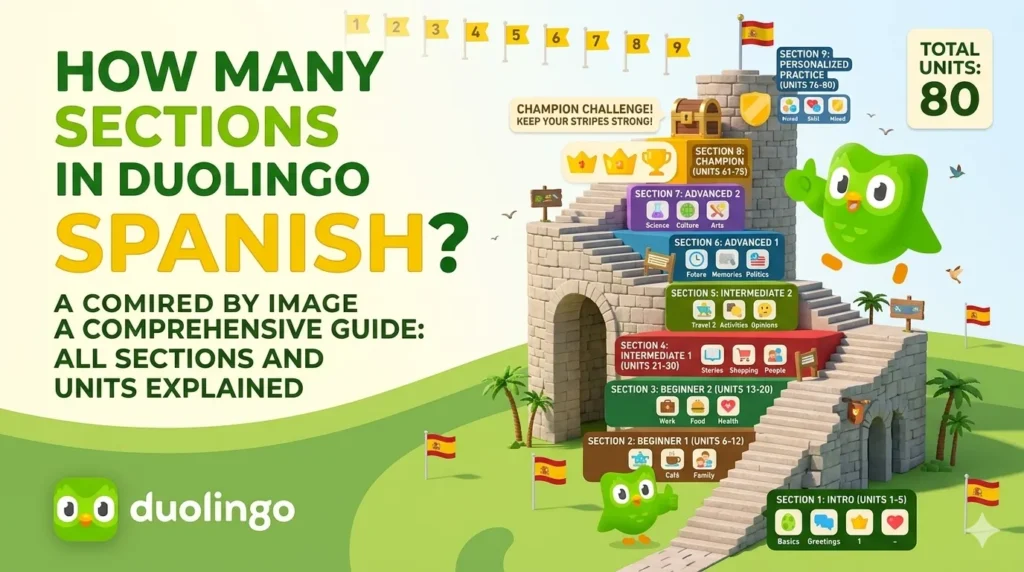
As of 2026, Duolingo Spanish is built around 8 core sections, with an extra Daily Refresh area that behaves like a ninth section on-screen. Many learners see different numbers across YouTube videos, Reddit threads, and older blogs, which makes the actual section count hard to pin down.
This guide will:
- Give you the exact section count for 2026.
- Break down what each section teaches and how it maps to real-world levels like A1–B2.
- Estimate time to complete each section and show you how to finish sections faster.
How Many Sections Are in Duolingo Spanish?
In 2026, the Duolingo Spanish course has 8 main sections in its mobile and web path. Alongside these, there is a Daily Refresh section that keeps reappearing above the main course, so many users think the course has 9 sections.
Key facts:
- Official structure: 8 sections plus Daily Refresh.
- Level range: The course is designed to take learners from beginner (A1) to upper-intermediate (around B2) on the CEFR scale.
- Checkpoint system: Each section ends with a Checkpoint, which is a short quiz that unlocks the next section.
If you open the app right now and haven’t finished the course, you’ll likely see Section 1–8, with Daily Refresh sitting above or apart from the main list.
Duolingo Spanish Sections Breakdown
Each section in Duolingo Spanish groups a set of units (mini-topics) that build on grammar, vocabulary, reading, and speaking skills. Here’s how the 8-section structure breaks down into learning stages:
Section 1 – Basics
Section 1 is the true beginner entrance point for Duolingo Spanish. It focuses on:
- Basic greetings (“¿Cómo estás?”, “Buenos días”).
- Simple self-introductions (“Me llamo…”, “Soy de…”).
- Early nouns (family, colors, numbers) and present-tense “yo” forms.
By the end of this first section, you’ll recognize core phrases and be able to follow very short, simple sentences in Spanish.
Section 2 – Foundations
Section 2 strengthens what you learn in Section 1 and adds slightly more structure. Topics include:
- Everyday vocabulary (food, shopping, basic objects).
- Regular verb patterns in the present tense.
- Simple questions and answers (“¿Tienes…?”, “¿Dónde está…?”).
This section helps turn isolated words into short, usable sentences, which is critical if you want to speak in real conversations one day.
Section 3 – Intermediate Skills
By Section 3, the course introduces more complex grammar and starts moving learners into true intermediate territory. You’ll see:
- Past-tense forms (mainly pretérito for simple past).
- More sentence variety, including object pronouns (“lo”, “la”).
- Broader vocabulary themes like travel, work, and daily routines.
Here the crowns (skill levels) start to matter more because you’ll be revisiting topics to lock skills into long-term memory.
Section 4 – Advanced Practice
Section 4 acts as a bridge between intermediate and advanced practice. It typically mixes:
- Grammar drills (verb conjugations, stem-changing verbs).
- Reading and listening tasks that are longer than previous sections.
- More nuanced vocabulary (opinions, emotions, social situations).
If you’re using Duolingo in the United States as your main Spanish practice, this section is where you might start noticing real-world conversations feeling easier to understand.
Section 5 – Section 6 – Section 7 – Section 8
Sections 5–8 are heavy practice blocks that push learners toward upper-intermediate fluency.
| Section | Typical content focus | Approx. unit range (per user) |
| 5 | Long-format practice, higher-level vocab and grammar | Up to 250 units in some 2025–26 paths |
| 6 | More complex structures, conversations, and writing | Similar high unit count as 5 |
| 7 | Review-heavy, harder listening and reading | Around 180–250 units reported |
| 8 | Final checkpoint-style section, polishing weak areas | Around 180 units reported |
Because Duolingo personalizes the update, some users see more units in later sections, especially from Section 5 onward, while keeping other sections shorter.
What Each Section Actually Teaches You
Duolingo’s 8-section Spanish course is not just about vocabulary; it’s built to develop four core skills:
- Reading: Short sentences, stories, and prompts you must understand before answering.
- Writing: Typing or selecting correct words, plus longer “Translate” and Story tasks in later sections.
- Listening: Audio clips, dictation, and voice-match exercises that appear more often in Section 3 and beyond.
- Speaking: Optional voice exercises, especially in newer versions of the course.
If you’re thinking in American-oriented goals, this structure suits:
- High school or college students needing A2–B1 to pass exams.
- Adults preparing for travel or work conversations.
Duolingo Sections vs Language Levels (A1–B2)
Duolingo’s 8-section path is explicitly designed to cover CEFR levels A1 through about B2. Here’s a simplified mapping:
| Duolingo Section | Approx. CEFR range | What you can typically do |
| 1–2 | A1–A2 | Understand basic phrases, introduce yourself, ask simple questions. |
| 3–4 | A2–B1 | Talk about daily life, simple past events, and basic opinions. |
| 5–8 | B1–B2 (upper) | Follow short conversations, write simple emails, and understand more complex sentences. |
Even though the section labels don’t say “A1” or “B2”, the Checkpoint quizzes and skill icons are calibrated to those levels.
How Long Does It Take to Complete Each Section?
Time to finish a section depends on your daily practice, but here are realistic estimates for a typical learner:
- Casual learner (5–10 minutes/day):
- Sections 1–2: 1–2 weeks each.
- Sections 3–4: 2–4 weeks each.
- Sections 5–8: 4–8 weeks combined due to more units and longer lessons.
- Serious learner (20–30 minutes/day):
- Sections 1–4: about 1–2 months total.
- Sections 5–8: another 2–3 months for near-full completion.
If you’re using Duolingo in the United States as your only tool, expect roughly 4–6 months of consistent work to finish all 8 sections close to 5 crowns.
Does Completing All Sections Make You Fluent?
Completing all 8 sections of Duolingo Spanish is impressive, but it does not guarantee fluency on its own.
What Duolingo does well:
- Builds vocabulary and grammar foundations quickly.
- Keeps you motivated with streaks, gems, and short lessons.
Where it falls short:
- Limited real-time speaking and conversation practice.
- Few cultural context explanations or authentic media (TV, movies, podcasts).
To reach true conversation fluency, most learners in the United States add tutors, language exchanges, or immersion content to what Duolingo teaches.
Why Your Duolingo Sections Look Different
If your Duolingo Spanish screen shows more units in later sections or slightly different layouts, that’s expected.
Reasons include:
- Personalized updates: Duolingo reshapes the course path for different users, sometimes adding extra units in Section 5–8.
- Beta features: New Stories, Listening, or Writing modules can appear above or beside the main sections.
- Platform differences: The mobile app view may group or label sections differently than the web version.
No matter how the interface tweaks, the core structure is still 8 sections plus Daily Refresh.
Is Duolingo Spanish Enough on Its Own?
For many learners, Duolingo Spanish is a strong starting point, but it’s usually not enough by itself if your goal is real-world fluency.
Pros:
- Free or low-cost access to structured lessons.
- Gamified design that keeps you coming back daily.
- Good for A1–B1 grammar and vocabulary foundations.
Gaps:
- Minimal spontaneous speaking practice.
- Little error correction for pronunciation or sentence structure.
If you live in the United States and want to speak Spanish confidently, pairing Duolingo with a tutor, language app, or immersion videos is ideal.
Tips to Complete Sections Faster
If you want to finish Duolingo Spanish sections more quickly, use these strategies:
- Set a daily goal: Aim for at least 10–15 minutes/day to avoid burnout.
- Prioritize weak skills: Use the Leaderboard or Strengths tab to identify weak areas and review them first.
- Use Crowns smartly: Don’t grind to 5 crowns on every skill; target 2–3 crowns and then revise later.
- Add real practice: Listening to Spanish podcasts, music, or YouTube while studying reinforces what each section teaches.
Final Verdict
Duolingo Spanish’s 8-section structure is an excellent, beginner-friendly path that takes learners from complete zero to upper-intermediate comprehension. However, it works best as a core tool, not a complete solution, especially if your goal is real conversation fluency.
If you’re in the United States and want a low-barrier way to start Spanish, finish all 8 sections, then add real speaking and immersion to lock in what you learn.
FAQs
How many sections are there in Duolingo Spanish?
As of 2026, there are 8 main sections plus a Daily Refresh area, which many users count as a ninth section.
How many units are in Duolingo’s Spanish course?
The total number of units varies, but Sections 1 and 2 are short (around 8–30 units each), while Sections 5–8 can reach 250 or more units apiece in some 2025–26 paths.
How many units are in a Duolingo lesson?
A Duolingo lesson is usually one unit, which contains a set of 5–10 exercises focused on a single topic or grammar point.
What is a Duolingo Spanish course?
The Duolingo Spanish course is a mobile and web-based learning path of 8 sections that builds reading, writing, listening, and basic speaking skills from beginner (A1) to upper-intermediate (B1–B2).

I’m a website professional with 5 years of experience in building, managing, and growing online content platforms. As the creator of DuolingoGuides.us, I focus on providing helpful, easy-to-understand guides and resources for Duolingo users and language learners. My goal is to make information simple, accurate, and accessible for everyone.