Duolingo Daily Practice Guide: Stay Consistent & Actually Become
Why Most People Quit Duolingo
Most people quit Duolingo because the app promotes streaks and points instead of helping users build real speaking and listening skills. Many learners begin with ambitious goals, such as becoming fluent quickly or improving career opportunities, but lose motivation when short daily exercises fail to prepare them for real conversations or practical language use.
The main problem is not lack of discipline but relying on a system designed for engagement rather than fluency. This 2026 daily practice guide explains how to use Duolingo more effectively by creating a sustainable routine focused on speaking, understanding native speakers, and achieving practical English fluency in the US context.
1. Why Most People Fail at Daily Practice
Inconsistency kills progress
For many US users, life is too busy: commutes, work‑from‑home Zoom calls, school, or family all eat up short blocks of time. Without a fixed daily slot, Duolingo turns into “that app I’ll open later”—which often means never.
Research on habit formation shows that consistency beats duration: doing 5–10 minutes every day beats doing 30 minutes once a week when building language skills.
Boredom from the same format
Duolingo’s gamified model is great for new users, but over time the same sentence patterns, multiple‑choice drills, and robotic voices feel stale. Many learners report “plateauing” after a few weeks because they’re not challenged in speaking, listening, or real‑world usage.
This is why only using Duolingo isn’t enough for fluency; it works best when paired with authentic content and output practice.
No visible real‑world progress
If you only see little green trees, XP, and crowns, you may feel like you’re “unlocking content” without actually growing your ability to speak or understand live English. The app tracks completion, but not fluency milestones like “can hold a 3‑minute conversation” or “can understand a US‑based podcast at normal speed”.
That gap between in‑app metrics and real‑life ability is what frustrates motivated US learners the most.
3. A Simple Daily Routine for Busy US Users
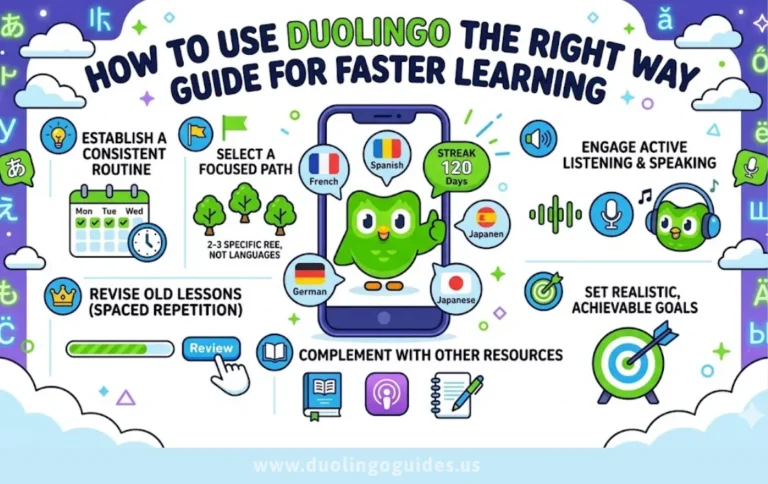
Here’s a realistic, 15‑minute daily Duolingo routine designed for Americans who work full‑time, commute, or care for a family:
5 minutes in the morning
Use stand-up time, coffee, breakfast, or getting ready for a quick warm-up session. Duolingo’s newer versions allow small daily goals such as five minutes light or ten minutes serious, helping users habit-stack the app with a consistent morning routine and maintain language practice every day.
- Review weak skills with 1–2 short drills.
- Speak each sentence aloud or whisper it to build mouth-muscle memory and improve pronunciation awareness.
5 minutes during a break
Use lunchtime, a commute, or a work break to do a short lesson. This is “dead time” re‑optimized for learning—instead of scrolling social media, you unlock a lesson or two.
- Use headphones in public and repeat words quietly.
- Turn on captions or transcripts to connect sound with spelling.
minutes before bed
End the day with a nightly review or a story or podcast exercise if your language path includes those. This evening repetition helps transfer new vocabulary into long‑term memory.
- Avoid binging multiple lessons at night; stay at 5–10 focused minutes and protect sleep.
- If you’re tired, do lighter skills (vocabulary, listening) instead of complex grammar.
This 15‑minute triangle (morning, break, night) mirrors the habit‑stacking principle: anchor Duolingo to existing routines so it feels automatic, not “extra effort”.
The Never Miss Twice Rule
Habit psychology behind the rule
The never miss twice rule is a powerful habit‑management hack: if you skip a day, you must do it the next day. This keeps your streak alive psychologically, even if the app’s green counter resets.
Why it works:
- Flexible streak thinking avoids back-to-back breaks that disrupt the habit loop.
- Missing one day isn’t failure, but missing two in a row signals routine slippage and motivates re-engagement.
Streak recovery system for US learners
Duolingo’s streak system (daily XP, streak freezes, and reminders) is designed to keep you coming back, but you can enhance it with your own recovery plan.
Try this:
- Maintain a minimum viable streak by doing at least one exercise daily.
- Enable Duolingo reminders at a routine-friendly time.
- Use a streak-free backup like flashcards or a short podcast when app limits stop you.
This combo turns Duolingo into a habit scaffold, not a fragile streak‑addiction.
How to Make Duolingo Actually Work
Turn drills into real speaking
Duolingo’s biggest strength is input (reading and listening), but fluency comes from output (speaking and writing). To make Duolingo work, bridge that gap:
- Shadowing: After each sentence, repeat it immediately in the same rhythm and pitch. This technique improves intonation and speed.
- Say five original sentences: After a lesson, take 3 key words and create 5 new sentences using them. This moves you from passive recognition to active use.
Real‑life English application
For Americans learning English‑based paths (like Duolingo English Test or business‑level English), real‑world practice is critical.
Ideas:
- Narrate your day: While making coffee or driving, describe your actions out loud in English: “I’m turning on the lights… I’m opening my laptop…”
- Use it in texts: When messaging friends or coworkers, switch a few phrases into Duolingo‑learned English structures.
- Practice for US‑style tests: If you’re prepping for the Duolingo English Test (DET), mirror its format in your own practice: short recordings, quick reading, and timed writing.
This turns Duolingo from a stand‑alone app into part of a real‑life English‑practice ecosystem.
Fixing Boredom & Repetition
Strategic “skip” use
If you’re doing the same skill again and again, it’s okay to skip or reduce repetition after you’ve mastered it. Modern Duolingo lets you move through lessons more quickly, and many learners find that burning through mastered content keeps motivation higher.
However:
- Don’t skip all reviews; sparse review is key for long‑term retention.
- Use Duolingo’s “Practice” or “Test Out” options to test your level before forcing endless drills.
Mix Duolingo with other tools
Using only Duolingo is like only using one textbook in a course. To avoid burnout, combine it with:
- Podcasts or videos: For English, try US‑style conversational podcasts or YouTube channels that match your level.
- Flashcards: Use Anki or a built‑in spaced‑repetition app for words you keep forgetting.
- Grammar sources: Add a light grammar overview (YouTube explainers or a simple guide) when you hit confusing rules.
This “Duolingo + X” model keeps practice fresh and covers all language skills, not just the app’s strengths.
What to Do Beyond Duolingo
Podcasts and media immersion
For US‑based learners, authentic English media is your best fluency accelerator. Try:
News‑style podcasts at normal speed (e.g., NPR‑style content).
- TV shows without subtitles, then with subtitles, then without again.
- Music playlists in your target language, with lyrics saved for later review.
This builds listening stamina and cultural intuition for American‑style English.
Conversations and real‑world speaking
Nothing beats actual conversations:
- Join language‑exchange meetups on apps like Tandem or HelloTalk, or in local US communities.
- Use AI conversation tools or paid tutors for structured speaking practice.
Even 5 minutes of real talk per week dramatically improves confidence and fluency compared to Duolingo alone.
Full‑immersion mindset
You don’t need to move countries for immersion. Simple habits help:
- Label your home in the target language (notes on fridge, desk, etc.).
- Change your phone or app language to English or your target language.
- Narrate chores out loud in English while cooking, cleaning, or driving.
This micro‑immersion turns everyday moments into stealthy practice.
Weekly Progress System for US Learners
Track measurable improvement
Instead of only tracking crowns and XP, set weekly fluency goals. For example:
| Metric | Duolingo‑only | Upgraded weekly tracking |
| Streak | 7 days | 7 days + 5 original sentences/day |
| Skills | 5 skills “done” | 5 skills + 3 new phrases used in real life |
| Lessons completed | 10 lessons | 10 lessons + 1 recorded audio practice |
Mini goals that feel achievable
Examples of mini goals:
- Week 1: Learn 20 workplace‑related phrases (e.g., “Can you send me that file?”).
- Week 2: Record a 60‑second self‑introduction in English.
- Week 3: Listen to a 5‑minute podcast segment without subtitles.
These mini‑wins build confidence and keep you from feeling stuck.
FAQs
Is 10 minutes a day enough on Duolingo?
For realistic fluency, 10 minutes is enough only if you combine it with outside practice. Many learning guides suggest 10–15 minutes of focused Duolingo daily, plus separate speaking, listening, or reading practice, can yield steady progress over months.
However, if your goal is test‑style English (like the Duolingo English Test), you’ll likely need more time and targeted practice than just 10 minutes a day.
How long to become fluent on Duolingo?
Fluency time depends on starting level, target language, and extra practice. For English‑based learners in the US, studies and guides suggest:
- Basic conversational level: often 3–6 months with consistent daily practice and real‑world use.
- Advanced fluency: typically 1–2+ years with deep immersion and structured practice.
Duolingo alone usually gets you to an intermediate level, but fluency requires conversations, media, and deliberate output practice.
What makes Duolingo a success?
Duolingo’s success comes from:
- Gamified design that makes learning feel like playing a game.
- Streaks and reminders that leverage habit‑formation psychology.
- Accessibility: free access, mobile‑first design, and simple onboarding for beginners.
However, long‑term success depends on how users supplement the app with real‑world practice.
How do I use Duolingo effectively to learn a language seriously?
To use Duolingo more seriously:
- Set daily goals (e.g., 10–15 minutes) and stick to them.
- Speak out loud for every exercise and add shadowing or mini‑speaking drills.
- Pair Duolingo with podcasts, videos, and conversation practice.
This transforms Duolingo from a casual game into a core tool in a larger language‑learning system.
How can I achieve my language goals on Duolingo?
Achieving language goals on Duolingo means:
- Aligning app use with your real‑life goal (travel, work, study, or test prep).
- Tracking progress outside the app (conversations held, new phrases used, recordings saved).
- Using the “never miss twice” rule to protect your streak even when life gets busy.
When your Duolingo habits mirror your real‑world needs, you’ll see genuine improvement.
Why am I not improving on Duolingo?
Common reasons for feeling stuck:
- Only using Duolingo without output practice (speaking or writing).
- Repeating the same easy skills instead of tackling harder content or real‑world materials.
- No regular time commitment: doing lessons “when you feel like it” instead of daily.
Fix this by adding daily speaking, expanding beyond the app, and making Duolingo part of a fixed schedule.
Conclusion
Duolingo in 2026 can help busy US learners build real English fluency—but only if you use it intentionally. By pairing short daily practice, the “never miss twice” rule, real‑life speaking, and weekly progress tracking, you turn the app into a powerful habit engine, not just a game.
If you follow this Duolingo daily practice guide, you’ll move from occasional streaks to consistent, measurable progress toward actual fluency in English.