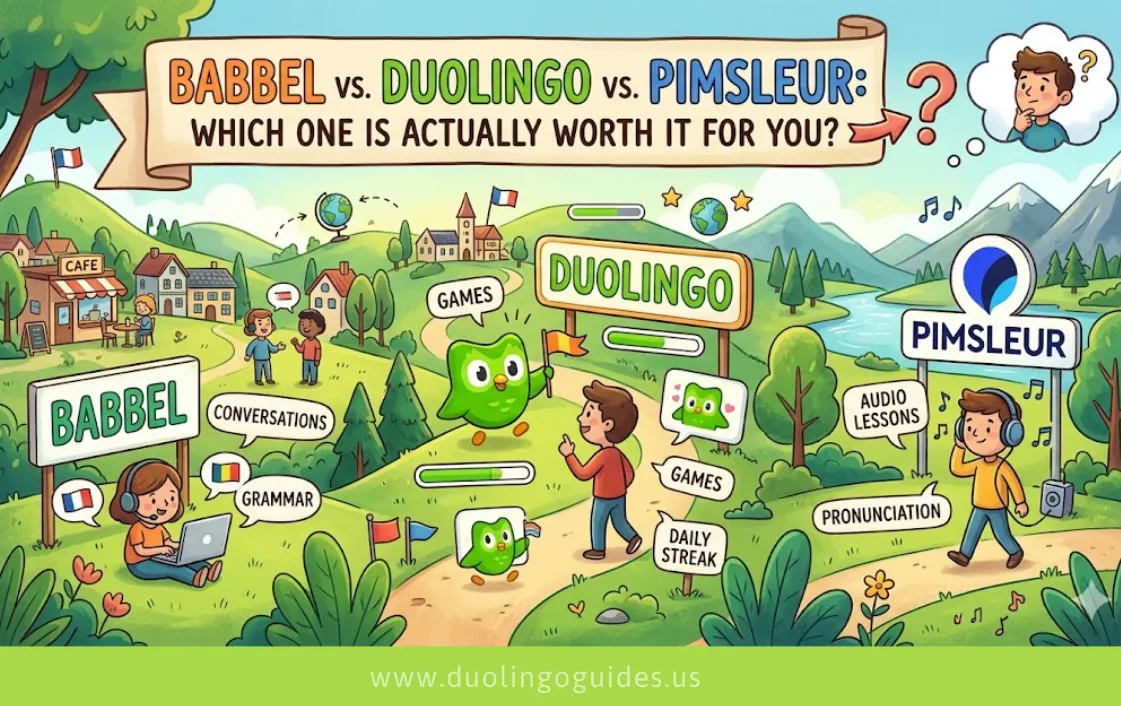
Babbel vs Duolingo vs Pimsleur (2026): Which One Is ACTUALLY Worth It for You?
You’re wasting money on language apps but still can’t speak after months of “lessons.”
We’ve tested Babbel, Duolingo, and Pimsleur in 2026 for real users – here’s the no-BS breakdown with facts.
Quick Verdict
Best overall: Babbel – balanced skills, grammar, and conversations for serious progress.
Best for beginners: Duolingo – free, fun gamified start to build habits fast.
Best for speaking: Pimsleur – audio immersion forces fluent pronunciation from day one.
Best for budget: Duolingo – solid free tier, Super at ~$7/month yearly.
Comparison in babbel vs duolingo vs pimsleur
Learning Style
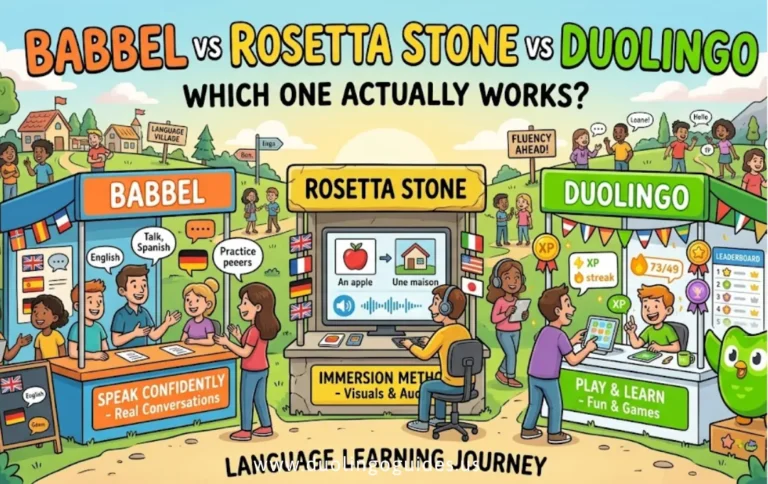
Babbel uses interactive lessons with grammar explanations, flashcards, fill-in-blanks, and native audio – perfect for visual/structured USA learners aiming CEFR A1-B2. Duolingo gamifies with streaks, hearts, and quick drills but skimps on deep grammar, suiting fun daily habits. Pimsleur is pure audio: listen-repeat-recall in 30-min sessions, ideal for hands-free drives but ignores reading/writing.
Also Check: Duolingo XP Points Explained (Guide)
Speaking Ability
Pimsleur excels in speaking fluency – users report conversational basics after levels, thanks to spaced repetition and prediction drills. Babbel’s speech recognition and mock convos build confident output, strong for Russian with clear pronunciation feedback. Duolingo hits A2 speaking for ~50-66% after basics, but practice feels disconnected without real talk.
Time Efficiency
Duolingo wins short bursts (2-5 min), fitting busy USA schedules for vocab streaks – 34 hours equals a semester. Babbel’s 10-15 min bites with reviews yield steady gains without burnout. Pimsleur demands 30-60 min daily for immersion, slower but deeper retention via audio recall.
Pricing & Value
In USA 2026, Duolingo dominates budget: free core, Super annual ~$84 ($7/mo), Family $120. Babbel offers value at $10/mo (6-mo) or lifetime $130 for 14 languages, including Live classes ~$50-99/mo. Pimsleur’s $20/mo All-Access (50+ langs) or $160/level suits committed audio fans, but pricier long-term.
Motivation & Consistency
Duolingo’s streaks/leaderboards hook casuals, but gamification fakes progress. Babbel motivates via quick wins and personalized reviews, high retention for pros. Pimsleur builds habit through daily audio rituals, less visual fun but strong for commuters.
Where Each App Fails
Duolingo: Gamification illusion – vocab heavy, weak grammar/speaking; intermediate stalls. Babbel: Limited to A2, needs visual focus; less immersive audio than rivals. Pimsleur: No grammar/reading, repetitive drills bore visuals; can’t solo to full fluency.
Best App for YOUR Situation
If you’re busy → Duolingo or Babbel – micro-lessons fit commutes.
If you want fluency → Pimsleur + supplement for reading.
If you’re lazy → Duolingo 😄 – streaks guilt-trip you into 5 mins daily.
Real-Life Use Case: 30-Day Simulation
Duolingo (30 days, 15 min/day): 90 lessons, A1 vocab/grammar basics; speak simple sentences but choppy. USA user: “Fun start, but can’t chat yet.”
Babbel (30 days, 15 min/day): 60 lessons to A1 end; handle dialogues, Russian alphabet down. “Grammar clicks fast.”
Pimsleur (30 days, 30 min/day): 30 lessons, core convos/pronunciation solid. “Order coffee abroad-ready.”
FAQs about comparison of Duolingo vs Babbel vs Pimsleur
Is Babbel better than Duolingo?
Yes for structured grammar and real-life dialogue learning; Duolingo is better for free, fun, game-like practice. Babbel feels like a classroom, while Duolingo keeps motivation high through short playful lessons.
Pimsleur or Babbel better?
Pimsleur is better for speaking and listening confidence; Babbel offers a balanced approach with grammar, reading, writing, and vocabulary, making it stronger overall for structured learning beyond conversation basics.
Babbel good for Russian?
Yes, Babbel is strong for Russian beginners, teaching grammar gradually, introducing cases step-by-step, and using practical dialogues that make complex rules easier to understand up to lower-intermediate levels.
Duolingo best free app?
Yes, Duolingo is among the best free language apps, offering many languages, fun lessons, and strong beginner vocabulary practice, but it often lacks deep grammar explanations and advanced conversational depth.
Babbel vs Pimsleur?
Babbel gives variety with grammar, vocabulary, reading, and writing practice, while Pimsleur focuses deeply on listening and speaking through repeated audio conversations, making them useful for different learning styles.
Pimsleur make you fluent?
Pimsleur can build strong conversational confidence and pronunciation skills, but full fluency usually requires additional resources such as reading, writing, grammar study, and real conversations with native speakers.
Conclusion:
Overall, no single language app fits everyone. Duolingo works best for beginners who need a free, fun way to build daily habits, while Babbel offers the most balanced path for learners who want structured grammar and steady progress.
Pimsleur stands out for speaking confidence and pronunciation. For real fluency, the smartest approach is combining one main app with consistent practice and real-life conversation.

I’m a website professional with 5 years of experience in building, managing, and growing online content platforms. As the creator of DuolingoGuides.us, I focus on providing helpful, easy-to-understand guides and resources for Duolingo users and language learners. My goal is to make information simple, accurate, and accessible for everyone.