Is Duolingo Dangerous? Complete Safety Guide for Kids, Parents
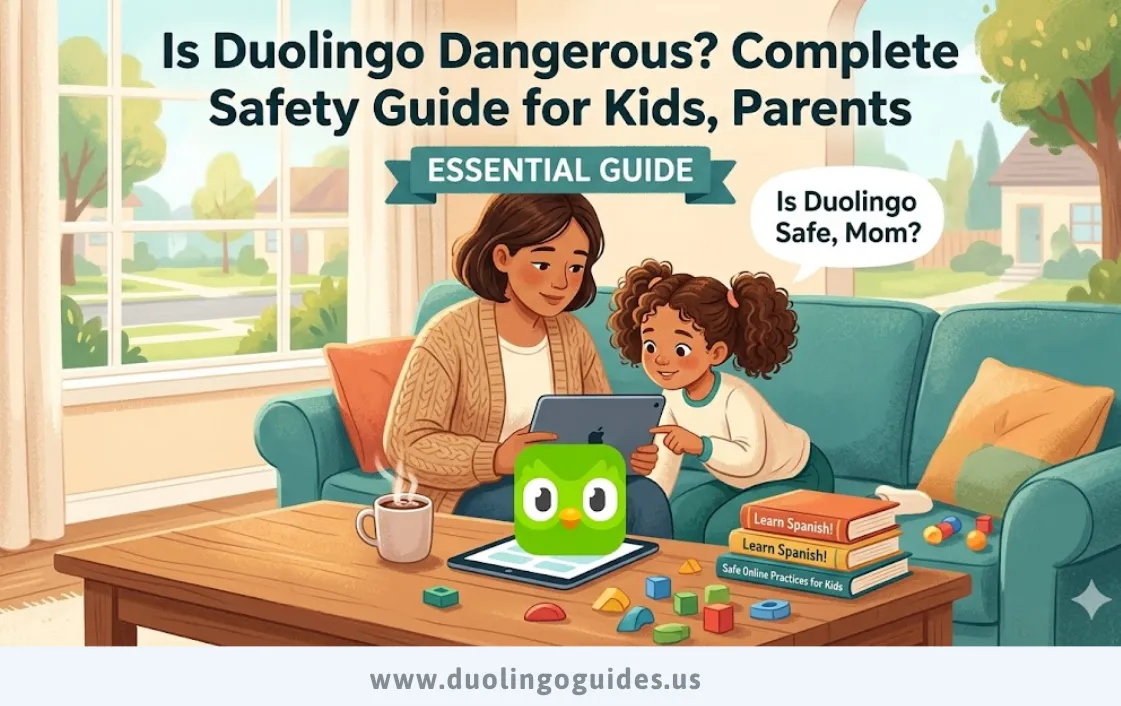
Duolingo has become one of the most popular language-learning apps in the usa, but growing concerns about screen time, data privacy, and streak-based addiction have raised important questions about its safety—especially for children.
While the app offers engaging and educational content, its gamified design and data practices require careful use. This guide explores whether Duolingo is truly safe in 2026 and how to use it responsibly.
Why People Think Duolingo is Dangerous
Several trends in 2023–2026 have made people in the USA ask, “Is Duolingo dangerous?”
Addiction & streak system
- Duolingo’s daily streak, leaderboards, and XP rewards tap into habit formation psychology similar to social media.
- Many US teens report feeling guilty or anxious when they break a long streak, which can push compulsive use.
Ads and screen‑time exposure
- The free version shows ads and in‑app promotions, which can pull kids toward other apps or YouTube links.
- Pediatric groups in the USA warn that every extra hour on apps like Duolingo adds to blue‑light fatigue and attention fragmentation.
Gamification psychology
- Gamified lessons make learning fun, but they can also make learners equate progress with streaks and medals instead of real fluency.
- This can create a “illusion of learning”—users feel they’re advancing when they’re mostly memorizing phrases.
Also Check: Duolingo XP Points Explained (Guide)
Is Duolingo Safe for Kids?
For American families, the question is: Is Duolingo safe for kids? The short answer is yes, with proper settings and supervision.
COPPA‑compliant child accounts
- In the USA, Duolingo follows COPPA by automatically creating child‑accounts for users under 13, which hide social features like leaderboards and friend‑adding.
- These accounts do not allow public friend lists or chat, reducing exposure to predators.
Parental concerns in 2026
- Critics in the USA argue that kids may sneak into blog‑style or “Discover” sections that contain links to other sites, including YouTube or social media.
- Age verification is self‑reported, so parents must help their child choose the correct age or face inappropriate social features.
Real risks vs perceived risks
- Real risks:
- Accidental clicks to external links.
- Over‑screen‑time if unmanaged.
- Perceived risks (often overblown):
- Content ideology or “political” themes in some user‑reported sentence examples, which are not the norm across core lessons.
With parental controls and time limits, Duolingo is safe for kids in the USA.
Privacy & Data Collection
American users’ biggest fear is “Does Duolingo steal your data?” The truth is more nuanced than yes or no.
What data Duolingo collects
Duolingo collects:
- Basic info: Name, email, age, device type, and location.
- Behavioral data: Lesson progress, streaks, mistakes, timestamps, and in‑app interactions.
They say this data improves course recommendations and keeps the app free for most users.
Is it sold or shared?
- Duolingo states it does not sell user data outright but may share it with partners, advertisers, and service providers under privacy‑policy terms.
- The company emphasizes encryption in transit (SSL) and lets users access, download, or delete their data via a Data Vault.
Data breach and security issues
- In 2023, data from 2.6 million users was scraped and sold on a dark‑web hacking forum, including usernames, real names, and email addresses.
- Duolingo claims this came via an exposed API and public profile data, not a full server hack.
So Duolingo isn’t “stealing” data, but it’s not 100% risk‑free—especially if you reuse passwords or share sensitive info.
Is Duolingo Effective, or a Waste of Time?
Many US learners ask: “Is Duolingo enough to learn English?” The answer is “no—but it helps if paired with real‑world practice.”
Learning limitations
- Duolingo excels at vocabulary building and basic sentence patterns, but it often skips explicit grammar rules.
- Lessons are short and repetitive, ideal for beginners, but not optimized for advanced reading or nuanced writing.
Fluency expectations
- Average US users report improving A1–B1 level (beginner to lower‑intermediate) with Duolingo, but struggling to reach C1/C2 without speaking practice.
- Apps like Duolingo are designed for habit formation, not full fluency.
Vs real speaking practice
- Without talking with native speakers, tutors, or immersion, learners often fail the “real conversation test”—even after months of daily streaks.
- For US students, Duolingo works best as a supplement to classes, iTalki, or language‑exchange apps.
So Duolingo is not a waste of time, but it should not be your only strategy.
Addiction & Psychological
The real “danger” of Duolingo for many US users is psychological, not physical.
Streak system psychology
- The streak counter uses loss‑aversion psychology—people hate losing a 100‑day streak more than they enjoy the lesson itself.comparitech+1
- This can push five‑minute “check‑ins” into hours of compulsive play, especially for teens.
Notification strategy
- Duolingo sends push reminders, email nudges, and on‑screen prompts that resemble social‑media FOMO.
- Combined with leaderboards and XP, this can create habit loops where users feel obligated to “check in,” even when they’re tired.
Habit vs dependency
- For balanced learners, streaks build positive study habits.
- For stressed or anxious students, it can become a digital obligation instead of a fun tool.
If you feel guilty, anxious, or obligated to use Duolingo every day, it’s worth re‑evaluating your usage.
How to Use Duolingo Safely
Here’s how USA parents and learners can use Duolingo safely while keeping streaks and gamification in check.
Time limits and screen‑time rules
- Set daily limits (e.g., 15–30 minutes) via device screen‑time controls or Duolingo’s own pacing.
- Use it as a warm‑up or review, not as the only study method.
Parental controls for kids
- In the USA, parents should:
- Help kids choose “under 13” age to trigger COPPA‑compliant child accounts.
- Turn off or monitor social features, leaderboards, and friend lists.
- Disable external links or use kid‑oriented “Duolingo Kids” modes where available.
Balanced learning strategy
- Pair Duolingo with:
- Speaking practice (tutoring apps, language exchanges).
- Reading (children’s books, news articles).
- Writing (journals or short essays).
- Use streaks as motivation, not as a measure of success.
These steps turn Duolingo from a potential risk into a safe, structured learning habit.
Duolingo Alternatives
For US learners who want less gamification or stronger privacy, several alternatives exist.
Babbel
- Focuses on structured grammar lessons and real‑world dialogues.
- Stronger for adult learners who want clear rules and cultural context.
Rosetta Stone
- Uses immersive, image‑based learning without heavy translation.
- Popular in US schools and corporate training programs.
Busuu
- Blends gamified lessons with community feedback from native speakers.
- Offers CEFR‑aligned plans useful for US students preparing for exams.
For privacy‑focused families, paid apps like these often use less data‑driven advertising than Duolingo’s free tier.
FAQs
Is Duolingo safe for kids?
Yes, with child accounts and parental controls.
Can Duolingo be addictive?
Yes—its streak system and notifications can create habit loops similar to social media.
Does Duolingo steal data?
No, but it collects and shares user data under privacy‑policy terms and suffered a 2023 leak of 2.6 million profiles.
Is Duolingo safe for students?
Yes, as a supplemental tool if balanced with other study methods.
Is Duolingo safe?
Mostly yes, but with data‑privacy and addiction risks that need managing.
Is Duolingo legal in China?
Duolingo is by default blocked in China due to internet‑censorship rules, much like other foreign apps.
What safety measures should I take while interacting with Duolingo?
- Use strong, unique passwords.
- Enable privacy settings and Data Vault.
- Limit ads and social features for kids.
Does Duolingo have security issues?
Yes—there was a data‑scraping incident in 2023, though Duolingo claims its servers weren’t directly breached.
Why do people say not to use Duolingo?
Critics worry about over‑reliance, streak‑addiction, and shallow grammar teaching.
Is Duolingo okay for learning a language?
Yes, for beginners and intermediate learners who combine it with real‑world practice.
Why are people getting rid of Duolingo?
Some users quit due to ads, upselling, or data‑privacy concerns, or because they hit a fluency plateau.
Is Duolingo enough to learn English?
No—it helps with vocabulary and basics, but not for full fluency without speaking, writing, and listening practice.
Conclusion
Duolingo is not inherently dangerous, but it requires mindful use. Its lessons are safe and effective for building basic language skills, yet risks like streak-driven overuse, data privacy concerns, and excessive screen time should not be ignored.
For children especially, parental controls and supervision are important. When combined with real-world practice and clear time limits, Duolingo can be a valuable and safe learning tool rather than a digital distraction.

I’m a website professional with 5 years of experience in building, managing, and growing online content platforms. As the creator of DuolingoGuides.us, I focus on providing helpful, easy-to-understand guides and resources for Duolingo users and language learners. My goal is to make information simple, accurate, and accessible for everyone.