Why Is Duolingo Free? The Real Business Model Explained

Yes, Duolingo is free, but “free” does not mean the company operates without making money. Duolingo uses a freemium business model, which allows people to learn languages without paying while generating revenue from advertisements, paid subscriptions, language tests, partnerships, and other business activities.
The basic Duolingo experience gives users access to complete language courses, interactive lessons, quizzes, stories, challenges, streaks, leagues, and other gamified features. According to the sources reviewed, Duolingo has grown to 500+ million registered users, offers 40+ languages, and has generated hundreds of millions of dollars in revenue.
The important question, therefore, is not simply “Is Duolingo free?” It is “How can Duolingo afford to let so many people use it for free?”
The answer comes down to several connected revenue sources.
Duolingo Uses a Freemium Business Model
Duolingo’s main strategy is freemium: the core learning experience is available at no cost, while users can pay for additional features.
This model gives Duolingo two major advantages.
First, removing the price barrier allows millions of people to try the platform. Second, a portion of those free users can eventually become paying subscribers.
The official Duolingo explanation emphasizes that advertising and subscriptions help subsidize the free learning experience. In other words, paying users help support access for users who do not pay.
This approach also explains why the free version can be useful while still containing restrictions.
What Can You Do for Free?
The competitor research indicates that the free version provides substantial educational content rather than being merely a limited demonstration.
Free users can access:
- Complete language courses
- Lessons and exercises
- Stories
- Challenges
- Quests
- Streaks
- Leaderboards and leagues
- Friends and social features
- Guidebooks
- Streak-related rewards
- Mobile and desktop access
The official Duolingo source specifically states that learners can study 1 language or 40 languages without paying.
So, the basic educational content is not hidden completely behind a subscription.
Advertising Helps Pay for Free Duolingo
Advertising is one of the simplest answers to why Duolingo is free.
Free users see advertisements while using the platform. Those advertisements generate revenue for Duolingo without requiring every learner to purchase a subscription.
This creates a straightforward exchange:
Free users receive access to learning content, while Duolingo earns advertising revenue from their activity.
That model becomes particularly powerful when a platform has hundreds of millions of registered users.
The research reviewed for this article mentions 500+ million registered users, while another source cites 570+ million users by 2023 and 500+ million app downloads.
Even when an individual free user generates relatively little advertising revenue, a very large user base can make advertising an important part of the overall business.
Why Does Duolingo Show Ads?
Ads also encourage a distinction between the free and paid experiences.
Someone who is happy to tolerate advertisements can continue using Duolingo without paying. Someone who dislikes advertisements or wants additional features has a reason to consider Super Duolingo.
This means advertisements are not simply a limitation. They are also part of Duolingo’s conversion strategy.
Paid Subscriptions Support the Free Version
Advertising is only one part of the model.
Duolingo also makes money from users who upgrade to paid subscriptions, particularly Super Duolingo and Duolingo Max.
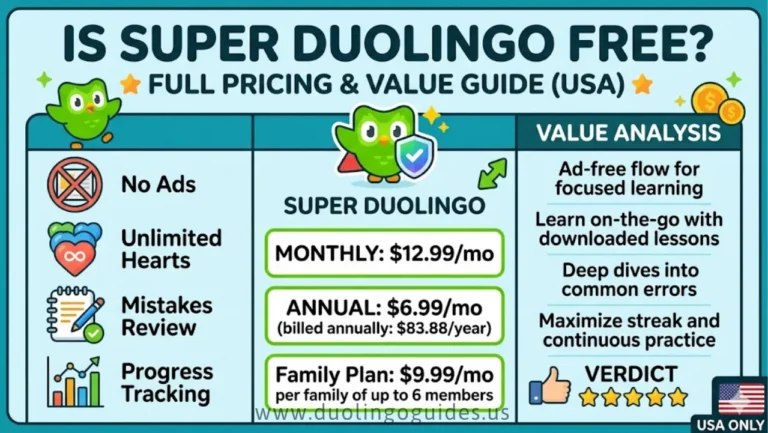
Super is designed to improve the standard experience with features such as:
- No advertisements
- Unlimited hearts or energy
- Unlimited Legendary attempts
- Unlimited timed challenges
- Personalized practice
- Practice Hub access
- Monthly streak repair
- Offline learning
Duolingo Max goes further by adding AI-powered features, including Explain My Answer and AI conversation or roleplay features.
The official Duolingo material describes the relationship clearly: subscribers help keep the courses available to everyone.
That is an important part of understanding why Duolingo can maintain a free tier.
Duolingo Max Creates Another Revenue Stream
Duolingo Max is the higher-priced subscription tier and gives Duolingo another way to monetize users who want more advanced features.
The competitor research says Max launched in 2023 and initially used OpenAI GPT-4 for AI-powered learning features.
Earlier pricing cited by the competitors was:
- $30 per month
- $168 per year
One 2024 source said Max was initially available on iOS for learners studying French and Spanish.
The more recent 2026 competitor research places Max at approximately $29.99 per month, showing that the product remains positioned as a premium offering.
The purpose of Max is therefore different from the purpose of the free tier. Free Duolingo attracts and retains a huge audience, while Max gives highly engaged users an opportunity to pay for more advanced functionality.
How Much Does Super Duolingo Cost?
Pricing has changed over time and can vary by plan and region, but the competitor research gives several useful reference points.
Older sources cited $6.99 per month and $119.99 per year for Super.
The 2026 competitor research gives approximately:
- $12.99/month for Super
- $84–$96/year for Super annual pricing
- $119.99/year for the Family Plan
- Up to 6 users on the Family Plan
Because Duolingo pricing can change, users should treat older prices as historical rather than assuming they represent today’s exact checkout price.
The key point is that Super converts some free users into paying customers, creating revenue that supports the wider platform.
The Free Version Has Limits
Calling Duolingo free is accurate, but the current experience is not completely unrestricted.
This becomes especially important with the transition from the old Hearts system to the newer Energy system.
Previously, free users commonly had 5 hearts. A wrong answer could cost one heart, and hearts could regenerate over time.
The newer Energy system changes how free practice is limited.
According to the 2026 competitor research, the Energy system began rolling out on mobile in mid-2025. Free users commonly start with around 25 energy units, and an exercise can consume 1 energy unit, even when the answer is correct.
One source estimates that ordinary free users may get approximately 2–3 lessons before needing to wait for more energy, representing roughly 15–20 minutes of typical practice.
Another analysis estimated a free session at around 20–25 minutes.
The exact experience can vary, but the broader point is consistent: free access exists, but extended practice can be restricted.
How Does Energy Make the Free Model Work?
The Energy system gives Duolingo another way to balance free access with monetization.
The competitor analysis reports:
- Starting energy: 25 units
- Energy cost: approximately 1 unit per exercise
- Energy recharge: 1 unit per hour
- Row boosts can restore around 1–5 energy units
- Ads can provide around 1–5 energy units
- Ads may last around 5–30 seconds
This means a free learner can sometimes watch an advertisement or use other in-app mechanisms to continue learning rather than immediately purchasing a subscription.
For Duolingo, that creates another connection between free usage, advertising, and paid upgrades.
Why Doesn’t Duolingo Simply Charge Everyone?
Duolingo’s enormous user base is one of the biggest reasons a free model makes sense.
The sources reviewed mention:
- 500+ million registered users
- 570+ million users cited for 2023
- 30+ million monthly users
- 500+ million app downloads
- 40+ languages
- Nearly 40 distinct languages
- 98 courses cited in one source
A mandatory subscription would create a much larger barrier to entry.
Instead, Duolingo can attract people who would never pay for a traditional language course. Some remain free users, some watch advertisements, and some eventually upgrade.
This creates a much larger potential audience than a subscription-only product might have.
Duolingo Also Makes Money From Language Tests
Duolingo’s business extends beyond its language-learning app.
The Duolingo English Test provides another source of revenue because users pay to take the proficiency examination.
This is strategically useful because the company can serve learners at different stages:
A person may begin with free language lessons, become a regular user, upgrade to a paid subscription, and potentially encounter other Duolingo products such as its language proficiency testing service.
That gives Duolingo multiple ways to generate revenue from its broader education ecosystem.
Business Partnerships Add Another Revenue Source
Duolingo has also been associated with corporate and B2B partnerships.
These partnerships provide another potential source of business value beyond individual learners.
Instead of relying entirely on individual subscription payments, Duolingo can participate in commercial relationships where organizations use or support its products.
This helps explain why the company’s business model is broader than simply putting language lessons behind a paywall.
Duolingo’s Huge Scale Makes the Model Possible
The numbers reported by the competitors show just how large Duolingo became.
One source cites $531 million in 2023 revenue, representing a 44% year-over-year increase.
Another figure cited is $120.2 million in Q2 bookings revenue, with a 35% increase.
The same research mentions a valuation of approximately $2.4 billion and total funding of around $183 million.
These numbers demonstrate an important point:
Duolingo does not need every learner to pay.
Its business can work by combining a massive free audience with several monetization channels.
Duolingo Has Also Worked to Reduce Its Technology Costs
Another interesting part of the business model is technology efficiency.
The competitor research mentions Duolingo’s use of Amazon Web Services (AWS) and 100+ microservices.
It also reports:
- More than 60% compute-cost reduction in one quarter
- Around 25% cost reduction through Spotinst
Reducing infrastructure costs matters because serving hundreds of millions of users can be expensive.
If Duolingo can make its technology more efficient while growing its audience, more of its revenue can support product development, marketing, operations, and expansion.
Is the Free Version Really Free in 2026?
Yes—but with limitations.
This is where the answer becomes more nuanced.
The free version still provides access to language courses and core learning activities. You do not need a subscription simply to begin learning.
However, free users may encounter:
- Advertisements
- Energy limitations
- Restricted advanced features
- Limited access to some AI features
- Fewer opportunities for extended uninterrupted practice
The 2026 competitor research describes the free tier as particularly suitable for:
- Building a daily learning habit
- Maintaining a streak
- Participating in leagues
- Enjoying gamification
- Trying a language before paying
- Supplementing another learning method
The limitations become more noticeable when users want longer sessions, advanced grammar help, speaking feedback, or open-ended conversation practice.
What Does Super Duolingo Give You?
Super is essentially the option for users who like Duolingo but want fewer restrictions.
Depending on the current plan and platform, the main advantages described by the competitors include:
- No ads
- Unlimited hearts or Energy
- Unlimited Legendary attempts
- Unlimited timed challenges
- Personalized practice
- Practice Hub
- Monthly streak repair
- Offline lessons
This creates a clear value proposition.
The free version lets you learn without paying, while Super makes the experience less restricted and more convenient.
What Does Duolingo Max Add?
Max is positioned above Super.
Its main differentiator is AI-powered learning.
The competitor research highlights features such as:
- Explain My Answer
- AI conversation practice
- Roleplay
- Additional AI-powered interactions
Earlier versions of the product used GPT-4.
Therefore, Max is not simply “Duolingo without ads.” It is designed to offer a more advanced learning experience through AI features.
Is Duolingo Free Forever?
One competitor cites Duolingo’s messaging that the platform would remain free forever.
The important interpretation is that “free” refers to continued access to the core learning service, not that every Duolingo feature will always be available without restrictions.
The company’s model depends on maintaining a balance:
Free access → large audience → advertising and engagement → paid upgrades → revenue → continued free access.
As long as that model remains commercially sustainable, Duolingo has a strong incentive to keep a free tier available.
Can You Become Fluent With Free Duolingo?
This is a separate question from whether Duolingo is free.
The competitors consistently raise an important limitation: free Duolingo alone may not be enough for full conversational fluency.
Duolingo can help build:
- Vocabulary
- Basic grammar familiarity
- Recognition skills
- Study habits
- Consistency
- Foundational language knowledge
However, conversational ability requires more than recognizing answers or translating short sentences.
One critical analysis argues that Duolingo can place too much emphasis on recognition, translation, scaffolding, and engagement, while providing less opportunity for spontaneous recall, contextual use, and real conversation.
Another source specifically argues that even a very long streak does not automatically mean conversational fluency.
This is why a learner may benefit from combining Duolingo with speaking practice, listening activities, writing, and real-world interaction.
Why Is Duolingo Free? The Simple Answer
Duolingo is free because its business model does not require every learner to pay.
Instead, the company combines several revenue sources.
1. Advertising
Free users see ads, generating advertising revenue.
2. Super Duolingo
Some users pay for an ad-free experience and additional features.
3. Duolingo Max
Users who want advanced AI-powered features can pay for the premium Max tier.
4. Language Testing
The Duolingo English Test creates revenue through paid proficiency testing.
5. Partnerships
Corporate and B2B relationships provide another commercial opportunity.
6. Large-Scale User Growth
A huge free audience increases the potential number of users who eventually generate revenue.
7. Cost Efficiency
Technology and infrastructure optimization can help Duolingo serve a massive audience more efficiently.
So, Is Free Duolingo Worth Using?
For many learners, yes.
The free version gives you access to a surprisingly large amount of educational content without requiring a subscription. You can build a streak, complete lessons, participate in leagues, explore courses, and develop foundational language skills.
The main trade-off is convenience and access to advanced features.
If you are comfortable with advertisements and shorter practice sessions, free Duolingo can be enough to build a consistent learning habit.
If you want unlimited practice, fewer interruptions, advanced review tools, or AI-powered features, a paid plan may make more sense.
Final Answer: Why Is Duolingo Free?
Duolingo is free because free users are part of its business model, not outside of it.
The company attracts a massive audience with free language courses, then monetizes that audience through advertising, Super subscriptions, Duolingo Max, language testing, partnerships, and other activities.
The numbers show why this strategy can work: the sources reviewed cite 500+ million registered users, 40+ languages, 30+ million monthly users, $531 million in 2023 revenue, and a 44% year-over-year increase.
So, when you use Duolingo for free, you are not using a product that has no business model behind it. You are using the free tier of a large freemium education platform.
That is the real reason Duolingo can say you don’t have to pay to learn while still operating as a profitable business.

I’m a website professional with 5 years of experience in building, managing, and growing online content platforms. As the creator of DuolingoGuides.us, I focus on providing helpful, easy-to-understand guides and resources for Duolingo users and language learners. My goal is to make information simple, accurate, and accessible for everyone.