Duolingo Tips And Tricks: 15 Smart Hacks To Learn Faster
Duolingo Tips And Tricks That Actually Work
Duolingo is one of the most popular language-learning apps in the United States, with millions of Americans using it to study Spanish, French, German, and English.
Yet many USA learners still struggle to see real progress because they focus on streaks and XP instead of deep learning.
This guide gives you 15 smart Duolingo hacks, a 7-day plan, and clear advice so you can raise your level faster and avoid common mistakes.
Why Most Duolingo Users Fail
A lot of US learners open Duolingo every day but don’t feel fluent enough for real conversations.
Here’s why most American users fail:
- They treat Duolingo like a game, not a study tool—chasing streaks and XP instead of accuracy.
- They never fix mistakes properly, so the same errors repeat over and over.
- They don’t combine Duolingo with real-life practice (talking, watching TV, reading), which limits real-world fluency.
- Many students skip explanations, stories, and tips and just rush through lessons.
- People often practice for 5–10 minutes per day, which is better than nothing but not enough for serious progress in the US college or job-market context.
If you recognize yourself in these points, the 15 Duolingo hacks below are designed to reverse each weakness.
15 Smart Duolingo Hacks For USA Learners
Hack #1 – Fix Your Mistakes Properly
Every time you get something wrong, do not just tap “Next” and move on.
Here’s what top US learners do:
- Read the tip or explanation before the lesson or after your mistake. Many courses give short grammar notes you can use as mini-lessons.
- Write down 3–5 wrong sentences in a notebook or note app, then retranslate them correctly. This builds long-term memory.
- Review mistakes the next day using the Practice Hub or “Practice” circles to reinforce weak spots.
Treating mistakes as free mini-lessons instead of “annoying failures” is one of the biggest mindset shifts in the US language-learning community right now.
Hack #2 – Use “Active Recall” On Every Lesson
Active recall means trying to produce the answer yourself before checking it.
On Duolingo, that looks like:
- For listen-and-type or speak exercises, pause and try to say or write the full sentence from memory.
- For reading or translation exercises, cover the answer and say it out loud or write it first, then compare.
This method is widely used in US study-skill communities because it strengthens recall far better than passive “just repeating what you see.”
Hack #3 – Stop Relying On Streaks
Chasing a streak is fun, but it can hurt progress if you start skipping steps just to keep it alive.
Here’s how American learners make streaks work for them:
- Keep your streak only if you complete a real session (10–20 minutes, not just 30 seconds).
- If you travel or get busy, use offline lessons or a short practice session instead of tiny “cheat” lessons.
- If you break a streak, reset your mindset: “This is a new phase of learning,” not a failure.
This approach keeps the gamification helpful instead of harmful for US-based learners.
Hack #4 – Combine With Real-Life Practice
Duolingo is strong for vocabulary and grammar, but real-life exposure makes you sound natural.
Here’s what US teachers recommend:
- Watch short videos or shows in your target language (with subtitles) 2–3 times per week.
- Change your phone or Netflix to your target language for 1–2 days a week to immerse yourself.
- Join language-exchange groups on Reddit, Discord, or local US communities to practice with real people.
- For English learners in the USA, try reading simple news articles or listening to American podcasts after each Duolingo session.
This combination is how many US international students go from “classroom level” to real-world fluency.
Hack #5 – Use Stories Feature Smartly
The Stories feature trains reading, listening, and vocabulary in a natural way.
To use it like a USA-style study hack:
- First read or listen without notes to test comprehension.
- Then replay the story and write down 5 new words or phrases with English meanings.
- A few days later, try to retell the story in your own words (even in English at first) to practice memory.
This “read-→ note-→ retell” method is similar to how US classrooms teach reading-comprehension skills.
Hack #6 – Limit Daily Practice Time (But Be Consistent)
Americans often burn out by trying to do “too much” in one day.
A better strategy is:
- 15–25 minutes per day of focused Duolingo practice beats 1 hour once a week.
- Use short breaks between lessons (walk, stretch, drink water) to keep your brain fresh.
- If you want to practice more, split your time: some Duolingo + some real-life practice (reading, listening, writing).
This balanced approach fits well with US high-school and college schedules, where time is tight.
Hack #7 – Use Hard Practice And Practice Hub
If you want to really master a skill, don’t just finish the lesson once.
Try this:
- After completing a new skill, go back later and do “Practice” or “Hard Practice” on that circle.
- The Hard Practice mode often gives more XP and tougher questions, forcing you to think deeper.
- Use the Practice Hub to target weak grammar points or vocabulary (like past tense, articles, or prepositions).
This “learn → practice → hard-practice” loop is how many US learners turn Duolingo into real-skill practice instead of just a game.
Hack #8 – Speak Out Loud (Even If You’re Shy)
Speaking is the hardest skill for many US learners, yet it’s critical for real-world use.
How to use Duolingo’s speech recognition smartly:
- For speak-to-the-mic exercises, say the sentence clearly and naturally, not just robot-like.
- If you’re shy, do the first 1–2 tries silently, then force yourself to speak out loud on later attempts.
- Repeat the same sentence 3–5 times to build mouth-muscle memory and confidence.
This “repeat-out-loud” habit is recommended by many US language-learning coaches to improve pronunciation and fluency.
Hack #9 – Use Timed Practice For Real-Life Speed
Timed Practice pushes you to respond quickly, like in real conversations.
Use it like this:
- Do 1–2 timed sessions per week after you’ve learned the vocabulary.
- Focus on accuracy first, then speed later. Don’t rush if you’re still mixing up grammar.
- After timed practice, review mistakes slowly to see which words or structures tripped you up.
This is how many US learners simulate fast-paced speaking situations (ordering food, asking directions, classroom Q&A).
Hack #10 – Mix Learning Styles (Reading, Writing, Listening, Speaking)
Top US teachers recommend balancing all four skills instead of focusing only on one.
Here’s a simple pattern:
- One day: Focus on reading and listening (Stories, timed practice, review).
- Next day: Focus on writing and speaking (typing full sentences, speaking aloud, recording yourself).
This rotation helps you grow evenly and match the US-style “balanced-skill” approach used in many language-test preparations.
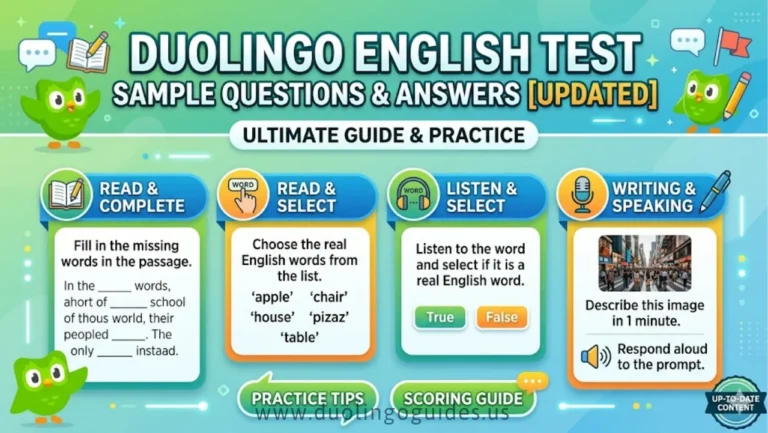
Hack #11 – Use Duolingo For English (DET Practice)
For non-native English speakers in the USA, Duolingo’s English course can help with the Duolingo English Test (DET).
Key tips:
- Practice reading, listening, and writing tasks regularly to build the skills needed for the test.
- Use timed and speaking exercises to get used to short, clear answers like “Read Aloud” and “Speak About the Photo.”
- Simulate real-test conditions (quiet room, no distractions) once a week to reduce anxiety.
This made-for-DET mindset is growing fast among US international students and test-takers in 2026.
Hack #12 – Track Your Progress With Goals
Instead of only chasing XP, set real learning goals.
Try goals like:
- “Learn 10 new words per day and use them in sentences.”
- “Finish 2 new skills this week and review 3 old ones.”
This goal-based approach fits well with how US schools and colleges teach productive study habits.
Hack #13 – Limit Distractions (Especially For US Teens)
Many US teens use Duolingo while multitasking (TikTok, music, texting), which reduces learning.
Better habits:
- Close other apps and put your phone on “Do Not Disturb” for 10–15 minutes.
- Use headphones for listening and speaking exercises to focus on pronunciation.
- If possible, do Duolingo in a quiet corner of your room or study space.
This “focused-mode” learning is encouraged by many US educators for better retention.
Hack #14 – Rotate Languages Carefully
Some US learners try too many languages at once (Spanish, French, German, Korean), which slows progress.
A smarter strategy:
- Pick one main language to focus on for 3–6 months.
- If you want to study a second one, keep it light (10 minutes a few days a week).
This “one-focus-language” method is common among US college students preparing for study-abroad programs.
Hack #15 – Use Super Only If You Need It (USA Buyers)
Duolingo Super offers extra features, but it’s not magic.
Here’s how many US users decide:
- Free users get strong core lessons, Stories, and some practice tools.
- Super users gain benefits like offline lessons, progress-tracking quizzes, and ad-free practice, which can help if you’re busy or on the go.
If you’re in the USA and on a budget, many learners say start free, then consider Super only if you need offline practice or extra insights.
Duolingo Free vs Super (USA Users)
Here’s a quick comparison for American learners in 2026:
| Feature | Duolingo Free (USA) | Duolingo Super (USA) |
| Core lessons & Stories | Available in full. | Same core content, plus extra practice. |
| Ads | Users see occasional ads between lessons. | Ad-free experience. |
| Offline lessons | Limited or none. | Can download lessons and practice without Wi-Fi. |
| Practice tools | Basic practice per skill. | Extra progress quizzes and practice features. |
| Price | Free download and basic use. | Monthly/yearly subscription (discounts often for students). |
For most USA learners, Free works well if you’re consistent and use the 15 hacks above.
Super shines if you travel a lot, use public transport, or want extra practice analytics.
H2: 7-Day Fast Learning Plan (USA)
This 7-day plan is designed for US learners who want real progress without burnout. Use it with your normal Duolingo routine.
Day 1 – Diagnostic & Setup
- Do 10–15 minutes of Duolingo lessons to see your current level.
- Write down 3 weak points (e.g., verbs, prepositions, speaking).
- Plan 15 minutes daily for week 1.
Day 2 – Active Recall Day
- Do reading and translation exercises using active recall (try from memory first).
- Write down 5 new words or phrases.
Day 3 – Hard Practice Day
- Review 2–3 old skills using Hard Practice or Practice Hub.
- Focus on mistakes, not speed.
Day 4 – Speaking & Listening Day
- Do all speaking and listening exercises out loud.
- Add 10 minutes of real-life listening (YouTube, podcast).
Day 5 – Stories & Writing Day
- Finish 1–2 Duolingo Stories and note new vocabulary.
- Write 3–5 sentences using those new words.
Day 6 – Timed Practice Day
- Do 1–2 timed practices on a topic you’ve already learned.
- After each session, review mistakes and patterns.