Duolingo Diamond Tournament: Rules, XP Tips & Timing

The Duolingo Diamond Tournament is a competitive event for learners who have reached the top of the league system. Instead of the usual one-week leaderboard, it stretches the competition across several weeks and asks you to keep earning XP at a high level the whole time. If you enjoy leaderboards and friendly rivalry, this is the most demanding challenge the app offers.
The tournament was first introduced in November 2021. Duolingo later removed it after a few months and then brought it back, and it still does not run every single week. Because of that history, you should treat it as an event that appears on Duolingo’s schedule rather than a permanent feature. If you cannot see it in your app today, that does not mean you did something wrong. It may simply not be active for your account at the moment.
How You Qualify for the Tournament
Before you can think about the tournament, you need to climb through Duolingo’s 10 leagues: Bronze, Silver, Gold, Sapphire, Ruby, Emerald, Amethyst, Pearl, Obsidian, and finally Diamond. Each week you earn XP against other learners in your group, and finishing high enough moves you up.
Once you are in the Diamond League, qualification depends on how you finish during an eligible week. Most guides describe the requirement as a Top 10 finish in your Diamond group, and that is the figure you will see repeated most often. A smaller number of sources claim only the Top 3 are promoted. These two claims cannot both be right for the same event, and Duolingo can change its rules between seasons. The sensible approach is to aim for the top of your group regardless. If you finish first, you are safe under either version of the rule, and you can confirm the exact cutoff in the app when the tournament banner appears.
A typical Diamond League group has about 30 learners. The top ten places can qualify for the tournament, while the bottom five are demoted to the Obsidian League. That means a weak week costs you more than just a missed opportunity, so steady XP matters even when no tournament is running.
How the Three Stages Work
The tournament runs for 3 weeks in total, with one stage per week. The first week is the Quarterfinals, the second is the Semifinals, and the third is the Finals. In the early stages your job is simply to finish high enough to move on. Sources generally agree that the top 10 advance from each round, which means you do not have to win every week. You only have to avoid slipping out of the advancing positions. In the Finals, the learner with the highest XP wins.
One detail that often confuses people is the number of participants. You may see a figure of 15 players attached to the tournament itself, while the regular Diamond League group has 30. These numbers describe different things. The league group is your weekly pool, and the tournament field is the smaller set of qualifiers who move into the event. Keeping those two ideas separate will save you a lot of confusion when you read about the format.
Understanding XP: Where the Points Come From
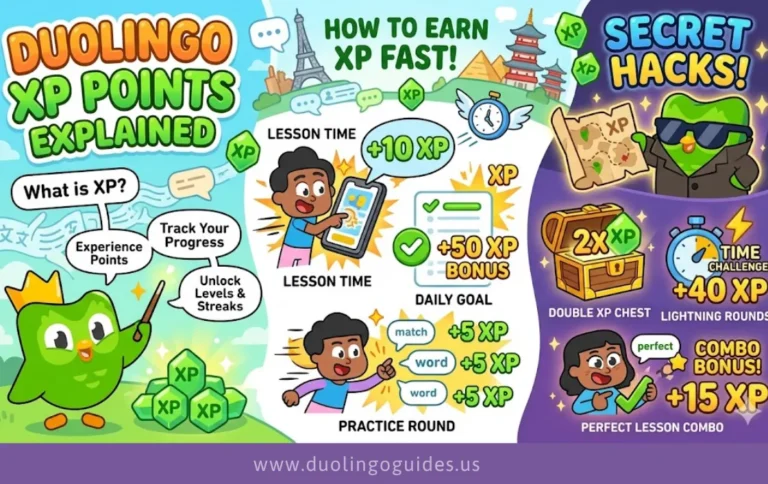
Everything in the tournament comes down to XP, so it helps to know what each activity is worth. A regular lesson earns around 10 XP, which is fine for building a habit but too slow for serious competition. Timed challenges are far more efficient, typically paying 40 to 50 XP each, and in some cases up to 100 XP. Legendary Levels are also strong earners at roughly 40 to 80 XP, and a perfect Legendary lesson completed during an XP boost can exceed 100 XP.
The lesson here is simple: when you only have a few minutes, choose the activity with the highest return. Spending your boosted time on ordinary 10 XP lessons is the most common way learners waste an opportunity. Challenges such as Match Madness, Lightning Round, and Ramp Up reward speed and accuracy, which makes them ideal for stretches of double XP.
Setting Daily XP Targets That Make Sense
Your target should depend on your goal. If you are simply building a language habit, a modest goal of about 50 XP per day is realistic, and a 200 XP day can feel like a satisfying milestone. Practice time that works for most people is 10 to 20 minutes for beginners, around 30 minutes for intermediate learners, and 45 to 60 minutes for advanced learners who want to stay competitive.
Competing for a tournament spot is a different story. Learners who hold the top places in Diamond often aim for 500 to 1,000 XP per day, and some weekly totals pass 20,000 XP. These are extreme examples, not requirements, and you should not feel pressured to match them. Think of them as the ceiling of what dedicated competitors do, and pick a target that fits your schedule. A consistent 45 minutes a day will usually serve you better than one exhausting weekend followed by burnout.
Using Double XP Boosts the Smart Way
The biggest efficiency gain comes from double XP boosts. A boost multiplies your earnings by 2x for a short window, so the value depends entirely on what you do while it is running. Start the boost only when you are ready to play challenges back to back, and avoid activating it at random while you are distracted or about to get interrupted.
Early Bird and Night Owl Chests
Two daily rewards are worth building into your routine. The Early Bird Chest appears when you complete a lesson between 6 AM and 12 PM, and it gives a 15-minute XP boost you can use later that evening. The Night Owl Chest works in the opposite direction. Finish a lesson between 6 PM and 12 AM, and you unlock a boost for the next morning. These windows are what players report, and they may vary by app version or account, so check your own chest screen to confirm.
Stacking Boosts for Longer Sessions
Boosts can be combined to create a longer stretch of double XP. For example, the third daily quest usually rewards a Gold Chest with a 15-minute boost. If you activate your Early Bird boost and then claim the Gold Chest while it is running, the timer can extend to roughly 30 minutes. Stacking behavior may differ depending on your app version, so test it once and watch the timer before relying on it during an important week.
Friends Quest Rewards
Friends Quest rewards are another useful source of boosts, usually worth 15 to 30 minutes of double XP. The key detail is that the timer starts when you claim the reward, not when you finish the quest. Leave the reward unclaimed until you have a clear block of free time, then use it for challenges rather than basic lessons. Happy Hour events offer a similar double XP opportunity, though the exact timing is not fixed, so keep an eye on your notifications.
Timing Your Week for a Better Leaderboard Position
Timing can matter almost as much as effort. New league weeks begin on Monday, and highly active players often start collecting XP right away. Some learners therefore delay their first session until Monday evening or Tuesday, using a Streak Freeze if needed, in the hope of being placed in a less competitive group. This is a community-tested tactic, not a guaranteed result, because Duolingo does not publish exactly how groups are formed. If your streak is important to you, weigh that risk before trying it.
Weekends are a better place to concentrate extra effort. Saturday and Sunday are good days for long, high-XP sessions because you can plan them around chests, quests, and Happy Hour. It also helps to open the first day of a new week with a strong session, since an early lead puts pressure on everyone else in your group.
Gems and Rewards
Gems are worth managing carefully during tournament weeks. You can earn them through daily and weekly challenges, Friend Quests, XP milestones, and streaks. The best use is spending them on Double XP boosts and perfect-lesson bonuses, because those directly raise your score. Rewards for finishing well include a tournament badge, XP boosts, and recognition among other learners. Winners may receive extra perks, but the details can change, so treat any specific prize as subject to Duolingo’s current offer.
A Simple Plan for Your Tournament Weeks
Begin by confirming that you are in the Diamond League and that the tournament is active for you. Then pick a daily XP number you can actually sustain, and schedule one or two high-value sessions per day rather than many small ones. Complete a lesson in the morning window to earn the Early Bird boost, save quest and Friends Quest rewards for a planned block of time, and spend that block on timed challenges and Legendary Levels. Use gems for boosts when the stakes are highest, usually in the later rounds. Finally, rest. Language learning is a long game, and a tournament is only a few weeks of it.
FAQs
Is the Duolingo Diamond Tournament available to everyone?
No. You need to reach the Diamond League first, and the tournament itself does not run continuously. It has been removed and brought back before, so availability can differ between users and over time. If you do not see it, keep competing in your league and check again in a later week.
How many places qualify for the tournament?
Most guides say the top 10 in your Diamond group qualify, while a few say only the top 3. Because the rule is not consistent across sources and Duolingo may adjust it, aim for the highest rank you can. The in-app banner is your final reference.
How long does the tournament last?
It lasts three weeks, with one week each for the Quarterfinals, Semifinals, and Finals. You need to stay among the advancing players in the first two rounds, and the Finals are decided by total XP.
What is the fastest way to earn XP?
Use a double XP boost and spend it on high-reward activities such as timed challenges and Legendary Levels. These pay far more per minute than regular lessons, which give about 10 XP each.
Do I need to earn 1,000 XP every day?
No. That figure describes what top competitors sometimes aim for. A smaller daily goal that you can keep up all week is more realistic for most learners, and consistency usually beats occasional bursts.
Is it worth delaying my first lesson on Monday?
It might help, but nothing guarantees it. Delaying could place you in a quieter group, yet you risk breaking your streak if you are careless. Try it only if you are comfortable with that trade-off.
Can I rely on the chest timings and boost lengths?
Use them as a starting point. The 6 AM to 12 PM and 6 PM to 12 AM windows and the 15-minute boosts are widely reported, but Duolingo updates its app often. Always confirm what you see on your own screen.

I’m a website professional with 5 years of experience in building, managing, and growing online content platforms. As the creator of DuolingoGuides.us, I focus on providing helpful, easy-to-understand guides and resources for Duolingo users and language learners. My goal is to make information simple, accurate, and accessible for everyone.