Duolingo Crown Levels Explained: How the Progress System Works & How to Level Up Faster
If you’ve stared at your Duolingo path for a few weeks, you’ve probably wondered: “Why is my Crown Level barely moving?” For many learners in the United States using English as both native and target language (for example, Spanish-to-English courses), the Crown Level system feels confusing, slow, or even misleading.
This guide breaks down the hidden logic behind Duolingo Crown Levels, explains how they relate to XP and skill strength, and gives you a fast-track strategy that actually moves your progress bar instead of spinning your wheels on the same lessons over and over.
Introduction
Duolingo’s gamified design works great for daily motivation, but it hides the real mechanics behind Crown Levels, which is why many users feel stuck at the same level for days. In the U.S. user base, where learners often study Spanish, French, or German with English as the base, the mismatch between perceived fluency and actual Crown growth becomes especially frustrating.
By the end of this article, you’ll know:
- What Crown Levels actually measure.
- Why your level sometimes seems “frozen.”
- How to level up faster without burning out.
What Are Crown Levels in Duolingo?
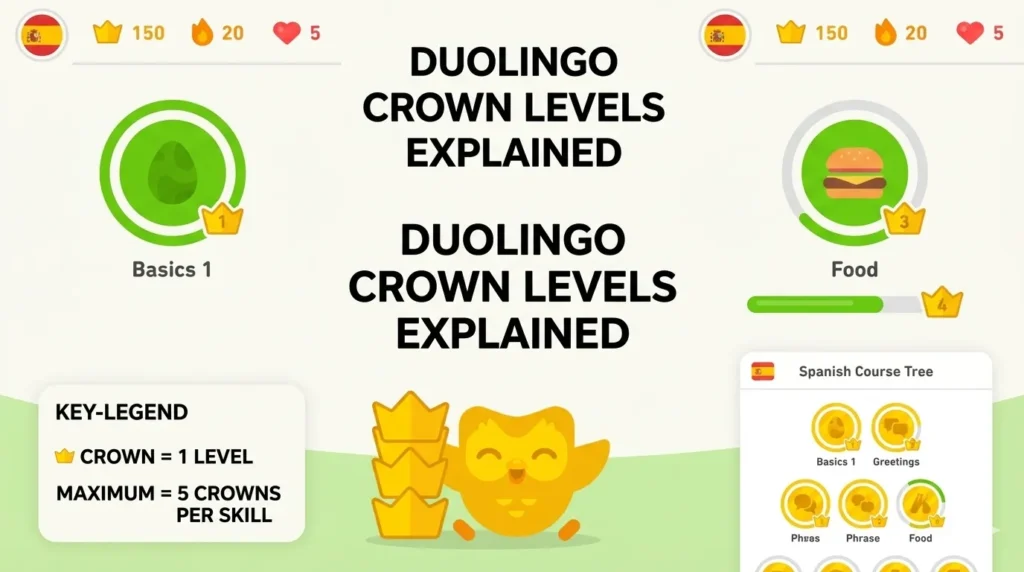
In simple terms, Crown Levels track how many times you’ve successfully completed a specific skill on your Duolingo path. Each skill (such as “Basics,” “Food,” or “Travel”) can be leveled up to five crowns, and reaching Level 5 means you have fully mastered that skill.
Think of it like a skill tree or progression ladder. Each crown represents a rung:
- Level 1: Introduction to the skill.
- Levels 2–4: Gradual increase in difficulty and repetition.
- Level 5: Mastery (skill turns gold).
For U.S. learners, this means you’re not just “learning vocabulary”; you’re repeatedly proving you can use that vocabulary in different exercise types, which aligns with spaced-repetition best practices common in language-learning research.
How Crown Levels Actually Work
Behind the fun animations, Crown Levels follow a hidden lesson-repetition system that many users never fully understand. To earn a new crown level in a skill, you must complete all the required lessons for that level with limited errors (usually no more than three mistakes in a single lesson).
Once you reach a given Crown Level, Duolingo uses spaced repetition to strengthen that skill over time. If you stop practicing, the skill may “decay” and drop back down a level, forcing you to re-earn a crown. This is why repetition is part of the system, not just busywork.
Key mechanics:
- Each skill has up to 5 crowns; some have fewer depending on the course.
- Higher crown levels require more lessons and more varied question types.
- Skill decay can cause you to lose a crown if you ignore the skill for too long.
Why Your Crown Level Is Not Increasing
If you’re an English-speaking user in the U.S. and your Crown Level seems stuck, it’s usually because of one of three traps:
1. Already mastered content
Once a skill hits Crown Level 5, you can’t earn more crowns in that specific skill. Many learners keep practicing the same mastered skills, expecting progress, but Duolingo is designed to push you toward new or weaker topics instead.
2. Practice mode confusion
Duolingo’s Practice / Stories / Listening Practice modes give XP but don’t always add new crowns for the same skill. Users think they’re “leveling up” when they’re mainly reinforcing already-known material.
3. Skill decay dragging you backward
If you skip a skill for days or weeks, Duolingo may reduce its crown. This resets your progress slightly and makes it feel like you’re not gaining levels, even if you’re actively learning elsewhere.
Crown Level vs XP vs Skill Strength
| Concept | What it measures | Impact on learning |
| Crown Level | Mastery of a specific skill (Levels 1–5 in each skill). | Shows depth of practice in that topic. |
| XP | Total points earned from all lessons, practices, and events. | Reflects activity, not mastery. |
| Skill strength | A hidden “strength meter” that goes up/down with practice and decay. | Affects how fast a skill drops or stays stable. |
Takeaway: You can have high XP but low crown growth if you’re only doing easy lessons. For real progress, focus on new crowns and strengthening weaker skills, not just racking up points.
Fastest Way to Increase Crown Levels
Here’s a fast-track strategy that most U.S. learners ignore:
1. Smart lesson targeting
- Open your Duolingo path and look for skills that are below Level 5.
- Prioritize skills that are only at Level 1 or 2, since they take fewer lessons to level up.
2. Focus on weak skills
- Use the Strength meter (if available via Duolingo Plus) to find struggling skills.
- Spending 10 minutes on these weak skills can boost crowns faster than 30 minutes on already-strong topics.
3. Avoid repetition traps
- Don’t keep redoing the same skills just to hit XP goals.
- If a skill is at Crown Level 5, move on to new units or weaker skills instead.
A simple daily rule: “One new skill to Level 5 per day” will noticeably speed up your overall crown count without extra time.
Common Mistakes That Slow Down Progress
Even in the U.S., where learners often have strong English skills and quick access to Duolingo, these mistakes are universal:
1. Over-practicing easy skills
Users love practicing what they already know, which feels comfortable but rarely adds new crowns. This creates the illusion of progress while the real skill distribution stays uneven.
2. Ignoring new units
New units often contain lower-level skills that jump you from Crown 1 → 5 quickly. Skipping them in favor of “advanced” topics slows your total crown growth.
3. Misusing practice features
- Timed practice and Stories are great for fluency, but they don’t always generate new crowns.
- Relying on them without completing new skill levels keeps your XP high and crown count low.
Correct habit: Use fun modes after you’ve earned at least one new crown that day.
Do Crown Levels Really Improve Fluency?
Here’s the uncomfortable truth: Crown Levels improve recall, consistency, and pattern recognition, but they don’t equal real-world fluency on their own.
For English learners in the U.S. (for example, Spanish speakers learning English), Crown Levels help by:
- Reinforcing vocabulary in context.
- Training your brain to recognize grammar patterns quickly.
- Encouraging daily practice habits, which is one of the biggest predictors of long-term success.
However, true fluency also requires:
- Real conversations with native speakers.
- Reading longer texts and listening to native-speed content.
- Writing and speaking without relying on hints or translations.
So: Crown Levels are a strong training tool, not a final fluency score.
Advanced Strategy (For Fast Learners)
Serious learners in the U.S. can use a combined XP + Crown strategy to maximize efficiency:
1. Combined XP + Crown strategy
- Do new skill lessons first thing to earn crowns.
- Then, use practice modes for the rest of your session to earn XP without blocking your progress.
2. Daily routine system (15–20 minutes plan)
- Minute 1–5: Complete lessons in a new or weak skill to push it one or two crown levels up.
- Minute 6–15: Do practice or Stories in that same skill to reinforce it.
- Minute 16–20: Review one near-Level-5 skill to keep it from decaying.
This routine keeps your crowns growing, your skill strength stable, and your XP high—without needing hours per day.
FAQs
Why did my Crown Level reset?
Duolingo may reduce a skill’s crown if you haven’t practiced it for a long time, via its skill decay system. This isn’t a glitch; it’s a reminder to keep your skills fresh.
Can I reach Crown Level 5 quickly?
Yes, especially in new skills that only need a few lessons per level. Focus on Level 1–4 skills instead of over-practicing Level 5 skills.
What are crown levels in Duolingo?
Crown Levels are Duolingo’s way of marking how many times you’ve successfully completed a skill (Up to five crowns per skill, with Level 5 = full mastery).
How high does Duolingo Russian score go?
In Russian and most courses, each skill still maxes out at Crown Level 5, turning gold when mastered. The overall course difficulty and vocabulary load increase, but the crown system stays the same.
Which Duolingo level is B2?
Duolingo does not map Crowns directly to CEFR levels (A1–C2), but reaching Level B2 typically requires completing most of the core path, earning many Level 5 skills, and supplementing with real-world practice.
Is a 2000-day Duolingo streak good?
A 2000-day streak is impressive and shows consistent daily practice, which is excellent for habit-building. However, streaks don’t guarantee fluency—quality of practice and exposure matter more.
Are Crown Levels necessary for fluency?
Crown Levels help build vocabulary and grammar habits, but they’re not strictly “necessary” for fluency. Many learners reach high fluency with minimal crown-chasing by combining Duolingo with real-life usage.
What is the highest Crown Level?
The highest Crown Level per skill is Level 5 (gold). Across the whole course, your total progress is reflected in how many skills you’ve pushed to Level 5, not in a single “overall crown” number.
Conclusion
Duolingo Crown Levels are a powerful, often misunderstood system that rewards deep practice over superficial repetition. For U.S. learners using English as either native or target language, understanding the hidden logic of skill repetition, decay, and XP can transform a frustrating experience into a clear, fast-track path.
By focusing on new skills, weak skills, and a smart 15–20-minute routine, you can level up faster, keep your crown count rising, and build real-world language habits that go far beyond the app.
If you track just one metric beyond your streak, make it your Crown Levels—they’re the closest thing Duolingo has to a real-progress dashboard.

I’m a website professional with 5 years of experience in building, managing, and growing online content platforms. As the creator of DuolingoGuides.us, I focus on providing helpful, easy-to-understand guides and resources for Duolingo users and language learners. My goal is to make information simple, accurate, and accessible for everyone.