Duolingo Language Report : The Most Popular Languages
Meta Description: Explore the Duolingo Language Report 2025, including the top 10 most popular languages, English’s global dominance, the rise of Japanese and Korean, historical trends from 2020–2025, and key insights from learners around the world.
The Duolingo Language Report 2025 offers a clear picture of how language learning is changing around the world. Based on 12 months from October 1, 2024, to September 30, 2025, the report highlights which languages people are learning, where learning trends are changing, and which countries show the strongest interest in multilingual education.
The data goes beyond a simple list of popular languages. It shows the continuing global strength of English, the growing interest in Japanese and Korean, and how language rankings have changed since 2020. The report also provides useful insights into polyglot learners, highly active learners, and Duolingo English Test participants from around the world.
Duolingo Language Report 2025 at a Glance
The 2025 report analyzes global language-learning activity across Duolingo’s platform over a period of 12 months.
Some of the most important numbers include:
- 10 languages make up the main global ranking.
- English is the most popular language in 154 countries.
- English increased by 14% compared with the previous report.
- Japanese ranks 4th globally.
- Korean ranks 6th globally.
- Japanese and Korean became available through more than 20 additional source languages.
- The Duolingo English Test included participants from 219 countries.
- Test participants represented 148 different first languages.
- Asia accounted for 55% of all test sessions.
- Africa’s share increased from 7% to 8.3%.
- Countries generally needed at least 5,000 Duolingo learners to be included in the country-level analysis.
- Learners under the age of 13 were excluded from the analysis.
These figures help explain not only which languages are popular, but also how widely language learning is distributed across the world.
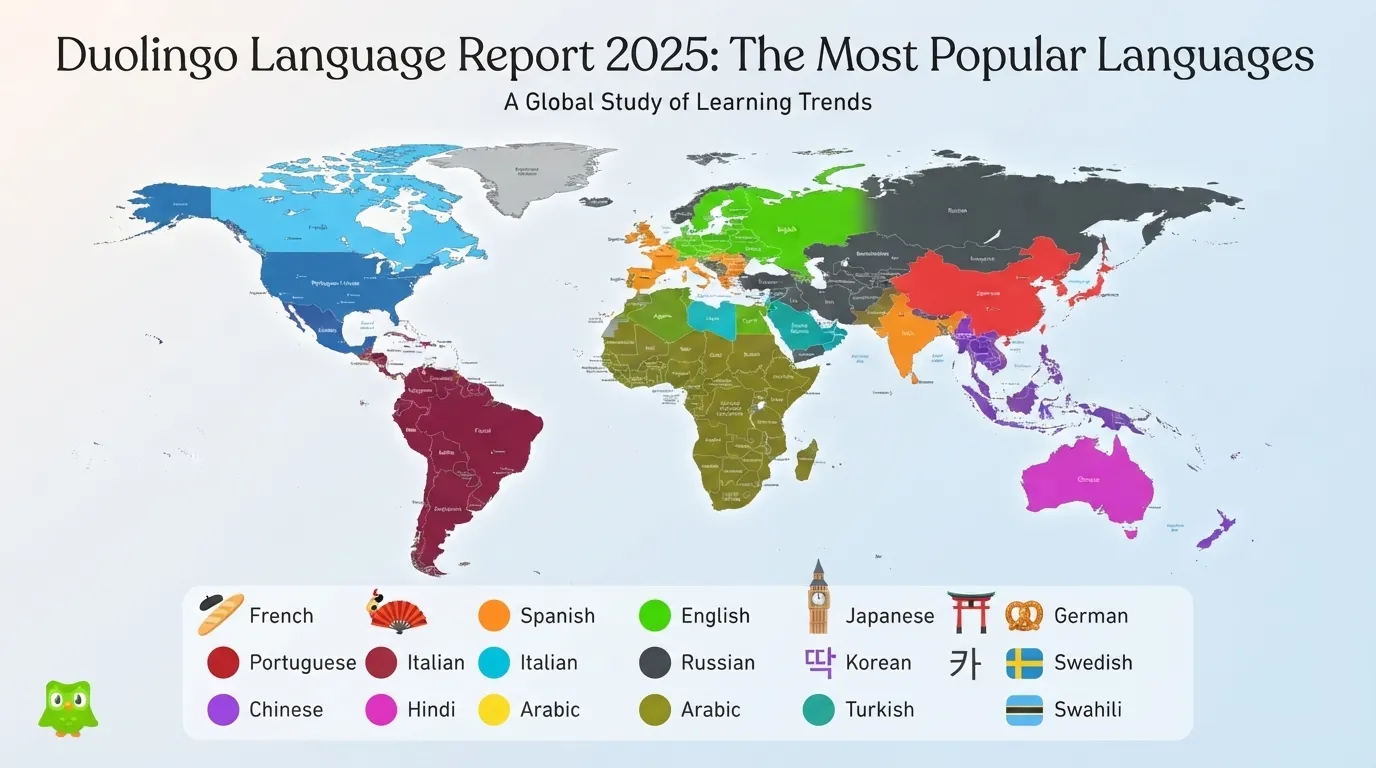
The Top 10 Most Popular Languages in 2025
The global ranking includes a mixture of international, regional, cultural, and career-focused languages.
The top 10 are:
- English
- Spanish
- French
- Japanese
- German
- Korean
- Italian
- Chinese
- Portuguese
- Hindi
English, Spanish, and French continue to occupy the leading positions. However, the presence of Japanese in 4th place and Korean in 6th place shows that global learning interests are becoming more diverse.
English Remains the World’s Leading Learning Language
English continues to dominate global language learning.
In the 2025 report, English was the number-one language in 154 countries. This was a major increase from 135 countries in 2024.
The number of learners studying English also grew by 14%.
Only 25 countries did not place English within their top two most popular languages.
This long-term pattern is easy to understand. English is widely connected with international communication, education, travel, technology, entertainment, and career opportunities. As a result, it remains relevant across regions with very different native languages.
The historical data also shows how strong this trend has become. English has remained one of the dominant learning languages throughout the annual reporting period that began in 2020.
Japanese Reaches 4th Place Worldwide
Japanese holds the 4th position in the 2025 global ranking.
Its strong position reflects growing international interest in Japanese culture and entertainment, as well as travel and personal learning goals. Another important factor is accessibility.
Japanese and Korean became available to learners through more than 20 additional source languages. This allows more people to begin learning without first needing to study through English.
Making courses available from more starting languages can significantly expand the number of potential learners. This helps explain why global rankings can change even when interest in a language is already strong.
Korean Holds 6th Place
Korean ranks 6th among the world’s most popular languages on Duolingo.
Its rise is particularly important when viewed historically. Korean first reached 6th place in 2023 and has continued to maintain a strong global position.
The language was also identified as the second-fastest-growing language in seven countries.
This suggests that Korean is not simply attracting learners in one region. Its growth is spread across multiple countries and continues to show international demand.
English, Spanish, and French Continue to Lead
Although Japanese and Korean are gaining attention, the three largest languages in the ranking remain English, Spanish, and French.
These languages benefit from broad international use and strong educational demand.
Spanish is widely useful across multiple continents, while French remains important in Europe, Africa, Canada, and international organizations.
Together, the leading languages show two major patterns in global learning.
First, learners continue to choose languages that provide practical international opportunities.
Second, more learners are also choosing languages because of cultural interest, entertainment, travel, and personal connection.
The 2025 ranking reflects both trends at the same time.
How Language Learning Has Changed Since 2020
Looking at one year can show current popularity, but historical data from 2020 to 2025 provides a better view of long-term changes.
The six-year dataset makes it possible to compare:
- Which languages appeared in the largest number of countries.
- How often a language reached the number-one position.
- How often it became the second-most-popular choice.
- Which languages increased their geographic reach over time.
- How the global ranking changed from year to year.
This historical approach is useful because a language can experience a short-term increase without becoming a permanent part of the global learning landscape.
By comparing 2020, 2021, 2022, 2023, 2024, and 2025, longer-term patterns become easier to identify.
One important historical milestone occurred in 2023, when Korean reached 6th place for the first time.
Another major change occurred between 2024 and 2025, when English increased from being the top language in 135 countries to 154 countries.
Global Events Can Change Language Learning Behavior
Language-learning trends do not always change slowly. Major world events can create sudden increases in interest.
The clearest example from recent Duolingo reporting involved Ukrainian.
During the 2022 reporting period, Ukrainian experienced extraordinary growth after the Russian invasion of Ukraine.
In Ireland, the number of Ukrainian learners increased by 2,229%.
The growth was particularly strong during the early stages of the conflict. Although the increase began to slow during March and April, learning activity remained above pre-invasion levels.
This example demonstrates an important point about language data.
People learn languages for many reasons, including:
- Travel.
- Education.
- Career opportunities.
- Entertainment.
- Family connections.
- Cultural interest.
- Major global events.
Because of this, changes in language rankings can sometimes reflect changes happening outside language education itself.
Most Polyglot Countries in 2025
A polyglot learner is defined here as someone learning three or more languages.
The countries with the strongest concentration of polyglot learners in 2025 were:
- Japan
- Australia
- Finland
- Germany
- United Kingdom
Japan ranked first for the second consecutive year and reached the top position for the third time in the last four years.
This is a notable result because it shows that language learning in these countries often extends beyond a single additional language.
Instead of studying only one foreign language, many learners are actively exploring multiple languages.
Countries With the Most Serious Learners
Learning multiple languages is one measure of engagement, but it does not necessarily show how consistently people study.
The countries identified as having the most serious learners in 2025 were:
- Japan
- Hungary
- Belarus
- Russia
- Germany
Japan appears at the top of both major country lists.
It ranks first for polyglot learning and first for highly committed learners.
Germany also appears in both top-five rankings, suggesting strong overall engagement with language learning.
These results show that popularity and commitment are not exactly the same thing. A country may have many people learning a language, but another country may have learners who study more consistently or pursue several languages at once.
What the Duolingo English Test Data Shows
The language report also includes information from the Duolingo English Test.
Participants came from 219 countries and represented 148 different first languages.
Asia accounted for 55% of all test sessions, making it the largest regional contributor.
Africa also showed growth, increasing its share from 7% to 8.3%.
Another important figure involves the combined representation of Mandarin, Spanish, and Arabic speakers, which accounted for 31% of participants.
These numbers highlight the global demand for English-language assessment.
English learning is not limited to casual study. For many learners, it is connected to academic opportunities, international mobility, and professional goals.
The Connection Between Language Learning and Other Subjects
Duolingo is no longer focused only on languages. The platform also includes subjects such as Chess, Math, and Music.
The data reveals an interesting connection among learners studying Latin.
More than 19% of Latin learners also studied Chess.
Around 14% also studied Math.
Approximately 13% also studied Music.
These numbers suggest that learners often use the platform for more than one type of educational activity.
A person interested in Latin, for example, may also be interested in strategy, mathematics, or music.
This broader learning behavior could become increasingly important as educational platforms expand beyond their original subject areas.
Why the Rankings Matter
The Duolingo Language Report is useful because it measures language-learning behavior across many countries rather than focusing on a single school system or region.
However, popularity should not be confused with the total number of speakers worldwide.
A language may have hundreds of millions of native speakers but still rank lower in language-learning activity.
The report measures what people choose to study on the platform.
That means the ranking can be influenced by several factors:
- Course availability.
- Number of source languages.
- International usefulness.
- Cultural popularity.
- Travel trends.
- Education.
- Career goals.
- Global events.
- New course launches.
For example, making Japanese or Korean available from more than 20 additional source languages can increase access and potentially change their global position.
How the Data Should Be Interpreted
The report provides valuable information, but it has important limits.
It represents activity among Duolingo learners rather than every language learner in the world.
It also uses country-level inclusion criteria. Countries generally needed at least 5,000 learners to appear in the analysis, while users under the age of 13 were excluded.
This means the report should be understood as a large-scale view of digital language-learning behavior rather than a complete census of global language education.
The methodology is still valuable because the dataset covers a broad international audience and allows meaningful comparisons between countries and across multiple years.
Key Takeaways From the Duolingo Language Report 2025
The most important conclusion is that global language learning is becoming more diverse.
English remains the dominant learning language and reached the number-one position in 154 countries, up from 135 countries in 2024.
At the same time, Japanese reached 4th place and Korean maintained 6th place, showing continued growth in languages associated with strong cultural and international interest.
The historical data from 2020 to 2025 also reveals that rankings can change over time as new courses become available and global events influence learner behavior.
Japan stands out as the leading country for both polyglot learning and serious learners, while Germany appears in the top five for both categories.
The Duolingo English Test data adds another perspective, with participants from 219 countries and 148 first languages, while Asia accounted for 55% of all test sessions.
Frequently Asked Questions
What is the Duolingo Language Report?
The Duolingo Language Report is an annual analysis of language-learning trends based on activity across the Duolingo platform. It highlights popular languages, country-level rankings, growth trends, and changes in global learning behavior.
What are the top 10 most popular languages in the 2025 report?
The top 10 are English, Spanish, French, Japanese, German, Korean, Italian, Chinese, Portuguese, and Hindi.
Which language is the most popular on Duolingo?
English is the most popular language in the 2025 report. It ranked first in 154 countries.
Why are Japanese and Korean becoming more popular?
Both languages benefit from strong global cultural interest and improved accessibility. Japanese and Korean were made available through more than 20 additional source languages, allowing more learners to access these courses.
Which country has the most polyglot learners?
Japan ranked first among the most polyglot countries in 2025. Australia, Finland, Germany, and the United Kingdom followed.
Which country has the most serious language learners?
Japan ranked first, followed by Hungary, Belarus, Russia, and Germany.
How far back does the historical Duolingo data go?
The historical analysis covers six years, from 2020 through 2025.
Does the Duolingo Language Report represent all language learners worldwide?
No. The report represents learning activity within Duolingo’s dataset. It is a large view of digital language-learning trends, but it does not include every person learning a language through schools, private tutors, books, or other platforms.
Final Thoughts
The Duolingo Language Report 2025 shows that language learning is shaped by both long-term needs and changing global interests. English remains the clear leader, reaching the number-one position in 154 countries, while Japanese and Korean continue to hold strong positions in the worldwide ranking.
The six-year trend from 2020 to 2025 also shows that language popularity is not fixed. New course access, cultural influence, education, career goals, and major global events can all change what people choose to learn. For anyone interested in global language trends, the report offers a useful snapshot of where language learning is today and how it has evolved over time.