Can You Learn English on Duolingo? Honest Reality, Limits
Many learners in the United States open Duolingo every single day, yet still struggle to speak English confidently in real life. They pass levels, earn streaks, and collect hearts, but when a native speaker asks them a question at work, in class, or at a store, they freeze.
This article cuts through the hype and asks one clear question: Can you realistically learn conversational, everyday English on Duolingo? You’ll learn the truths, the limits, and the simple, practical strategy that turns Duolingo from a fun game into a real part of your English-learning routine.
What Duolingo Actually Does Well
read 3 point about duolingo actually does well
1. Strong vocabulary building
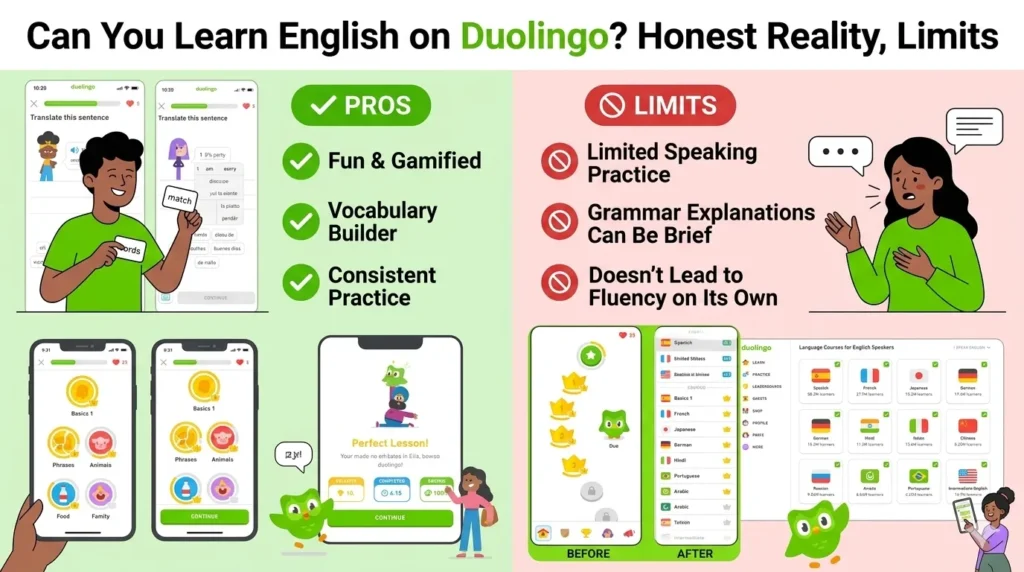
Duolingo excels at drilling core vocabulary—common words for food, family, travel, work, and daily life. Short, repetitive exercises help you recognize and recall high-frequency terms, which is exactly what beginners and lower-intermediate learners in the U.S. need.
2. Gentle basic grammar exposure
Instead of long grammar lectures, Duolingo uses implicit learning: you see patterns like present simple, present continuous, and basic questions repeated in context. This aligns with studies showing that learners who complete Duolingo’s English courses improve across reading and listening skills.
3. Powerful habit formation
The streaks, hearts, and gamification keep American users coming back daily. Research and user-experience data show that regular, short practice significantly boosts beginner-level performance, especially in reading and listening accuracy after a few weeks.
In short, for a beginner in the U.S., Duolingo is excellent for:
- Building a basic word bank
- Getting used to simple sentence structures
- Creating a daily practice habit
The Biggest Problem Users Face
“I can understand, but I can’t speak”
A very common complaint from Duolingo users in the U.S. is:
“I understand the lessons, but when someone talks to me in English, my brain just blanks.”
This happens because:
- Duolingo focuses on input (reading and listening) and accepts tap-and-select answers, not free-form speaking.
- Many learners never practice responding to open-ended questions, which is how real conversations work.
No real conversation practice
Most Duolingo units are short, mechanical drills—translating sentences, matching words, or choosing the correct option. These are useful for memory, but they don’t simulate:
- Natural pauses and interruptions
- Different accents (especially American English)
- Real-time decision-making in a chat or interview
Users with long streaks can still struggle to speak fluently, because the app does not provide enough real-world conversation time.
Slow fluency development
For intermediate to advanced learners, Duolingo’s structure can feel too light and repetitive. Tasks stay short and isolated, so you rarely build complex, connected speech—which is essential if you want to:
- Participate in college classes in the U.S.
- Discuss work projects
- Give opinions in meetings or social settings
Without deeper, longer practice, fluency growth naturally slows, even if you maintain a months-long streak.
Can You Really Learn English on Duolingo?
The short, honest answer is:
Yes, you can learn some English on Duolingo—but not fully.
Beginner → Good
For absolute beginners, Duolingo is very effective. Studies of English-learning Duolingo users show clear improvements in reading, listening, and basic communication skills after a few weeks of practice.
In the American-English context, this means you can:
- Recognize common words and phrases
- Follow simple questions and directions
- Fill in basic forms and understand short texts
This is a strong foundation, but it’s just step one.
Intermediate → Limited
Once you reach intermediate level, Duolingo’s bite-sized lessons become a bottleneck. You may:
- Know many words but mix up tenses
- Understand instructions but can’t express your own ideas clearly
- Feel stuck repeating the same patterns instead of expanding
Research and user feedback suggest that learners who rely only on Duolingo often stay at low-intermediate and do not reach true fluency.
Advanced → Not enough
For high-intermediate or advanced learners, Duolingo is not sufficient.
- Sentence complexity and real-world nuance (slang, idioms, cultural context in the U.S.) are limited.
- There is little practice in giving long explanations, debating, or writing essays—skills that matter for college, jobs, or professional communication in English-speaking countries.
Expectation vs Reality
Many U.S. learners expect:
- “If I use Duolingo every day, I’ll become fluent in English.”
- “I just need to finish the course to handle real conversations in America.”
But here’s the reality:
| Expectation | Reality |
| Daily Duolingo = fluent English | Daily Duolingo = better vocabulary and basic grammar, not automatic fluency |
| Completing the course = ready for real life | Completing the course = good foundation, still needs real conversation practice |
| No speaking practice needed | Active speaking practice is essential for confidence and speed |
Duolingo is designed to start your journey, not finish it.
Why You Are Not Becoming Fluent
Passive learning issue
Most people treat Duolingo like TV watching instead of gym training. They:
- Tap answers quickly
- Rely on multiple attempts
- Skip the need to produce full sentences themselves
This passive mode builds recognition but not automatic recall. Real fluency requires quick retrieval under pressure, not slow, repeated guessing.
Lack of speaking output
Duolingo does include some speaking exercises, but many learners:
- Turn off the mic
- Only repeat when forced
- Never speak longer than a short phrase
Without consistent output, your mouth and brain don’t get used to real-time English production. This is why users in the U.S. report improved test scores but still feel speech-shy in real conversations.
No real-world practice
Even if your Duolingo account is full of gold trophies, you may have never:
- Answered a real question from a stranger
- Explained a problem at work or school in English
- Held a 5–10 minute casual chat
Real-world practice is where confidence, accent adaptation, and fluency grow—areas Duolingo alone cannot cover.
How to Use Duolingo the Right Way
1. Daily consistency, but with limits
Use Duolingo 5–20 minutes daily as a warm-up, not your entire English day. This:
- Builds habit
- Reinforces vocabulary
- Keeps you in the routine without burning out
Research shows that regular, short practice is more effective than long, irregular sessions.
2. Combine with active speaking practice
Every Duolingo session should be followed by 5–10 minutes of speaking:
- Repeat all sentences out loud with natural rhythm
- Answer simple questions in English (e.g., “What did you do today?”)
- Use a mirror or phone recorder to hear your own accent
This bridges the “I can understand but can’t speak” gap common among U.S. learners.
3. Use the shadowing technique
Shadowing means listening to a short audio clip and immediately repeating it aloud, trying to match speed and intonation.
You can:
- Use Duolingo’s audio exercises like mini-shadowing drills
- Extend to YouTube videos, podcasts, or TikTok clips in American English
This trains your ear and mouth together, improving both listening and speaking.
4. Increase listening exposure
Pair Duolingo with:
- American-English YouTube videos (daily life, school, work topics)
- Duolingo Stories and listening exercises (if available)
- American TV shows or movies with subtitles
This exposes you to real-world accents, slang, and pacing, which the app alone cannot provide.
Is Duolingo Enough? Honest Verdict
For beginners in the U.S., Duolingo is great as a starting point. It builds vocabulary, introduces basic grammar, and helps form a daily English habit.
However, Duolingo alone is not enough if your goal is:
- Comfortable everyday conversation
- Speaking in class, work, or social settings
- True fluency and confidence
To reach that level, you must add real speaking practice, listening to native speakers, and real-world use.
Better Alternatives or Add-ons
1. Speaking-practice apps
- HelloTalk, Tandem, or Speaky: Connect with native English speakers for text and voice chat. This forces you to think and respond in real time, which Duolingo doesn’t.
- Speech-recognition apps: Use apps that evaluate your pronunciation and fluency, giving you feedback on pitch, speed, and clarity.
2. YouTube listening practice
- Search for channels like Rachel’s English, business-English channels, or student-life vlogs from the U.S.
- Watch with English subtitles, then without, to level up your listening comprehension in real-world American English.
3. Real-conversation methods
- Join local English clubs, meetups, or conversation groups
- Take online speaking classes or tutoring sessions
These methods fill the biggest gap Duolingo leaves: real, unscripted conversation practice.
Conclusion
Duolingo can help you learn English, especially as a beginner, but it cannot make you fluent by itself. It builds vocabulary and basic grammar and keeps you consistent, which is valuable.
Yet without real speaking practice, listening to native speakers, and using English in real life, you’ll still struggle to speak confidently.
For learners in the U.S., the best strategy is: use Duolingo as a foundation, then add active speaking, shadowing, and real-world conversation.

I’m a website professional with 5 years of experience in building, managing, and growing online content platforms. As the creator of DuolingoGuides.us, I focus on providing helpful, easy-to-understand guides and resources for Duolingo users and language learners. My goal is to make information simple, accurate, and accessible for everyone.