When Was Duolingo Created? The Fascinating Story Behind
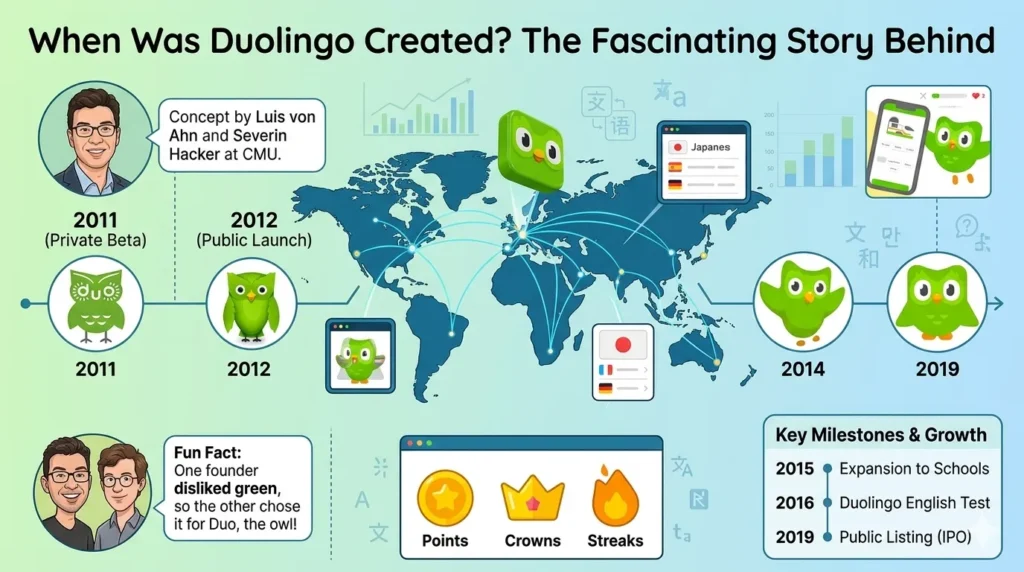
Duolingo was created in 2009 when Carnegie Mellon University professor Luis von Ahn and his student Severin Hacker first formulated the idea in Pittsburgh, USA. The company officially launched its private beta on November 27, 2011, and went public on June 19, 2012. This free app addressed costly language education by crowdsourcing translations while teaching users.
What is Duolingo?
Duolingo is an American edtech platform offering gamified language learning through bite-sized mobile lessons. Users master 40+ languages like Spanish, French, and even fictional ones like Klingon via interactive exercises on vocabulary, grammar, and speaking.
Headquartered in Pittsburgh, Pennsylvania, USA, it boasts 130 million monthly active users as of Q1 2025, blending AI personalization with fun streaks to make learning addictive.
People use it for quick daily practice, travel prep, or career boosts, as it’s accessible on iOS, Android, and web without any fees for core features.
Duolingo’s green owl mascot, Duo, motivates users with reminders and rewards.
Why Was Duolingo Created?
Duolingo solved the education accessibility crisis, especially for non-English speakers facing sky-high costs to learn languages. Founder Luis von Ahn from Guatemala witnessed how $1,200+ classroom courses barred his community from English fluency, limiting jobs and opportunities.
The app tackled this by offering free, forever education, using user translations to fund itself via partnerships like CNN content localization.
In the USA, where immigrants seek integration, it democratized learning amid rising demand for multilingual skills in tech hubs like Silicon Valley.
Who Created Duolingo?
Luis von Ahn, a Guatemalan-American computer science professor at Carnegie Mellon University in Pittsburgh, co-founded Duolingo with Severin Hacker, his Swiss PhD student. Von Ahn’s prior success selling reCAPTCHA to Google for millions fueled his shift to education tech.
Motivated by Guatemala’s poverty, von Ahn aimed to “reduce economic inequality” through free tools. Hacker brought technical prowess in crowdsourcing algorithms.
Their academic roots at CMU emphasized scalable, human-computation models, birthing Duolingo’s unique translation-learning hybrid.
How Duolingo Started
The early idea sparked in 2009 at CMU labs, blending von Ahn’s CAPTCHA expertise with Hacker’s mobile prototyping for free English lessons via user-generated translations. They bootstrapped a flash-based prototype tested on Guatemalan users.
By November 30, 2011, Duolingo Inc. formed in Pittsburgh, USA, securing seed funding from Union Square Ventures ($3.3M) and Tim Ferriss.
Private beta launched November 27, 2011, hitting 100,000 users fast; public release followed June 19, 2012, with iOS app in November.
Major Milestones Timeline
| Year | Key Event | Impact |
| 2009 | Idea formulated at CMU | Academic origins in Pittsburgh. |
| 2011 | Founded Nov 30; private beta Nov 27 | 500K sign-ups in months. |
| 2012 | Public launch June 19; iOS app Nov | Web-to-mobile shift. |
| 2013 | Apple’s App of the Year | 10M users; gamification boost. |
| 2015 | Android app; 13 languages | Global expansion. |
| 2021 | IPO on NASDAQ (DUOL) | Valued at $6.5B. |
| 2023 | Duolingo Max with GPT-4 | AI roleplay features. |
| 2025 | 130M MAU | Dominant USA edtech player. |
Why Duolingo Became So Popular
Duolingo’s free model eliminated barriers, unlike pricey rivals like Rosetta Stone. Its gamification—streaks, XP leagues, hearts, and Duo the owl—turns learning into a daily habit, with users averaging 20 minutes/day.
Mobile-first design suited busy Americans, launching iOS early and optimizing for commutes in cities like New York.
Viral word-of-mouth, school integrations, and social sharing propelled it to #1 education app in the USA App Store repeatedly.
Duolingo’s streak counter keeps millions logging in daily.
Common Questions
Is Duolingo free?
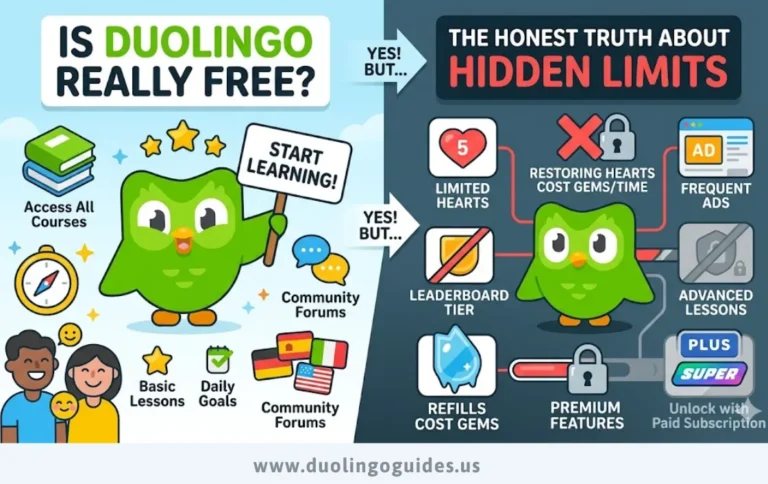
Yes, core features are free forever; Duolingo Plus ($6.99/month) removes ads.
Who owns Duolingo today?
Publicly traded (NASDAQ: DUOL); founders retain influence; no single owner.
Who invented Duolingo?
Luis von Ahn and Severin Hacker at Carnegie Mellon.
How did Duolingo become a popular language learning app?
Via free access, gamification, and mobile optimization, hitting 500M downloads.
Why did Luis von Ahn create Duolingo?
To make English free for poor Latinos, inspired by Guatemala’s barriers.
What is Duolingo & how does it work?
Gamified app with 5-10 min lessons on reading/speaking; AI adapts difficulty.
Is Duolingo effective for learning?
Yes for basics/vocab; pair with practice for fluency.
Final Summary
Duolingo, born in 2009 Pittsburgh labs and launched 2011, transformed language learning with free, fun tools by Luis von Ahn and Severin Hacker. From solving cost barriers to 130M users via streaks and AI, it’s America’s edtech giant. Key takeaway: Accessibility + gamification = global dominance.

I’m a website professional with 5 years of experience in building, managing, and growing online content platforms. As the creator of DuolingoGuides.us, I focus on providing helpful, easy-to-understand guides and resources for Duolingo users and language learners. My goal is to make information simple, accurate, and accessible for everyone.