Duolingo English Test Sample Questions and Answers: Best Guide
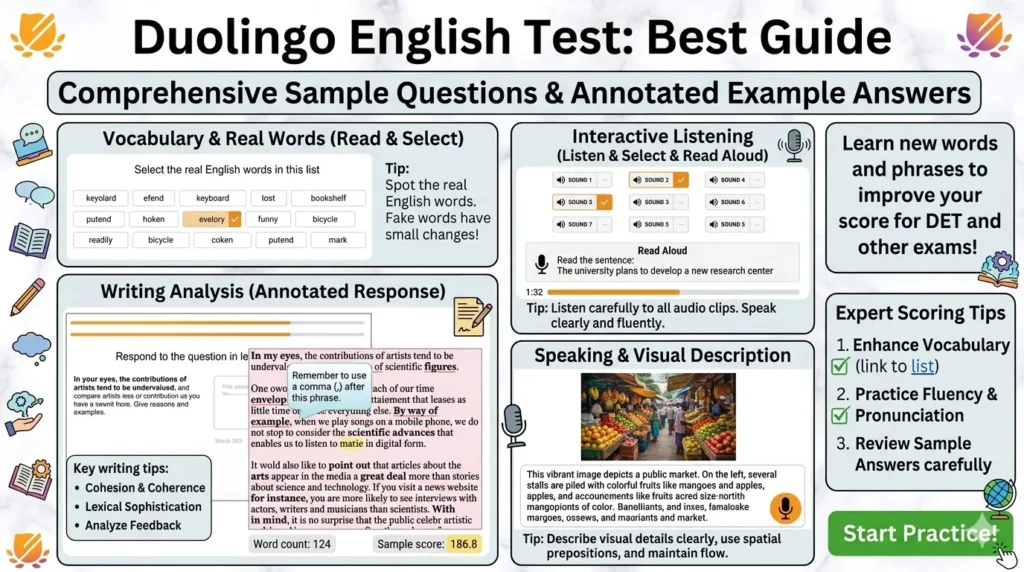
The Duolingo English Test is a short, computer-adaptive English exam that many universities in the USA accept for admissions, and it checks reading, writing, listening, and speaking skills in one sitting. In this guide, you’ll get real-like sample questions, clear answer models, and practical strategies to help you perform better.
What To Expect
The test includes an onboarding section, then a graded adaptive section where question difficulty changes based on your performance. Common question types include Read and Select, Fill in the Blanks, Read and Complete, Read Aloud, Listen and Type, Write About the Photo, Speak About the Photo, and the speaking and writing samples.
The experience is fast-paced, so accuracy matters, but so does speed. A strong prep routine should focus on understanding instructions quickly, typing cleanly, and speaking with steady fluency.
Question Types With Samples
1. Read And Select
This task shows a list of words, and you choose the real English words only; the exam uses this type to test vocabulary recognition and reading speed.
Sample set:
- transparent
- blone
- memory
- qinter
- nation
Answer: transparent, memory, nation.
Explanation: those are the real English words.
Pro tip: scan for familiar word shapes first, then eliminate obvious nonsense forms.
Common mistakes: selecting near-lookalike fake words and rushing too fast.
2. Fill In The Blanks
This question asks you to complete a sentence with the correct word, and it measures grammar, vocabulary, and sentence sense.
Sample:
The meeting was delayed because the manager was ___.
Answer: absent.
Explanation: “absent” fits the meaning and grammar.
Pro tip: read the full sentence before choosing, not just the blank.
Common mistakes: picking a word that sounds right but does not match tense or meaning.
3. Read And Complete
This task gives you a short passage with missing letters in some words, and you must restore the full word.
Sample:
I enjoy re___ing books on weekends.
Answer: reading.
Explanation: the missing letters complete the word naturally.
Pro tip: use context and common word patterns, not guesswork alone.
Common mistakes: misspelling easy words because of speed pressure.
4. Write About The Photo
This question asks for a short written description of an image, and it tests grammar, vocabulary, and clarity.
Sample image description: A man is waiting at a bus stop while holding a suitcase. The street looks busy, and it seems like morning.
Band-level answer:
A man is standing at a bus stop with a suitcase in his hand. He appears to be waiting for transportation, and the street behind him looks active and crowded. The scene suggests he may be traveling for work or a trip.
Template:
There is/are ____. The person/people seem to ____. In the background, I can see ____. The scene looks ____.
Pro tip: write 3–5 clear sentences instead of trying to sound overly fancy.
Common mistakes: copying the image too literally without adding natural detail.
5. Speak About The Photo
This task asks you to describe a picture aloud for a short time, and the test evaluates fluency, pronunciation, and coherence.
Sample prompt:
Describe a photo of two students working together in a library.
Answer framework:
- Start with what you see.
- Add what the people are doing.
- Mention the setting.
- End with a likely interpretation.
Sample response:
I can see two students sitting at a table in a library. They seem to be studying together and talking quietly. There are books and notebooks in front of them, which suggests they are preparing for a class or exam. The room looks calm and organized.
Pro tip: keep speaking continuously, even if the response is simple.
Common mistakes: long pauses, repeated words, and stopping too early.
6. Listen And Type
This question plays a sentence, and you must type exactly what you hear.
Sample:
Audio sentence: The train arrives at 8:30 tonight.
Answer: The train arrives at 8:30 tonight.
Pro tip: pay close attention to punctuation, numbers, and short function words like “a,” “the,” and “at.”
Common mistakes: missing articles, swapping words, and spelling errors.
7. Read Aloud
You read a sentence aloud, and the test checks pronunciation, rhythm, and clarity.
Sample:
The city park is full of people enjoying the sunny afternoon.
Pro tip: speak naturally and clearly, not too fast.
Common mistakes: mumbling, skipping words, and reading with unnatural pauses.
Mini Practice Test
Here is a short mixed drill in a more realistic style.
- Read and Select: honest, hones, orange, brange
Answer: honest, orange - Fill in the Blanks: She was late because the bus was ___.
Answer: delayed - Read and Complete: The child was very cur___ about the new toy.
Answer: curious - Write About the Photo: Describe a woman holding a laptop in a cafe.
Model answer: A woman is sitting in a cafe with a laptop in front of her. She appears to be working or studying while drinking something warm. The environment looks relaxed and quiet. - Speak About the Photo: Describe a classroom with students listening to a teacher.
Framework: setting, people, activity, purpose.
Timing tip: answer quickly, keep moving, and do not overthink each item.
High-Scoring Strategies
Strong DET performance comes from clear, simple language rather than memorized advanced phrases. For writing, use short organized sentences, add relevant details, and avoid grammar mistakes that distract from meaning.
For speaking, use a steady pace, complete your thoughts, and build answers with a simple structure like “what I see, what it means, and why it matters.” Vocabulary helps, but accuracy matters more than rare words.
Common Mistakes
The biggest traps are rushing, leaving answers incomplete, and ignoring spelling details in typing tasks. Many test takers also lose points by speaking too little or writing very short responses that do not develop the idea.
Another common problem is trying to sound too advanced and making grammar errors instead. A clean, natural answer usually performs better than a complicated but inaccurate one.
Scoring Explained
The Duolingo English Test is adaptive, which means the test adjusts to how you are performing as you go. That is why strong consistency matters more than one perfect answer.
In general, the test rewards reading accuracy, listening precision, speaking fluency, writing clarity, and overall control of English. If you want a higher score, focus on reducing small mistakes across many question types.
7-Day Plan
Day 1: Learn the test structure and timing.
Day 2: Practice reading tasks like Read and Select and Read and Complete.
Day 3: Work on writing with photo descriptions and short summaries.
Day 4: Train listening with dictation-style drills.
Day 5: Practice speaking prompts aloud with a timer.
Day 6: Take a full mock test and review errors.
Day 7: Repeat weak areas and do one final timed review.
FAQs
Does Duolingo offer free practice questions?
Yes, free sample materials and practice-style examples are widely available, and official-style prep content exists through Duolingo and partner resources.
How do I practice answering Duolingo English test questions?
Use timed drills for reading, typing, writing, and speaking so your speed and accuracy improve together.
How many Duolingo English Test practice questions are there?
There is no single fixed number because question sets and practice materials vary by source and test format.
Does the Duolingo English test guarantee a specific score?
No test can guarantee a score, because performance depends on your live responses and adaptive difficulty.
Conclusion
The best way to prepare for the Duolingo English Test is to combine sample questions, timed practice, and simple answer frameworks that keep your English clear and accurate. If you want a score-friendly approach, focus on consistency, speed, and low-error writing and speaking rather than trying to memorize long answers.

I’m a website professional with 5 years of experience in building, managing, and growing online content platforms. As the creator of DuolingoGuides.us, I focus on providing helpful, easy-to-understand guides and resources for Duolingo users and language learners. My goal is to make information simple, accurate, and accessible for everyone.