How Does Duolingo Work? Features, Learning Method & Real
Struggling to learn Spanish or French amid busy schedules? This 2026 guide delivers an honest breakdown of Duolingo‘s mechanics, strengths, and limits for U.S. users seeking real results.
What is Duolingo?
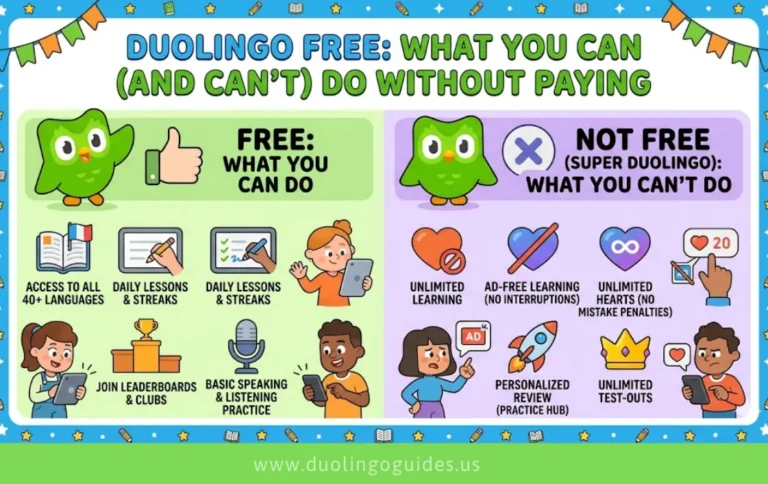
Duolingo is a free mobile app launched in 2011, now serving over 500 million users worldwide, including millions in the USA. It teaches 40+ languages through bite-sized, gamified lessons accessible on iOS, Android, and web.
Core features include a skill tree where users unlock topics like “Food” or “Past Tense,” earning XP points and maintaining streaks for daily engagement. Recent 2026 updates opened B2-level advanced content (e.g., translation-free stories, podcasts via DuoRadio) for free in nine languages like English, Spanish, and Japanese.
Core Learning System
Duolingo relies on gamification with rewards, leaderboards, and hearts (now evolving to energy systems) to boost retention. Its spaced repetition algorithm reviews vocabulary at optimal intervals, adapting to user performance.
AI personalization tailors lesson difficulty, mixing translation, speaking, listening, and quizzes in 5-minute sessions. Lessons progress via a tree structure, building from basics to complex scenarios at CEFR B2 level.
Why It Feels Fun
Duolingo hooks users psychologically with dopamine hits from streaks, badges, and cartoonish characters like Duo the owl. This creates habit-forming fun, ideal for beginners building daily routines.
However, the addictive loop prioritizes engagement over depth, leading to “productive procrastination” where users feel progress without fluency gains. Emotional nudges like reminders combat dropout rates common in U.S. learners.
Does It Work for Fluency?
No, Duolingo alone doesn’t deliver conversational fluency (CEFR C1+). Studies show it matches university beginners’ gains in reading/writing after 3 months but lags in speaking/listening for real-world use.
After 4-6 weeks, novices hit 90% accuracy in basic tests, and 2026’s advanced features help reach B2 (independent user). For U.S. adults aiming for fluency, it’s a strong starter (500-1,000 hours for basics) but needs supplements.
Biggest User Problems
- Limited speaking practice: Exercises feel scripted; real conversations falter despite 1,500-day streaks.
- Grammar gaps: No explicit rules; users learn patterns implicitly, confusing intermediates.
- Plateaus at intermediate: Information overload without hierarchy stalls progress beyond basics.
- Retention issues: 80% quit within months due to repetitive drills ignoring context.
- No real-world transfer: Fun sentences don’t prep for U.S. travel or jobs.
Effective Usage Tips
Pair Duolingo with immersion: Spend 15 minutes daily on lessons, then apply via podcasts or U.S.-based language meetups. Focus on weak skills via practice hubs; ignore gems/hearts for flow.
Track via Duolingo Score (CEFR-aligned); combine with Anki for vocab and iTalki tutors weekly. U.S. users: Leverage free advanced Stories and DuoRadio for B2 listening in 2026.
Duolingo vs. Others
| Feature/App | Duolingo | Babbel | Rosetta Stone | Pimsleur |
| Cost (Monthly) | Free (Super: $12.99) | $13.95 | $11.99 | $19.95 |
| Strength | Gamification, vocab base | Grammar-focused convos | Immersion audio | Speaking drills |
| Fluency Level | A2-B2 starter | B1 conversational | B1 listening | B2 speaking |
| U.S. Popularity | 100M+ downloads | Structured adults | Travel pros | Audio commuters |
Duolingo wins for free habit-building; rivals excel in targeted skills.
Worth It in 2026?
Yes for U.S. beginners building daily habits and basic vocab—especially with free B2 updates. Skip if seeking rapid fluency; it’s 20% of a full routine.
FAQ
Is Duolingo enough?
No—great for basics, pair with conversation practice.
How long to fluency?
1-2 years (500+ hours) for conversational; varies by language.
How does Duolingo work?
Gamified lessons with AI, spaced repetition, skill trees.
Can you become fluent using Duolingo?
Not alone; reaches B2 max effectively.
Disadvantages?
Weak grammar/speaking; plateaus quickly.
Why do people stop?
Repetition bores; no real progress feel.
Monthly cost?
Free; Super Duolingo $12.99 removes ads/limits.
How does it teach?
Interactive quizzes, stories, AI adaptation.
Duolingo method?
Spaced repetition + gamification for retention.
What is the app?
Free language learner with 40+ courses.
Can you become fluent?
With supplements, yes; app alone, no.