
Duolingo English Test Sample Questions & Answers [Updated 2026] – Guide
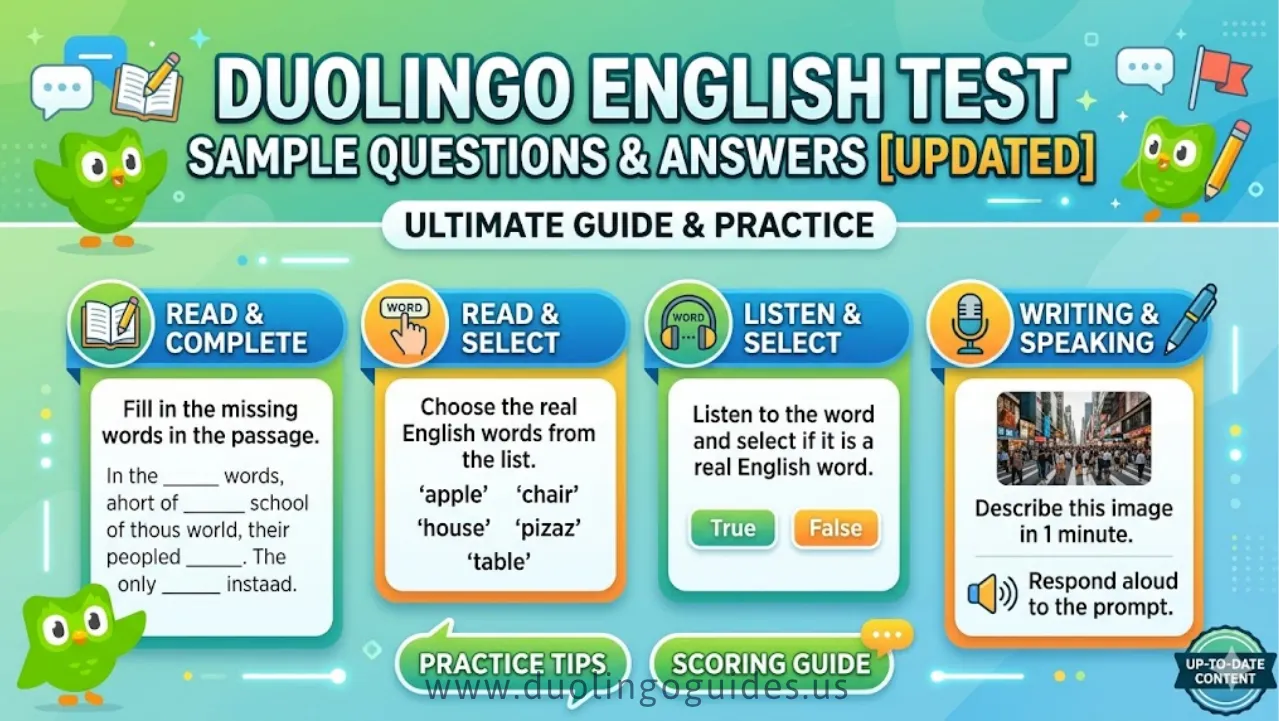
The Duolingo English Test (DET) is a popular, easy way to show English skills for school or work. Updated for 2026, it tests Reading, Listening, Speaking, and Writing using everyday English.
This guide gives sample questions, answers, tips, and study strategies to help you prepare, improve, and feel confident on test day.
Sample Reading Questions (2026 style)
On the Duolingo English Test Sample, Reading appears in short, adaptive formats such as:
- Read and Select: Decide which of several options are real English words (e.g., “dresson” vs. “birthday”).
- Fill in the Blanks: Choose the correct word from a short list to complete a sentence (e.g., “The students _ their homework” → “completed”).
- Read and Complete: Finish a sentence by dragging the right word or phrase into each blank.
In the USA, questions often use everyday English (school, work, shopping, travel) rather than highly technical vocabulary, so focus on high‑frequency academic and conversational words.
Answers & Explanations
- For Read and Select, eliminate clearly non‑real words (odd spelling, mixed‑language look) and keep words that follow English patterns (e.g., “birthday,” “likes”).
- For Fill in the Blanks, check verb tense (past, present), subject‑verb agreement, and typical collocations (e.g., “do homework,” “take a test”).
Scoring Tips & Common Mistakes
- Duolingo English Test Reading is adaptive: harder questions if you answer early ones correctly, so aim for accuracy over speed in the first few questions.
- Common mistakes:
- Choosing similar‑looking wrong words (e.g., confusing “their” and “there”).
- Not reading full sentences before selecting answers.
Sample Listening Questions
Duolingo English Test Listening includes:
- Listen and Type: Type what you hear in a short spoken sentence (used for both Listening and Writing).
- Interactive Listening: Answer several questions after a short audio clip (e.g., “What is the main idea?”).
In a USA context, accents are mostly American English, with clear but natural speech pace and everyday topics like classes, plans, or weather.
Answers & Explanations
- For Listen and Type, focus on strong vowels and stressed words; you do not need perfect punctuation or capitalization, but the words must be recognizable.
- For Interactive Listening, listen for the main idea and key details (times, places, reasons) rather than trying to capture every word.
Timing Strategies & Tips
- Use the first second of the clip to predict the topic (e.g., “appointment,” “exam,” “movie”).
- Practice with short US‑accented podcasts or news clips and write 1–2‑sentence summaries to build speed.
Sample Speaking Prompts
DET Speaking tasks include:
- Read Aloud: Read a short sentence on screen.
- Listen, Then Speak: Answer a question after hearing a short audio.
- Speak About the Photo: Describe an image (e.g., people at a café).
For test‑takers in the USA, DET accepts various English accents, but clear pronunciation and natural rhythm matter more than perfect “American” accent.
Model Answers & Evaluation Criteria
- A strong speaking answer:
- Starts with a clear main idea (e.g., “The picture shows a group of students studying in a library.”).
- Adds 2–3 simple details (what, where, who, what they are doing).
- DET evaluates fluency, vocabulary, grammar, and pronunciation via automated scoring.
Pronunciation & Fluency Tips
- Record yourself on a phone and compare with native‑speaker samples; focus on word stress and clear vowels.
- During the test, speak at a steady pace, avoid long pauses, and do not rush; slightly slower but clear is better than fast and unclear.
Sample Writing Prompts
DET Writing includes:
- Write About the Photo: Describe or tell a short story based on an image.
- Interactive Writing: Answer two short‑response questions (e.g., “What is your favorite outdoor activity, and why?”).
In the USA, institutions often use these responses to check if your writing matches the level claimed by your overall DET score.
Model Answers & Step‑wise Grammar Analysis
- Good model structure: 1–2 sentences intro, 2–3 details, 1 closing sentence.
Example outline:- “In the picture, four friends are having a picnic.”
- “They look happy and are sharing food.”
- “This shows how people enjoy spending time together outdoors.”
- Grammar focus points:
- Subject‑verb agreement (e.g., “They are eating,” not “They is eating”).
- Correct tense (simple present/past for photos and experiences).
Time Management Tips
- Spend 10–15 seconds planning key words before you type.
- Aim for 3–5 clear sentences; long, messy answers are not judged better than short, accurate ones.
How DET Scoring Works
DET scores range from 10 to 160, with an overall score and four subscores (Reading, Writing, Listening, Speaking).
Each item is scored automatically: correct vs. incorrect, plus measures of fluency, coherence, and grammar for longer responses.
Common Mistakes & How to Avoid Them
- Skipping instructions or rushing through questions before reading fully.
- Ignoring basic spelling and capitalization in “Listen and Type” or Writing.
To avoid these:- Take the official practice test and walkthroughs on Duolingo’s readiness page.
- Review sample questions from trusted 2026‑updated guides.
Study Plan
- 1 Week:
- Day 1–2: Learn all question types; take 1 full‑length practice test.
- Day 3–5: Focus on weak areas (e.g., Listening or Writing) using US‑accented materials.
- Day 6–7: 2 timed mock tests with environment similar to your test‑day setup.
- 2 Weeks / 1 Month:
- Add daily 15‑minute listening practice (news, lectures) and 10‑minute writing practice (photo descriptions, short essays).
FAQs
How to register for DET?
- Go to the official Duolingo English Test website, create an account, pick a test time, and pay the fee (around $65 USD), then follow the on‑screen setup steps.
How should I prepare for the Duolingo English Test?
- Understand the format, practice official and 2026‑style samples, improve US‑accented listening, and do timed writing and speaking drills.
Can I retake the test if I don’t get the score I want?
- Yes; there is no limit on retakes, but you must wait at least 48 hours between tests and pay the fee each time.
How accurate are sample questions?
Official and updated 2026‑ era sample questions closely mirror real DET item types and difficulty, but exact wording and audio will differ.
Can I get 160 easily?
- A 160 score is possible with strong, near‑native‑level English, consistent practice, and good test‑taking strategy, but it is not “easy” for most learners.
What types of questions are on the test?
- 13 main item types: Read and Select, Fill in the Blanks, Read and Complete, Read Aloud, Listen and Type, Interactive Reading/Listening, Write About the Photo, Interactive Writing, Listen/Read/Photo‑based Speaking, and Writing/Speaking Samples.
Is the Duolingo English Test accepted by all universities?
- Many US and international universities accept DET, but not all; always confirm with each university’s admissions or English‑proficiency page.
What equipment do I need to take the test?
- A laptop or desktop with a working webcam, microphone, and speakers; stable internet; a quiet room; and a government‑issued photo ID.
Conclusion:
Preparing for the 2026 Duolingo English Test (DET) means knowing the test format, practicing sample questions, and improving reading, listening, speaking, and writing skills. Learn the adaptive question types, focus on common English words, and follow clear strategies for each section.
Practice regularly with timed mock tests, review mistakes carefully, and aim for clarity and accuracy. Consistent effort matters more than speed. This updated guide helps you approach the DET confidently and do your best.

I’m a website professional with 5 years of experience in building, managing, and growing online content platforms. As the creator of DuolingoGuides.us, I focus on providing helpful, easy-to-understand guides and resources for Duolingo users and language learners. My goal is to make information simple, accurate, and accessible for everyone.