How Old Is Duolingo? Complete History Timeline Update
Duolingo is about 15 years old as of 2026, having been founded in 2011. This gamified language-learning app has transformed from a classroom idea into a global powerhouse, captivating millions with its owl mascot and bite-sized lessons.
When Was Duolingo Created?
Duolingo was created in 2011. Carnegie Mellon professor Luis von Ahn and student Severin Hacker launched it in Pittsburgh, Pennsylvania, as a free alternative to pricey language classes.
The private beta rolled out in November 2011, with public access in June 2012. This timing tapped into rising mobile learning demand in the USA.
Who Founded Duolingo And Why?
Luis von Ahn, a Guatemalan computer scientist, and Severin Hacker, his Swiss PhD student, founded Duolingo. Von Ahn, fresh off selling reCAPTCHA to Google, aimed to fix education inequality he saw in Guatemala—where English lessons cost a month’s wages.
Their mission: free, high-quality education for all. They built it as a crowdsourced translation tool funding free lessons, prioritizing accessibility over profit initially.
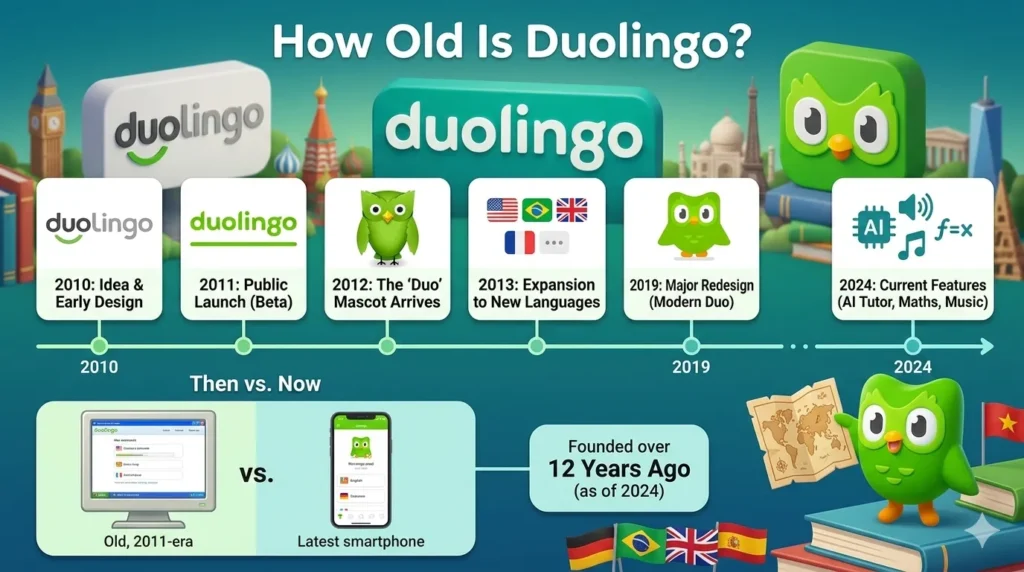
Duolingo History Timeline
Here’s Duolingo’s major milestones from idea to USA-dominant app:
- 2009: Idea born at Carnegie Mellon; von Ahn and Hacker prototype gamified learning.
- 2011: Company founded in Pittsburgh; private beta launches November.
- 2012: Public launch June 19; first courses (Spanish, French) explode in popularity.
- 2013: iOS/Android apps hit; reaches 10 million users, mostly USA-based.
- 2014: Iconic green owl (Duo) debuts; Duolingo English Test (DET) launches as affordable certification.
- 2017: Duolingo Plus (now Super Duolingo) introduces ad-free subscriptions.
- 2021: Goes public on NASDAQ (DUOL); valued at billions amid pandemic learning boom.
- 2023: Hits 300 million users; revenue tops $442 million.
- 2024-2026: Adds AI tutors, podcasts; Q4 2024 revenue at $209.6 million (up 8%).
This timeline shows Duolingo’s shift from nonprofit experiment to public company powerhouse.
How Duolingo Has Evolved Over Time
Duolingo started with simple translation exercises crowdsourcing subtitles for websites. It evolved to gamified streaks, XP points, and leagues by 2014.
Learning methods advanced: From isolated words to story-based lessons, dialogues, and grammar tips in 2020s courses like Spanish. Path redesign in 2021 made lessons adaptive, harder progressively—no more regressions.
USA users saw mobile-first growth, with AI features like roleplay and explainers by 2026, boosting retention without losing free access core.
Is Duolingo Still Relevant Today?
Yes, Duolingo thrives in 2026 with 500+ million registered users (100M+ monthly actives). Its value lies in habit-building for busy USA professionals and students.
Constant updates—like Music, Math, ABC courses and Gen Z memes—keep it fresh. DET certifications aid USA college admissions affordably.
How Duolingo Makes Money
Duolingo uses a freemium model: Core app free with ads and limited hearts. Super Duolingo subscriptions ($6.99-$12.99/month) remove ads, add unlimited hearts, and unlock AI Legend mode.
Revenue streams include DET ($49/test), in-app purchases, and targeted ads. 2024 saw $531M+ annual revenue, mostly from USA/EU subs—proving free hooks paid upgrades.
Why Duolingo Became So Popular
Gamification—streaks, leaderboards, Duo push notifications—makes learning addictive like Candy Crush. Accessibility (free, offline, 5-min lessons) hooked USA millennials post-2012.
Fun marketing (meme virality, TikTok) and word-of-mouth fueled growth. By 2021 IPO, it was USA’s top-grossing education app.
Pros and Cons Based on Its History
| Aspect | Pros | Cons |
| Founding | Free mission democratized learning | Early translation focus felt gimmicky |
| Evolution | Constant updates (AI, stories) keep pace | Gamification prioritizes streaks over depth |
| Monetization | Freemium scales to billions | Ads/hearts frustrate free users |
| Popularity | 100M+ DAUs via fun UX | Layoffs (2024) sparked backlash |
| Impact | DET aids USA immigrants | Not full fluency tool alone |
Balanced historically: Revolutionary access, but needs supplements for mastery.
What Duolingo’s History Means for Learners Today
Duolingo’s 15-year track record builds trust—proven by surviving recessions, pivots, and 2021 IPO. USA learners can rely on its stability for consistent progress.
It sets realistic expectations: Great for vocab/habits, pair with conversation practice. Reliability shines in updates, ensuring your investment pays off long-term.
This unique longevity edges competitors like Babbel—Duolingo evolves without abandoning free roots.
FAQs
Is Duolingo outdated?
No, 2026 updates like AI podcasts keep it cutting-edge.
Can you become fluent?
Not alone—builds strong base; combine with speaking practice.
What is the history of Duolingo?
Founded 2011 by von Ahn/Hacker for free education; public 2012.
Why is Duolingo saying duo died?
Meme from aggressive streak reminders; Duo lives as mascot.
Why is Duolingo LGBTQ?
Inclusive stories/pride events reflect diverse USA users.
When did Duolingo start?
2011 founding; 2012 launch.
Why is Duolingo so popular?
Gamification, free access, viral marketing.
How has Duolingo changed over time?
From translations to AI-adaptive paths.
When did Duolingo become a popular education app?
2013 with mobile apps.
Is Duolingo 100% correct?
95%+ accurate; occasional errors fixed fast.
Who owns Duolingo?
Public (NASDAQ: DUOL); von Ahn CEO.
How many users does it have?
500M+ total; 100M+ monthly actives (2026).

I’m a website professional with 5 years of experience in building, managing, and growing online content platforms. As the creator of DuolingoGuides.us, I focus on providing helpful, easy-to-understand guides and resources for Duolingo users and language learners. My goal is to make information simple, accurate, and accessible for everyone.


