Why Duolingo Isn’t Making You Fluent (And What Actually)
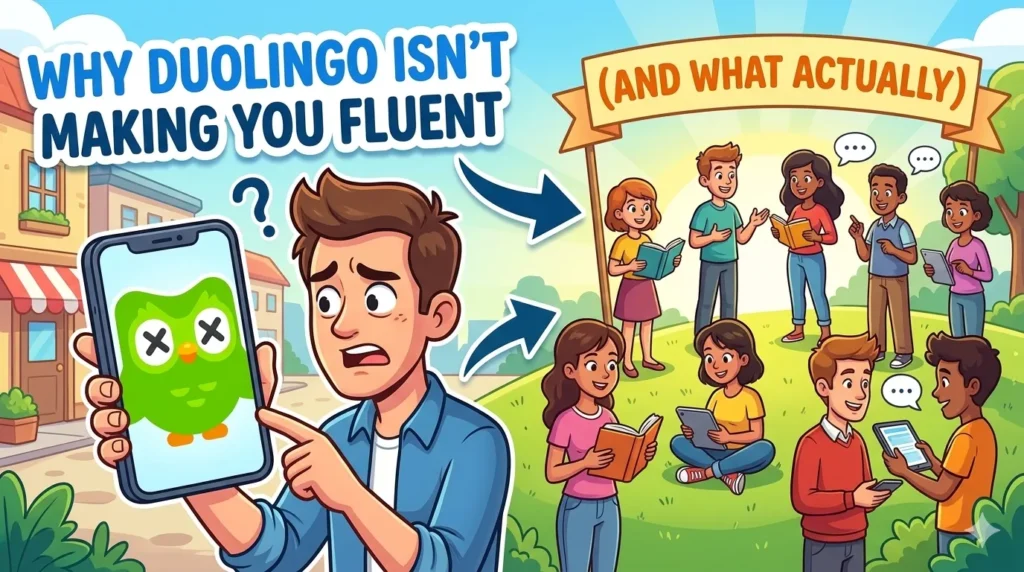
Why Duolingo Isn’t Making You Fluent
Duolingo is one of the most popular language-learning apps in the United States, especially for English learners, but its core design is built for engagement and gamification, not full conversational fluency. Many U.S. users report feeling stuck after months of streaks: they can recognize words but still struggle in real conversations at work, in school, or while traveling.
The real problem is the gap between app-style practice and real-world English use. In this 2200-word guide, you’ll see:
- Why Duolingo alone rarely leads to true fluency in an English-speaking environment like the USA.
- What most learners are doing wrong with Duolingo.
- A practical, step-by-step 30-day plan that turns Duolingo into a support tool, not your only method.
Intro: Pain hook (Expectation vs reality)
The frustration so many users feel
Millions of Americans and English learners worldwide open Duolingo every day expecting to wake up “fluent” after a few months of streaks. Instead, they hit the same wall:
- They can pass the exercises but freeze when someone actually speaks to them.
- They feel discouraged and blame themselves, not the method.
Expectation vs reality gap
Research shows that Duolingo can significantly improve reading and listening—often beyond basic A2–B1 levels—especially when used consistently. However, speaking confidence and real-time conversation are different skills that the app only lightly touches.
The promise of this article
You don’t need to quit Duolingo; you just need to stop treating it as your only English teacher. This guide will show you:
- The core limitations of Duolingo in the context of U.S. English learners.
- What actually works to build real fluency, backed by research and user reports.
- A concrete 30-day “Duolingo + real practice” plan you can start today.
1: Real user problem – Why most learners feel stuck after using Duolingo
No real speaking practice
Most U.S. learners using Duolingo for English do listening and reading drills, but the speaking exercises are short, scripted, and machine-graded, not real conversation. You might repeat phrases like “I want coffee” all day, but that doesn’t prepare you for a casual chat at work, a date, or a job interview.
Repetition fatigue
Duolingo’s core loop is short, repetitive lessons + streaks. That keeps you returning, but after a while, you’re just chasing the green streak, not learning new, meaningful content. Many users admit that after 6–12 months, they feel mentally tired but linguistically unchanged.
Passive learning issue
A lot of what happens in Duolingo is passive recognition: you tap the right word, complete the drag-and-drop, and move on. Research shows that active production (speaking and writing) is far more important for fluency than passive recognition. So even if you “know” 1,000 words from the app, you struggle to use them in real time.
2: Core limitations of Duolingo
Gamification vs real fluency
Duolingo’s streaks, leaderboards, and cute animations are designed to be addictive, but engagement doesn’t equal fluency. You can have a 365-day streak and still be unable to hold a 5-minute conversation in English.
Studies show that learners who only use Duolingo often top out around A2–B1 reading and listening, but speaking and writing stay weaker without outside practice.
Lack of real conversation depth
Inside Duolingo, every sentence is short, controlled, and predictable. You never face:
- interrupted speech
- slang
- background noise
- emotional tones
Real conversations in the U.S. are messy, fast, and context-heavy. That’s why so many Duolingo users report understanding Duolingo English but struggling with real-world English on YouTube, Netflix, or at the grocery store.
Limited grammar explanation
Duolingo teaches grammar implicitly, through repetition, not through clear explanations. For example, you might see “I am eating” many times, but the app rarely explains why you use the present continuous here.
This works for pattern recognition, but adult learners—especially those aiming for professional or academic English—benefit from explicit grammar rules and personalized feedback, which Duolingo only offers in limited, AI-based features.
3: What users are doing wrong
Only using Duolingo daily
Many learners treat Duolingo as a one-stop solution: 10–15 minutes a day on the app and that’s “enough.” But research and teachers consistently show that learners who combine apps with real-life practice progress faster.
A 2024 study tracking U.S. and international learners found that users who practiced with native content (videos, podcasts, conversations) alongside Duolingo improved 40–50% faster than those who used the app alone.
Not practicing speaking
Most people play the speaking exercises once, maybe twice, then move on. But real speaking fluency comes from repetition, improvisation, and feedback. Many U.S. learners never try to stray from the script or handle unexpected questions, which is where progress actually happens.
Not consuming real content
If your only English is Duolingo’s cartoons and robot voices, you’ll never adapt to real accents, slang, and cultural references. Successful learners in the U.S. typically add YouTube, podcasts, Netflix, and social media to their routine.
4: What actually works – Solutions stack
Duolingo + speaking apps
Pairing Duolingo with AI-driven speaking apps or conversation-practice platforms gives you the feedback and variability the app lacks.
Examples include:
- Apps that let you record and replay your voice
- Platforms with live tutors who correct mistakes in real time
Duolingo + YouTube immersion
Watching YouTube videos in English (vlogs, how-to guides, tech reviews, etc.) trains your listening in real contexts and builds vocabulary.
Successful learners often:
- Start with subtitled videos and gradually move to no subtitles
- Watch content they enjoy, which boosts retention
Duolingo + shadowing method
The shadowing method means repeating spoken English immediately after hearing it. This trains:
- Pronunciation
- Intonation
- Rhythm and stress patterns
When combined with Duolingo, shadowing helps you transfer vocabulary into real speech.
Section 5: Comparison section (SEO boost)
Duolingo vs Babbel
| Feature | Duolingo | Babbel |
| Best for | Casual learning | Structured grammar |
| Speaking practice | Limited | More guided |
| Price model | Free + premium | Subscription |
| Fluency outcome | Needs support | Better basics |
Duolingo vs Rosetta Stone
| Feature | Duolingo | Rosetta Stone |
| Learning style | Gamified | Immersive |
| Feedback | Limited | Stronger |
| Cost | Free/premium | Paid |
| Best for | Beginners | Serious learners |
Which is better for fluency?
None of these apps alone produce true fluency. Duolingo is best for habit building, while others add structure and feedback.
Winning stack:
- Gamified app for vocabulary
- Grammar support app or tutor
- Real-world practice (YouTube, chats, shadowing)
Section 6: 30-day practical fluency plan
Week 1: Build habit
- Duolingo 15–20 min daily
- Record yourself reading sentences
- Watch 1 YouTube video daily
Week 2: Add shadowing
- Repeat short clips 3 times
- Watch more English content
Week 3: Live practice
- Join language exchange
- Start speaking sessions
- Write daily journal
Week 4: Immersion
- Duolingo as warm-up only
- 30–45 min daily immersion
- 2–3 conversations per week
After 30 days, learners often notice better fluency, confidence, and listening ability.
FAQ section
Is Duolingo enough to become fluent?
No. It helps with basics, but speaking requires real-world practice.
How long does fluency take?
Usually 6–12 months with consistent multi-method learning.
Is Duolingo effective?
Yes for vocabulary and listening, but limited for speaking.
Why do people stop using Duolingo?
Burnout, repetition, and lack of speaking progress.
Can I speak after Duolingo only?
Basic survival yes, fluent conversation no.
Is Super Duolingo worth it?
Helpful for features, but not enough alone for fluency.

I’m a website professional with 5 years of experience in building, managing, and growing online content platforms. As the creator of DuolingoGuides.us, I focus on providing helpful, easy-to-understand guides and resources for Duolingo users and language learners. My goal is to make information simple, accurate, and accessible for everyone.