Who Created Duolingo? The Fascinating Story Behind the World’s Most Popular Language App
Ever wondered who created Duolingo, the app that turns dull grammar drills into addictive daily streaks? Traditional language learning traps millions in boring textbooks and pricey classes, locking quality education behind paywalls. This story reveals how two innovators transformed that frustration into the world’s top free app, serving over 500 million users globally.
The Simple Question That Started Everything
Language learning has long plagued adults worldwide, especially in the U.S. where immigrants and professionals face sky-high costs—think $250+ for TOEFL tests alone. In places like Guatemala, von Ahn’s homeland, English classes cost a month’s wages, widening inequality gaps.
Traditional methods failed because they demanded hours of rote memorization without engagement, leading to high dropout rates—over 90% quit within weeks. Pittsburgh-based innovators spotted this gap, questioning: “What if learning could be free, fun, and effective?”
Who Actually Created Duolingo?
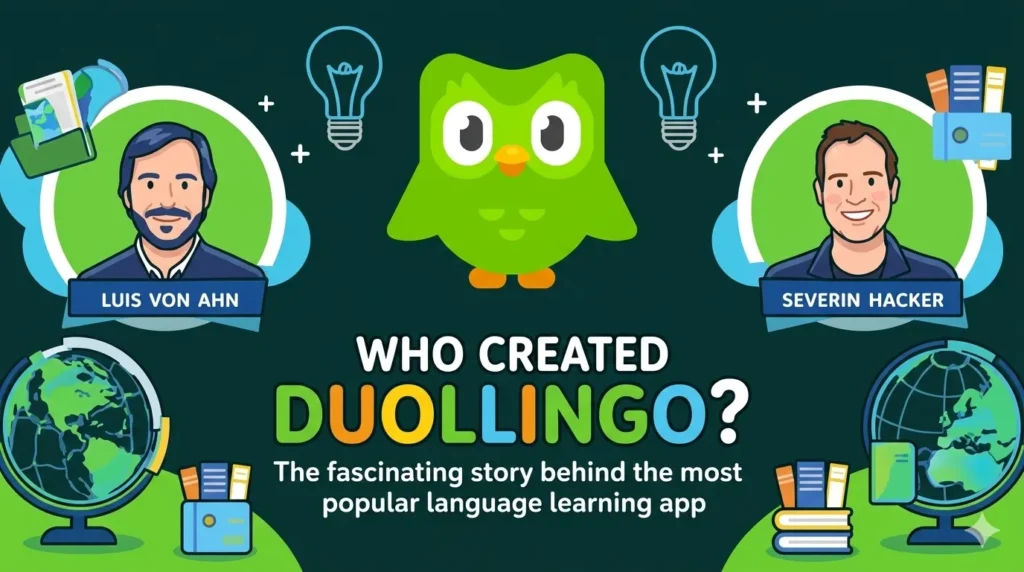
Luis von Ahn and Severin Hacker created Duolingo in Pittsburgh, Pennsylvania, launching the company in 2011.
Here’s the quick answer:
| Question | Answer |
| Founders | Luis von Ahn (CEO, Guatemalan-American) & Severin Hacker (CTO, Swiss) |
| Launch Year | 2011 (beta), public 2012 |
| Headquarters | Pittsburgh, USA |
The Idea Behind Duolingo
Von Ahn’s motivation stemmed from Guatemala, where poor communities couldn’t afford English lessons critical for opportunity. He aimed to democratize education, blending translation crowdsourcing with learning to make it free.
The core idea solved two U.S.-relevant problems: monolingual web content for diverse users and unaffordable language classes. Duolingo users translate real sentences, improving skills while generating value—pure crowdsourcing genius.
From Idea to Reality (Early Struggles)
The duo bootstrapped in 2009 at Carnegie Mellon, facing skepticism over free education’s viability. Early funding came unconventionally from von Ahn’s MacArthur grant, not VCs, as Pittsburgh’s scrappy scene above a bar housed 20 engineers in chaos.
Beta launched November 2011 after solving tech hurdles like adaptive algorithms; public release hit June 2012. Rejections and pivots—from pure translation to gamified lessons—tested resilience, but Pittsburgh tech hubs fueled grit.
Why Duolingo Became So Successful
Gamification hooked users with streaks, badges, and leaderboards, tapping psychology—U.S. users average 20-minute sessions daily. The free model exploded growth to 97.6 million monthly actives by 2024, proving accessibility wins.
AI personalization and bite-sized lessons fixed traditional flaws, while the green owl mascot (Hacker’s ironic green hate) went viral via memes. 2021 IPO valued it at $5B, blending mission with monetization via Duolingo English Test ($70 vs. $250 competitors).
Lesser-Known Facts About Duolingo Creation
Originally, Duolingo translated web content via user lessons to fund free access—evolving as Google Translate improved.
Von Ahn’s immigration nearly derailed him; despite reCAPTCHA success, visa barriers highlighted ironies for the education visionary. Hacker’s green owl aversion birthed Duo’s neon mascot, now a billion-dollar icon.
Pittsburgh roots stayed intentional—low costs bred innovation, powering 40 languages by 2020 and AI teaching ambitions.
What We Can Learn From This Story
Von Ahn’s tale inspires entrepreneurs to chase world-changing problems like education inequality, using U.S. opportunities from grants to IPOs. Bootstrap amid chaos, pivot boldly, and gamify for retention—the Duolingo mindset scales missions profitably.
Prioritize user psychology over perfection; free access built an empire, proving impact trumps immediate revenue.
FAQs
Who Founded Duolingo?
Luis von Ahn and Severin Hacker founded Duolingo in 2011 in Pittsburgh.
When Was Duolingo Created?
Idea born 2009, company founded 2011, public launch June 2012.
Why Is Duolingo Free?
Crowdsourced translations originally funded it; now premium upsells and tests sustain the core free model.
Who Invented Duolingo?
Luis von Ahn (CEO) and Severin Hacker (CTO) invented it at Carnegie Mellon.
What Is the Real Story of Duolingo?
From Guatemala’s education gaps to Pittsburgh’s chaotic startup, solving costly language barriers via gamified, free tech.
Why Did Luis von Ahn Create Duolingo?
To make English affordable for Guatemalans and global poor, inspired by his roots and reCAPTCHA success.
Is Duolingo Profitable?
Yes, post-IPO it’s a data-driven powerhouse with ads, subscriptions, and tests driving billions in value.
Conclusion
Duolingo’s rise from a Pittsburgh idea to global giant showcases innovation born of real pain points. Luis von Ahn and Severin Hacker prove free, fun education conquers barriers—lessons for any dreamer.

I’m a website professional with 5 years of experience in building, managing, and growing online content platforms. As the creator of DuolingoGuides.us, I focus on providing helpful, easy-to-understand guides and resources for Duolingo users and language learners. My goal is to make information simple, accurate, and accessible for everyone.