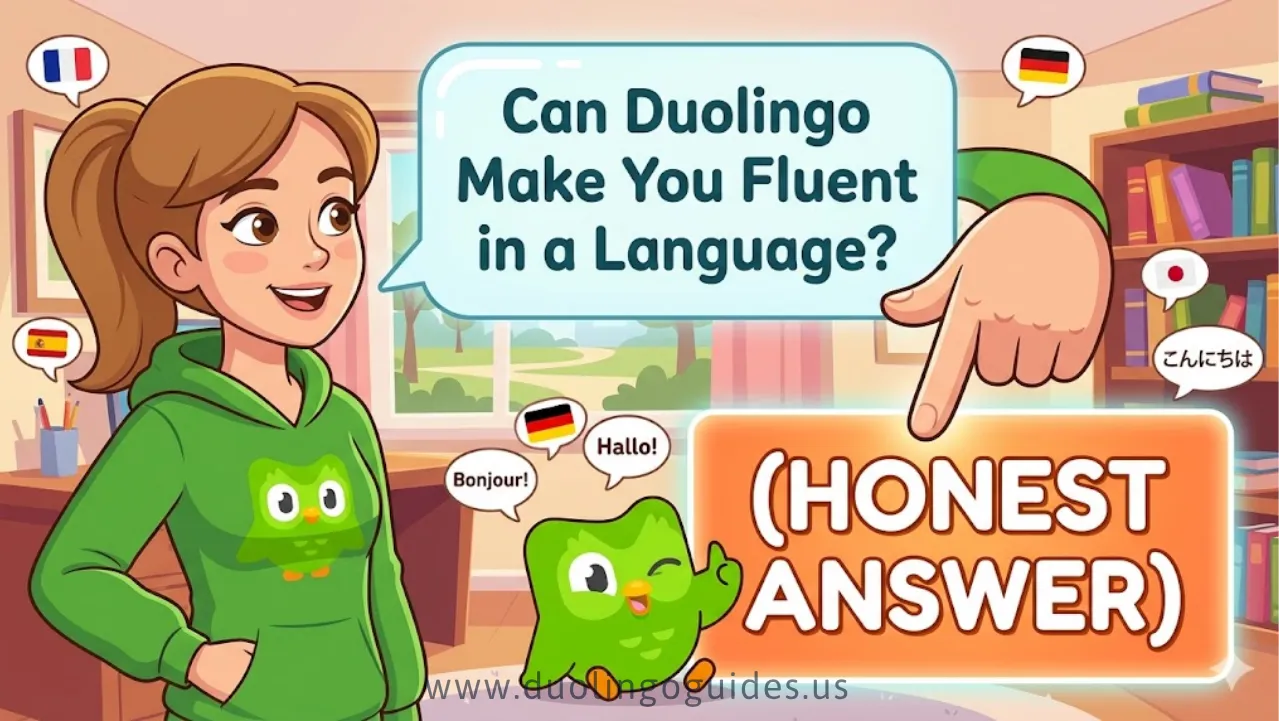
Can Duolingo Make You Fluent in a Language? (Honest Answer)
Duolingo has become one of the most popular language-learning tools, attracting millions of learners with its free, gamified lessons and easy daily practice.
However, true fluency involves more than memorizing vocabulary or maintaining streaks—it requires confident speaking, listening, and real-world communication.
Understanding what fluency means, how Duolingo works, and where its limits lie helps learners set realistic goals and build a smarter path toward conversational success.
Duolingo captivates millions of USA users with its free, gamified lessons, but fluency demands more than daily streaks.
This guide breaks down the reality based on research and learner experiences, tailored for busy Americans chasing conversational skills in Spanish, French, or beyond.
What Does “Fluency” Actually Mean?
Fluency isn’t just vocabulary—it’s effortless communication across contexts. The Common European Framework of Reference for Languages (CEFR) defines it precisely: A1/A2 for beginners (basic phrases), B1/B2 for independent users (spontaneous conversations), and C1/C2 for proficient mastery (nuanced debates).
Realistic expectations matter for USA learners. Duolingo targets up to CEFR B1 (intermediate), where you handle travel chats but struggle with idioms or debates—full fluency (C1+) needs 600-1,000 hours total, per Foreign Service Institute estimates for languages like Spanish.
Studies show Duolingo users hit CEFR A2 reading/listening after basics, but speaking lags without supplements.
How Duolingo Works
Duolingo thrives on gamification: streaks, XP points, leaderboards, and bite-sized lessons (5-15 minutes) hook USA users, with 97% of North American teachers calling it effective for motivation.
Strengths include adaptive AI personalizing paths, focusing on high-frequency words first—after 27 hours on Spanish, learners boost all skills, especially receptive ones like reading (90% accuracy).blog.
Its CEFR-aligned courses mimic university semesters: Spanish/French beginners match 4 semesters’ reading scores.
Also Check: How to Send Duolingo Scores to Universities
Why Duolingo Alone Is NOT Enough
The speaking gap hits hard—Duolingo’s exercises are scripted, not free-form, leaving users mute in real talks. A USA study found speaking gains, but only half hit targets without practice.
Listening gap: Lessons use slow, clear audio; real accents (podcasts, Netflix) overwhelm. Research confirms stronger receptive growth over productive.
Grammar gap: Rules are implied via patterns, not explained—frustrating for analytical USA adults versus intuitive kids.
Real User Problems
Meet Sarah from New York: 2 years of Spanish streaks, yet ordering tacos stumped her—no real speaking prep.
John in Texas hit 500-day streak on French but froze during a Paris trip call—listening to fast natives was chaos.
Lisa from California aced vocab but mangled grammar in emails, feeling “book smart, street dumb.” Reddit echoes: “Streaks don’t equal fluency.”
Mike in Florida quit after energy limits post-2025 update—paywalls killed momentum.
These USA stories highlight isolation: no partners, no immersion.
What Duolingo Is Actually Good For
Duolingo shines in vocabulary building—pattern recognition teaches 2,000+ words efficiently, outperforming peers in some trials.
Habit building is its superpower: USA users log 500 million lessons monthly, with streaks fostering consistency over willpower.
Perfect for commuters or parents squeezing 10 minutes daily.
Best Way to Use Duolingo
Combine with speaking apps like HelloTalk or Tandem for USA-based tandem partners—practice Duolingo phrases live, 15 minutes/day.
Add immersion: Netflix in target language (Spanish audiosubs), podcasts like Coffee Break—shadow dialogues for natural flow.
Shadowing technique: Repeat audio verbatim post-lesson, mutter in public for muscle memory. Pair with Anki for spaced repetition of weak spots.
Pro tip: Post-2025 update, use “5-Sentence Method”—rewrite lessons actively for output.
Better Alternatives (If Your Goal Is Fluency)
Babbel excels in conversational focus, USA-designed dialogues for travel/business—structured grammar, live tutors option, faster to B1.
Rosetta Stone immerses via 100% target language—no translations—strong on intuition, used by USA military; pricier but C1-proven.
| Feature | Duolingo | Babbel | Rosetta Stone |
| Gamification | High (streaks/XP) | Medium | Low |
| Speaking | Basic | Advanced (dialogues) | Immersive (speech rec) |
| Grammar | Implicit | Explicit | Intuitive |
| Price (USA) | Free/$7/mo Super | $15/mo | $11/mo |
| CEFR Target | A2-B1 | B1-B2 | B2-C1 |
Skill Level Progression
| Level | XP Range & Time Investment |
|---|---|
| Basic | 1,000–5,000 XP (1–3 months) |
| Intermediate | 10,000–30,000 XP (6–9 months) |
| Advanced | 30,000+ XP (9–12 months) |
FAQs
Can Duolingo alone make you fluent?
No, Duolingo alone usually cannot make you fully fluent. It builds vocabulary, grammar basics, and reading skills, but fluency requires real conversations, listening practice, writing, and consistent exposure to native speakers.
Does Duolingo actually teach you?
Yes, Duolingo does teach useful vocabulary, sentence structure, and pronunciation basics. It works well for learning fundamentals, especially for beginners, but it should be combined with other learning methods to achieve stronger language proficiency.
Can Duolingo help you fluently speak?
Duolingo can help improve speaking confidence through repetition and pronunciation exercises, but it rarely provides enough real-life conversation practice. Speaking fluently usually requires interacting with native speakers or language partners regularly.
How many hours for fluency?
Fluency typically requires hundreds to thousands of hours, depending on language difficulty. For example, easier languages may take around 600 hours, while harder languages can require over 2,000 hours of consistent practice and exposure.
Can I become fluent in a language using Duolingo?
You can become conversational using Duolingo if you stay consistent and add extra practice like speaking, listening, and reading. However, full fluency usually requires additional learning tools and real-life language experiences.
Best for beginners?
Yes, Duolingo is especially effective for beginners because it introduces vocabulary gradually and uses gamification to keep motivation high. It provides a strong starting foundation before moving into more advanced language-learning resources.
2025 update worth it?
The 2025 updates improved personalization, AI-based explanations, and speaking exercises. Many learners find these updates helpful for structured practice, but experienced learners may still need additional resources beyond Duolingo for advanced proficiency.
Why does no one like Duolingo anymore?
Some users complain about increased ads, reduced free features, and repetitive lessons. However, many people still like Duolingo for its simplicity, accessibility, and ability to make language learning feel less overwhelming and more enjoyable.
Is Duolingo actually helpful?
Yes, Duolingo helps build vocabulary, improve reading skills, and learning sentence patterns. Its daily practice structure encourages consistency, which is one of the most important factors for long-term language learning success.
Can Duolingo improve language proficiency?
Duolingo can improve early-stage proficiency by strengthening vocabulary recognition, grammar familiarity, and reading comprehension. However, higher-level proficiency requires immersive listening, speaking practice, and exposure to real-world conversations beyond the app.
How to effectively use Duolingo?
Use Duolingo daily for short sessions, review mistakes carefully, repeat lessons when needed, and combine it with listening practice, speaking exercises, and reading simple texts to reinforce learning and accelerate language progress.
Does Duolingo actually help?
Yes, Duolingo helps learners stay consistent through reminders and gamified lessons. While it may not create fluency alone, it provides structured practice that supports vocabulary growth and reinforces basic grammar understanding effectively.
Is Duolingo 100% correct?
No, Duolingo is not always 100% correct. Some translations may sound unnatural or overly literal. It is best used as a learning tool alongside dictionaries, grammar guides, and authentic native-language content for accuracy.
Will you be fluent if you finish Duolingo?
Finishing a Duolingo course does not guarantee fluency. It usually builds intermediate knowledge, but fluency depends on consistent speaking practice, listening exposure, and using the language actively in real-life situations over time.
Should I still use Duolingo?
Yes, you should still use Duolingo if you enjoy structured lessons and want daily language practice. It remains a useful tool, especially for beginners, when combined with other resources that strengthen speaking and listening skills.
Is Duolingo really effective?
Duolingo is effective for developing learning habits, expanding vocabulary, and improving reading recognition. However, its effectiveness increases significantly when paired with conversation practice, listening exercises, and exposure to real-life language usage.
Final Thought:
In conclusion, Duolingo is a powerful starting point that builds vocabulary, consistency, and confidence for beginners, but it should not be treated as a complete solution for fluency.
To move beyond basic understanding and reach comfortable conversation, learners must add speaking practice, exposure to natural audio, and active grammar study.
By combining Duolingo with real conversations, media immersion, and consistent effort, learners can turn daily lessons into meaningful progress toward genuine language fluency success.

I’m a website professional with 5 years of experience in building, managing, and growing online content platforms. As the creator of DuolingoGuides.us, I focus on providing helpful, easy-to-understand guides and resources for Duolingo users and language learners. My goal is to make information simple, accurate, and accessible for everyone.