Can You Actually Learn a Language With Duolingo? Honest Truth After Real Use
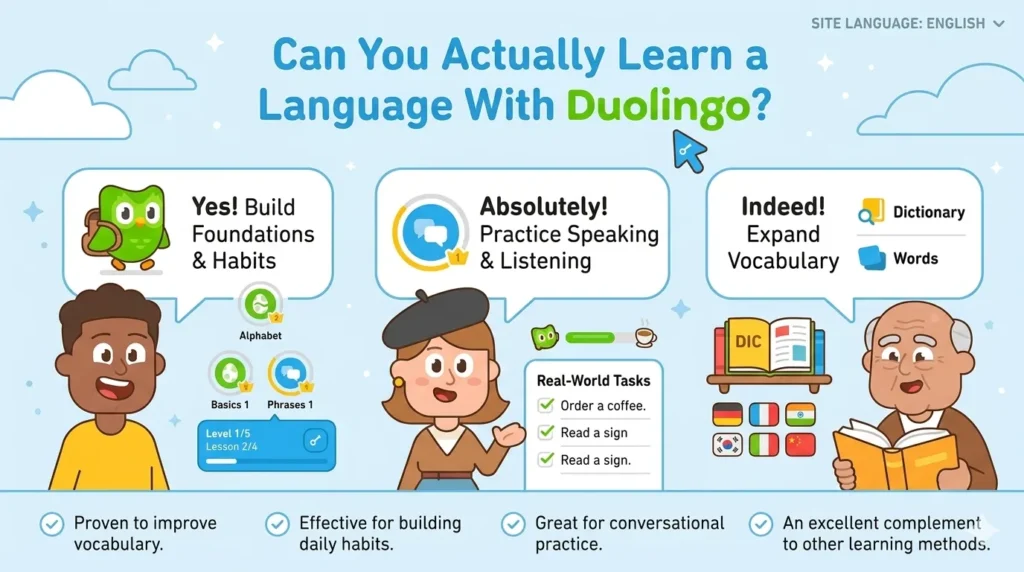
You’ve likely opened Duolingo daily, chased that streak, and wondered why conversations still feel impossible. This guide cuts through the gamified hype with research-backed truths: Duolingo excels at basics but won’t make you fluent alone.
Duolingo’s Core Strengths
Duolingo shines in vocabulary building through spaced repetition and quick drills, helping beginners recognize 1,000+ words after consistent use. Its habit creation features—like daily goals and reminders—keep 70% of U.S. users engaged longer than traditional classes, per efficacy studies. The beginner-friendly system uses gamification (points, leagues) to make lessons feel effortless, ideal for busy Americans starting Spanish or French.
Key Limitations Exposed
Speaking gaps plague users, as the app offers limited real-time practice, leaving pronunciation and fluency weak despite high streaks. Grammar confusion arises from implicit teaching—sentences appear without clear rules, causing errors in complex structures. Without real conversations, cultural nuances and spontaneous responses stay underdeveloped, a common complaint in U.S. learner forums.
True Fluency Verdict
Short answer: No, you can’t become truly fluent with Duolingo alone. Fluency means effortless C1-level use (CEFR scale)—holding 30-minute talks, understanding news, idioms included—which requires human interaction apps ignore. Studies show Duolingo reaches A2-B1 (intermediate) in reading/listening after Basic courses, but speaking lags.
Realistic Learning Timeline
From beginner (A1) to intermediate (B1) takes 3-6 months of 30 minutes daily on Duolingo, gaining solid vocab and basic sentences. Reaching fluent (C1) demands 1-2 years total, blending app time with practice—U.S. college students matched 5 semesters in months via Duolingo, but needed supplements. Factors like language similarity (e.g., English to Spanish: faster) speed this up.
Common Learner Trap
The biggest mistake? Treating Duolingo as a complete system. Streaks build false confidence, but without output practice, passive knowledge doesn’t convert to skills—many U.S. users hit plateaus after 200 hours.
Proven Language Method
Combine Duolingo for vocab with speaking (iTandem partners), listening (podcasts like Coffee Break Languages), and immersion (Netflix subtitles). This “input + output” approach, backed by U.S. studies, triples retention—use 34% app, 33% each for others.
Optimal Duolingo Routine
Follow this step-by-step plan:
- Daily 20 minutes: Complete 3-5 lessons pre-breakfast for habit lock.
- Time breakdown: 10 min vocab/grammar, 10 min stories for context.
- Weekly boost: Practice speaking via app’s AI or record responses.
Track XP; aim 500/week. U.S. users report 90% accuracy in basics after 4-6 weeks.
| Routine Element | Time | Focus | Expected Gain |
| Lessons | 20 min daily | Vocab + Grammar | A2 in 3 months |
| Stories/Practice | 10 min | Context | Better comprehension |
| External Add-On | 20 min | Speaking | B1 fluency path |
Worth the Time?
Duolingo is worth it for beginners building foundations—free, effective as classrooms for basics—but a waste if solo for fluency. Balanced: 80% U.S. users improve reading/listening, but pair it for speaking.
Final Verdict
Duolingo jumpstarts languages to intermediate but demands supplements for fluency—perfect for casual U.S. learners, not pros. Use if motivated by fun; skip if needing rapid conversations. Best for: Busy starters; not for: Fluent goals alone.
FAQs
Is Duolingo a good app for learning a language?
Yes for basics and habits, matching college intro classes.
Should linguists use Duolingo?
No—too basic; opt for advanced tools.
Can Duolingo be used as a substitute for language learning?
No, lacks full immersion.
How do I use Duolingo effectively?
Pair with speaking practice daily.
Can Duolingo really teach you a language?
Basics yes; fluency no.
Can you become fluent with only Duolingo?
Unlikely—needs real talk.
What is the #1 easiest language to learn?
Spanish for English speakers (similar vocab).
Can you reach C1 with Duolingo?
Rare alone; possible with extras.

I’m a website professional with 5 years of experience in building, managing, and growing online content platforms. As the creator of DuolingoGuides.us, I focus on providing helpful, easy-to-understand guides and resources for Duolingo users and language learners. My goal is to make information simple, accurate, and accessible for everyone.