
Duolingo Duels Explained: How They Work + Proven Tips to Win Every Time
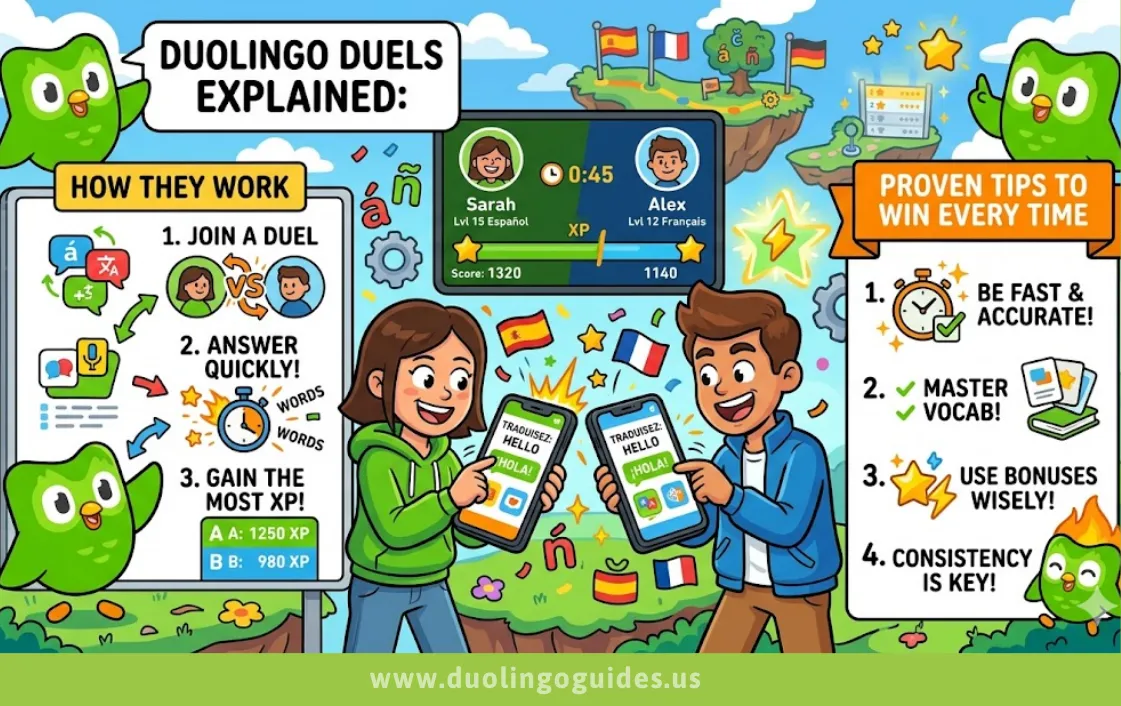
Duolingo Duels are designed to make language practice feel more competitive, fast, and fun. They reward both correctness and speed, so even strong learners can lose if they answer too slowly or make rushed mistakes.
Many users get frustrated because they know the right answer but still lose. That usually happens when the other player is faster, the questions come in a pressure-heavy format, or repeated mistakes drag down performance.
By the end of this article, you’ll understand how Duolingo Duels work and how to improve your chances of winning consistently in a US-focused, English-language context.
What Are Duolingo Duels
Duolingo Duels were a competitive feature in Duolingo’s iOS app that let users face another learner or a robot in language challenges. The feature was built around short, head-to-head practice rounds rather than long lessons, so the experience felt more like a game than a class.
In the archive description, each duel included around 10 questions and could involve translating sentences, pick-and-choose items, and listening tasks. The concept was meant to make practice more social and engaging while still reinforcing language skills.
Why You Keep Losing
The biggest reason users lose is the speed vs accuracy tradeoff. Duels reward correct answers, but they also reward being first, so a slower but accurate learner can still fall behind a faster opponent.
A second reason is hidden pressure. Competitive mode can make people rush, and rushed answers often create avoidable grammar or vocabulary mistakes. A third reason is repetition: if you keep missing the same patterns, the duel becomes a speed test on your weak spots instead of a fair skill check.
How Scoring Works
According to the archive description, one point is earned for a correct answer, and an additional point is awarded if you are the first to submit the answer. That means the system is not just measuring knowledge; it is measuring decision speed too.
A simple way to think about it is this: correctness gets you in the game, and speed helps you pull ahead. If two players know the same material, the one with faster recognition and fewer pauses usually wins.
Also Check: The Ultimate Duolingo Guide
Tips to Win Consistently
- Focus on patterns, not individual words. Duels often reuse familiar sentence structures, so pattern recognition saves time.
- Pre-read answer choices before committing. This reduces hesitation and helps you spot the correct structure faster.
- Fix slow typing. On mobile, even small delays matter because first submission can add points.
- Avoid panic mistakes. A rushed wrong answer hurts more than a calm, quick one.
- Play at lower-competition hours in US time. The same strategy often works in competitive app modes because matchup pools can vary by time, though Duolingo does not publicly document duel matchmaking by hour.
- Use practice mode strategically. Duolingo’s own research says the app supports reading, writing, listening, and speaking gains, so practice still matters for long-term performance.
- Learn from mistakes immediately. If you miss a tense, article, or listening pattern once, review it before the next round.
Common Mistakes
The first common mistake is rushing every question. Speed matters, but reckless speed causes wrong taps and loses points.
The second is ignoring grammar. Duels may feel like pure reaction time, but grammar knowledge still determines whether the answer is actually correct. The third is guessing too often. Guessing can sometimes help, but repeated guessing usually lowers your consistency.
Duels vs Practice Mode
Duels are better when you want motivation, urgency, and a competitive push. Practice mode is better when you want steady improvement without pressure.
Are Duels Worth It
Yes, if you enjoy competition and want extra motivation. Duels can make language learning feel more like a game, which is useful for people who struggle with consistency.
They are less useful if you get anxious under time pressure or if your goal is deep grammar study. Duolingo itself emphasizes that the platform supports language growth over time, so duels should be treated as a supplement, not the entire learning plan.
Final Strategy
- Build speed through familiarity.
- Protect accuracy by slowing down just enough.
- Review mistakes immediately.
- Practice weak patterns outside the duel.
- Use competition as motivation, not as your only study method.
FAQs
How does Duolingo duels make learning a language more fun?
It adds real-time competition, which turns practice into a challenge instead of a routine.
How does Duolingo work?
Duolingo uses structured lessons and practice to improve reading, writing, listening, and speaking skills over time.
What is Duolingo duels?
It was a head-to-head competitive feature where users answered language questions against another player or a robot.
What is Duolingo community?
It generally refers to the social side of Duolingo, including learners, competitions, and shared activity around the app’s features.
Conclusion
Duolingo Duels blend rapid decision-making with accurate language knowledge, making success dependent on both reflexes and understanding. Consistent improvement comes from recognizing recurring structures, controlling reaction speed, and refining weak areas through practice.
Staying composed prevents careless errors, while reviewing mistakes strengthens performance. Treating competition as a supportive tool alongside regular study helps maintain progress and improves outcomes over time. This approach builds confidence efficiently.

I’m a website professional with 5 years of experience in building, managing, and growing online content platforms. As the creator of DuolingoGuides.us, I focus on providing helpful, easy-to-understand guides and resources for Duolingo users and language learners. My goal is to make information simple, accurate, and accessible for everyone.