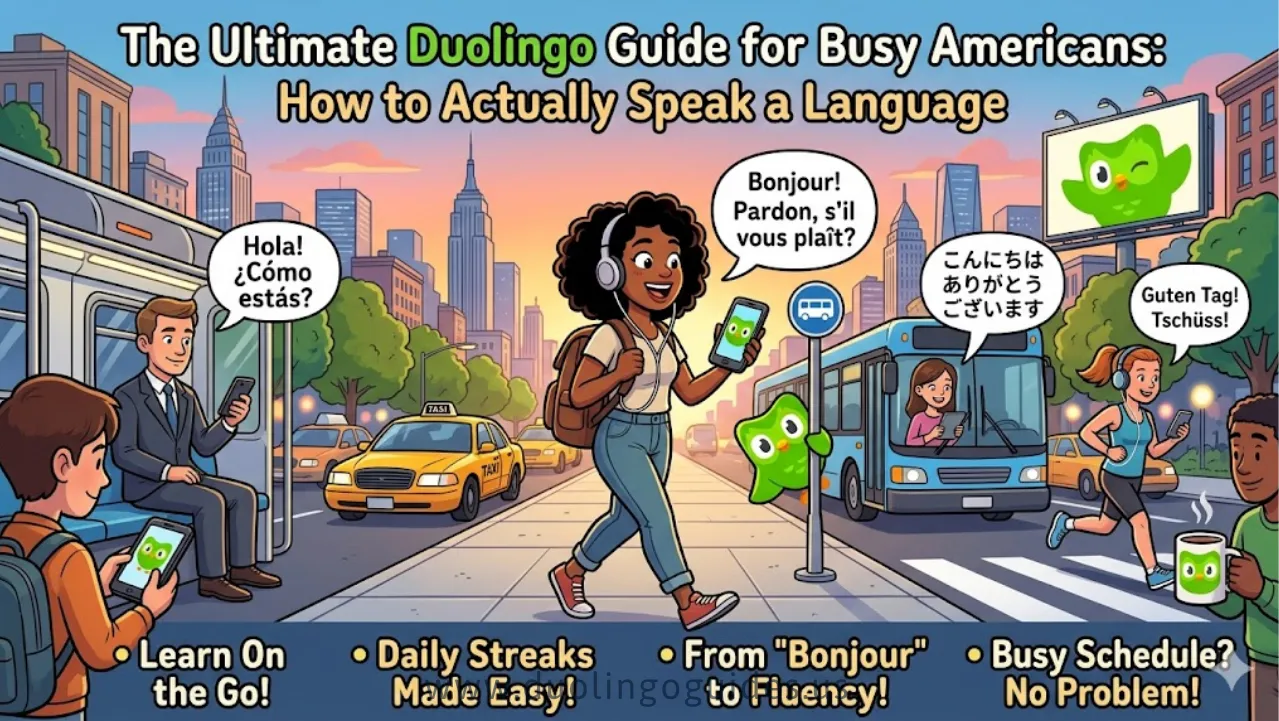
The Ultimate Duolingo Guide for Busy Americans: How to Actually Speak a Language in 30 Days
You can make real progress in 30 days, but Duolingo by itself will not get most busy adults speaking comfortably. The fastest results come when you combine Duolingo with listening, speaking, and real conversation practice.
Duolingo’s own research says learners can improve reading, writing, listening, and speaking after regular use, but outside research and language educators also stress that app practice alone does not replace live speaking.
You’ve been using Duolingo daily, but when it’s time to speak, your mind goes blank. That frustration is common because recognition practice is easier than producing sentences in real time. The good news is that the problem is usually the method, not your ability.
For busy Americans, the real goal is not “perfect fluency in 30 days.” It is to build enough listening, sentence control, and speaking confidence to handle simple everyday conversations. A realistic plan can do that if it uses short daily sessions and the right mix of tools.
Why Duolingo Isn’t Enough
Duolingo is good at teaching vocabulary, grammar patterns, and routine practice, and its research shows learners can improve in multiple skills. But app lessons often rely on multiple-choice recognition and fixed sentences, which do not fully train spontaneous speaking.blog.
Real conversation requires three things Duolingo does not fully simulate: understanding fast speech, forming your own answer immediately, and speaking without answer choices. That is why many learners “know” words on the app but still freeze with native speakers. Duolingo works best as a foundation, not the whole building.
Biggest Mistakes
The first mistake is passive learning, where users tap through lessons but never actively recall phrases from memory. Recognition is useful, but speaking needs retrieval under pressure.
The second mistake is skipping speaking practice entirely. Without shadowing, repetition, or live conversation, the mouth never gets trained to produce the language quickly.
The third mistake is no structure. Random lessons feel productive, but a clear weekly plan usually creates better progress for adults with limited time.
30-Day Plan
A realistic Duolingo plan for a busy U.S. schedule should focus on 30 to 45 minutes a day, not hours. The schedule below fits the kind of routine used in adult-learning guides: short weekday sessions plus one longer weekend practice block.
Also Check: Super Duolingo 3 Months Free
Week 1: Basics And Listening
In week 1, use Duolingo for core words, greetings, and survival phrases. Add 10 to 15 minutes of listening each day through beginner YouTube videos or slow podcasts so your ear starts recognizing the sound of the language.blog.
Example daily routine:
- 15 minutes Duolingo.
- 10 minutes listening.
- 5 minutes speaking out loud from memory.
- 5 minutes review of yesterday’s words.
Week 2: Sentence Building
In week 2, move from single words to full sentence patterns. Focus on practical structures like ordering food, asking for directions, introducing yourself, and making plans.
Write 5 short sentences each day and say them aloud three times. This helps convert passive knowledge into usable speech, which is where many app learners stall.
Week 3: Speaking Practice
In week 3, start speaking every day, even if only for 5 to 10 minutes. Shadow short audio clips by listening to a phrase and repeating it immediately, matching rhythm and pronunciation as closely as possible.
Use AI speaking practice, language exchange apps, or a tutor for guided conversation. Research and educator guidance consistently show that real-time interaction is the missing ingredient for speaking progress.
Week 4: Real Conversations
In week 4, use your best phrases in live conversations. Keep topics simple: introductions, routines, food, work, family, and travel. The aim is not perfection; it is fast response and comfort.
By the end of the month, a learner who practices daily can usually handle basic self-introductions, simple questions, and short replies much better than on day 1. That is a realistic success target for 30 days.blog.
Speaking Fast
Shadowing is one of the fastest ways to improve speaking because it trains your ear, mouth, and timing at the same time. Pick one short audio clip, listen once, then repeat it sentence by sentence until it feels natural.
A second fast method is conversation repetition. Record yourself answering common prompts like “Where are you from?” or “What do you do?” and replay your answer until you can say it smoothly. Real back-and-forth speaking matters because Duolingo itself does not provide true live dialogue practice.
Best Companion Tools
Duolingo becomes much stronger when paired with other tools. YouTube helps with pronunciation and visual context, podcasts build listening stamina, and language partners turn knowledge into action.
For busy Americans, the best combination is simple:
- Duolingo for structured practice.
- YouTube for short native input.
- Podcasts for commuting.
- Language partners or tutors for speaking.
Motivation Hacks
Streaks work because they lower the chance of quitting, but streaks alone do not create fluency. The reward is the habit, not the number.
Use a small reward after every session, such as coffee, music, or 10 minutes of guilt-free scrolling. Also set a visible weekly goal, like “I will speak 50 sentences this week,” because clear targets usually beat vague intentions.
Proof And Results
Duolingo’s own research says learners can improve reading, writing, listening, and speaking after three months, and other studies also show gains in comprehension and communicative skills. That supports using Duolingo as part of a learning system, especially for beginners.
At the same time, the strongest results come when learners do more than tap lessons. Studies and language-learning guides repeatedly point to a mix of input, recall, output, and feedback as the fastest path for adults with limited time.
FAQs
Can Duolingo make you fluent?
Duolingo can help you build a foundation, but fluency usually needs speaking practice, listening, and feedback beyond the app.
Is 30 days enough?
Thirty days is enough to build basics, confidence, and useful beginner speech, but not full fluency. A focused 30-day plan can still produce visible improvement.
What is the ultimate Duolingo guide?
The best guide is the one that combines Duolingo with listening, shadowing, and live speaking. Duolingo alone is useful, but not complete.
Can you learn a new language on Duolingo?
Yes, you can start and make progress on Duolingo, especially in beginner reading and listening. But speaking grows much faster when you add real interaction.
What are Duolingo levels?
Duolingo progress is tied to course advancement and score-based progress, and many courses map roughly to CEFR-style levels. The exact structure depends on the course.
How to master Duolingo?
Use it daily, review mistakes, speak answers aloud, and combine it with outside practice. The learners who improve most do not rely on one app alone.blog.
Best language to start?
For English speakers, Spanish is often one of the easiest practical choices, and Norwegian, Dutch, French, and Italian are also commonly ranked among easier languages. The best choice is still the language you will actually use.
About New Languages
Duolingo expanded heavily in 2025, including 148 new language courses, and it continues updating major courses. Public coverage also reported new endangered-language additions such as Zulu, Xhosa, Māori, Haitian Creole, and Austronesian Tagalog.
For 2026, there is no reliable official public list in the sources I found that confirms brand-new 2026 releases beyond ongoing updates. The safest statement is that Duolingo is still expanding and refreshing existing courses, but exact future launches can change.duolingo.
Conclusion
Duolingo is a strong starter, not a complete speaking system. Use it daily, but pair it with listening, shadowing, and live conversation to turn lessons into real speech.blog.
For busy Americans, the winning formula is simple: short daily practice, weekly speaking, and consistent review. That is how a 30-day plan becomes real progress instead of another streak.

I’m a website professional with 5 years of experience in building, managing, and growing online content platforms. As the creator of DuolingoGuides.us, I focus on providing helpful, easy-to-understand guides and resources for Duolingo users and language learners. My goal is to make information simple, accurate, and accessible for everyone.